Maracanã Stadium: The Iconic Heart of Brazilian Football
Located in the vibrant city of Rio de Janeiro, the Estádio do Maracanã (officially known as Estádio Jornalista Mário Filho) is more than just a sports venue; it is a global symbol of football passion. From hosting the world's largest crowds to serving as the stage for the most dramatic moments in sporting history, the Maracanã remains the largest stadium in Brazil and a cornerstone of South American athletics.
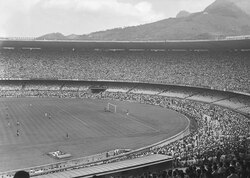
The stadium's legacy is defined by its scale and its role in the 1950 FIFA World Cup, an event that cemented its place in history. While its capacity has evolved over the decades to prioritize safety and comfort, its prestige as a "temple" of the beautiful game remains untouched.
Key Facts
- Official Name: Estádio Jornalista Mário Filho.
- Current Capacity: 73,139 spectators.
- Record Attendance: Officially 173,850, though 210,850 were present for the 1950 World Cup deciding match.
- Primary Tenants: Flamengo and Fluminense.
- Field Dimensions: 105 m × 68 m.
- Ownership: Rio de Janeiro State Government.
The Birth of a Colossus
Construction of the Maracanã began on July 2, 1948, with a goal to be ready for the 1950 FIFA World Cup. The timeline was aggressive, leaving less than two years for completion. When work fell behind, FIFA dispatched Ottorino Barassi, head of the Italian FA, to assist in Rio de Janeiro. A massive workforce of 1,500 people—increasing to 3,500 in the final months—raced to finish the structure.
The stadium officially opened on June 16, 1950, with a match between the Rio de Janeiro All-Stars and the São Paulo All-Stars, where Didi scored the first-ever goal. Despite its opening, the venue was still essentially a construction site, lacking a press box and toilet facilities. Nevertheless, it immediately became the largest stadium in the world, surpassing Hampden Park.

The 1950 World Cup Heartbreak
The Maracanã's first major international test came during the 1950 FIFA World Cup. The tournament reached a fever pitch on July 16, 1950, in the deciding game between Brazil and Uruguay. In front of a staggering crowd of 210,850 people, Uruguay defeated Brazil 2–1, leaving a lasting mark on the nation's sporting psyche.
Evolution and Modernization
For decades, the Maracanã was known for its massive terraced sections, allowing for crowds that frequently exceeded 100,000. The all-time club record was set in 1963 during the Fla–Flu derby (the rivalry between Flamengo and Fluminense), which drew 194,603 spectators.
Safety concerns led to significant changes over time. Following a railing collapse in 1992 that resulted in three deaths, the stadium began a transition to an all-seater configuration. In 1998, the ground was classified as a national landmark, ensuring it could never be demolished.
21st Century Renovations
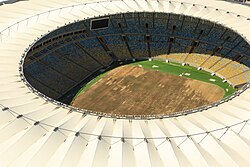
The stadium underwent several major renovations in 2000, 2006, and 2013. A significant overhaul between 2005 and 2006 reopened the venue in 2007 with a capacity of 87,000. Further rebuilding occurred to prepare for the 2013 FIFA Confederations Cup and the 2014 FIFA World Cup, where the Maracanã hosted the final match between Germany and Argentina.
A Versatile Venue for Global Events
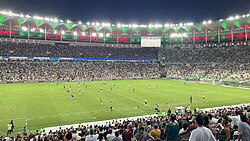
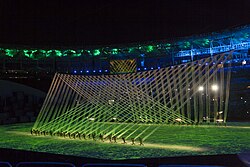
While football is its primary purpose, the Maracanã has hosted a diverse array of international events. It served as the main venue for the 2007 Pan American Games and the opening and closing ceremonies of the 2016 Summer Olympics and Paralympics.
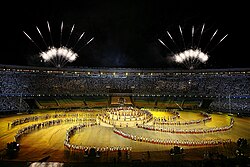
The stadium has also been a destination for music legends. Frank Sinatra performed to 175,000 people in 1980, and the rock band Kiss played to 137,000 fans in 1983. Both Tina Turner and Paul McCartney earned Guinness World Records for their performances here, each attracting over 180,000 attendees.
Beyond Traditional Sports
The venue has hosted unique sporting clashes, such as the 1951 vale tudo (anything goes) match between Masahiko Kimura and Hélio Gracie. Kimura's victory via a joint lock gave birth to the "Kimura lock," a staple technique in modern Brazilian Jiu-Jitsu (BJJ) and mixed martial arts. Additionally, the stadium is slated to host an NFL International Series game on September 27, 2026, featuring the Dallas Cowboys and the Baltimore Ravens.
Stadium Summary
| Feature | Details |
|---|---|
| Full Name | Estádio Jornalista Mário Filho |
| Location | Rio de Janeiro, Brazil |
| Current Capacity | 73,139 |
| Surface | Grass |
| Major Events | 1950 & 2014 World Cups, 2016 Olympics, Copa América |
| Public Transit | Maracanã Station (SuperVia) and Metrô Rio Line 2 |
Frequently Asked Questions
Who are the current operators of the Maracanã?
The stadium is owned by the Rio de Janeiro State Government and is operated by the football clubs Flamengo and Fluminense.
What is the record attendance at the stadium?
The official record is 173,850, although the deciding match of the 1950 FIFA World Cup is widely cited as having 210,850 spectators.
Why did the stadium's capacity decrease over time?
The capacity was reduced as the original terraced standing sections were replaced with individual seats to improve safety and comfort, particularly following a railing collapse in 1992.
Will the Maracanã host any future major tournaments?
Yes, the stadium is set to host matches during the 2027 FIFA Women's World Cup.
What non-football events have taken place at the Maracanã?
The stadium has hosted massive concerts by artists like Paul McCartney and Frank Sinatra, Papal Masses celebrated by Pope John Paul II, and martial arts bouts including the famous Kimura vs. Gracie match.