Manx Shearwater: The Long-Distance Voyager of the Atlantic
The Manx shearwater (Puffinus puffinus) is a remarkable marine bird known for its extraordinary migratory journeys and specialized adaptations for life at sea. First described by Danish zoologist Morten Thrane Brünnich in 1764, this species is a master of the North Atlantic, spending the vast majority of its life gliding just above the ocean surface.
The bird's scientific name, Puffinus, has a curious history. It derives from "puffin" and its variants, which originally referred to the cured carcasses of fat shearwater nestlings—once considered a delicacy. While the term later became associated with the Atlantic puffin, the Manx shearwater retains the scientific link to this linguistic root. Its English name refers to its nesting habits on the Calf of Man.
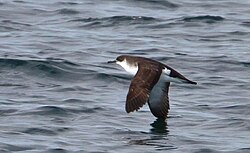
Key Facts
- Conservation Status: Least Concern (IUCN 3.1).
- Migration: Some individuals travel over 10,000 km to winter in the South Atlantic.
- Lifespan: Extremely long-lived; one recorded individual was at least 55 years old.
- Nesting: Burrows on small islands, visited exclusively at night.
- Flight Style: A "shearing" motion, dipping side-to-side with wings held at right angles.
Physical Characteristics and Flight
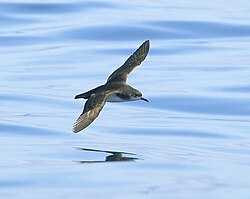
The Manx shearwater is a medium-sized seabird, measuring between 30 and 38 cm in length with a wingspan of 76 to 89 cm. Weighing between 350 and 575 g, its body is streamlined for efficiency. In the air, it resembles a flying cross, with its wings held perpendicular to its body.
Its flight is characterized by a "shearing" motion, where the bird dips from side to side with stiff wings and infrequent beats, often with wingtips nearly touching the water. Because its upper parts are black and its underside is white, the bird appears to flicker between colors as it glides low over the waves.
Specialized Vision and Sensory Adaptations
Because Manx shearwaters visit their breeding colonies only under the cover of darkness to avoid predators, they have evolved specific adaptations for nocturnal vision. Unlike diurnal (day-active) birds like pigeons, where the cornea provides the primary refractive power, the shearwater relies on its lens to bend light and focus images on the retina.
This anatomical difference results in a shorter focal length, providing a smaller but brighter image, which is essential for navigating at night. However, vision is not their only tool; they likely rely on a combination of hearing and smell to locate their specific nesting burrows.
![Each retina of the Manx shearwater has one fovea and an elongated strip of high photoreceptor density. The pecten has many blood vessels and appears to keep the retina supplied with nutrients.[18]](/images/90/de/90de006f7a4515cc26900191a615939f2422693a3a50d7077651e7f52b4ef690.webp)
Distribution and Epic Migrations
The Manx shearwater is entirely marine, typically flying within 10 meters of the sea surface. Its primary breeding colonies are located across the North Atlantic, including the United Kingdom, Ireland, Iceland, the Faroe Islands, France, and various Atlantic archipelagos like the Azores and Canary Islands. The most significant populations are found off the coasts of Wales, Scotland, and Northern Ireland, with the islands of Skomer, Skokholm, and Rùm hosting three-quarters of the British and Irish birds.
Their migratory patterns are among the most grueling in the animal kingdom. From July to March, they migrate to the South Atlantic, wintering primarily off the coasts of Brazil and Argentina. Juvenile birds are particularly hardy, capable of traveling 2,000 km just days after leaving the nest.
The scale of these journeys is staggering. A 50-year-old bird may cover over a million kilometers in migration alone. One specific bird ringed on Bardsey Island was estimated to have flown over 8 million kilometers during its 50-year lifetime.
Breeding and Social Behavior
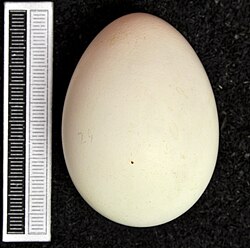
Breeding occurs in burrows, where the female lays a single white egg averaging 61 mm by 42 mm. During the breeding season, adults may commute up to 1,500 km from their colonies to offshore feeding grounds, such as the Mid-Atlantic Ridge, to find food for their chicks.
Rafting Behavior
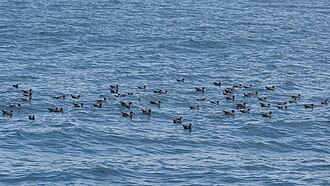
One of the most distinct social behaviors of the Manx shearwater is rafting. This occurs when birds gather in massive groups—sometimes exceeding 10,000 individuals—on the water near their breeding colonies. These rafts move closer to the island at night and drift further away during the day, creating a "halo" effect. This behavior is believed to be a strategy to reduce the risk of predation while waiting for dusk to return to their chicks.
Conservation and Threats
With a European population estimated between 1.05 million and 1.7 million individuals, the species is currently classified as Least Concern. While numbers are stable or expanding in the north, they face challenges in the Macaronesian islands.
Key threats include:
- Artificial Lighting: Newly fledged chicks can become dazzled by city lights, leading to "grounding" in built-up areas.
- Invasive Species: Introduced mammals like rats and cats prey on the birds, while rabbits may compete for burrow space.
- Human Consumption: In the Faroe Islands, between 1,000 and 5,000 chicks are legally harvested for food annually.
| Feature | Detail |
|---|---|
| Scientific Name | Puffinus puffinus |
| Wingspan | 76–89 cm |
| Weight | 350–575 g |
| Primary Wintering Grounds | Brazil and Argentina |
| Conservation Status | Least Concern |
| Key Breeding Sites | Skomer, Skokholm, Rùm |
Frequently Asked Questions
Why do Manx shearwaters only visit their nests at night?
They visit their colonies at night to avoid predators that are active during the day, utilizing specialized nocturnal vision and their sense of smell to find their burrows.
What is "rafting" in shearwaters?
Rafting is a social behavior where thousands of birds float together on the ocean surface near their breeding colonies, moving closer to shore at night and further away during the day to minimize predation risk.
How far do these birds migrate?
They migrate from the North Atlantic to the South Atlantic (Brazil and Argentina), a journey that can exceed 10,000 km one way.
What causes "grounding" in young shearwaters?
Grounding occurs when newly fledged birds are disoriented by artificial lights in urban areas, causing them to land on the ground where they are vulnerable and unable to take off again.
Are Manx shearwaters endangered?
No, they are currently classified as Least Concern by the IUCN due to their high overall population, although some regional populations face threats from invasive species and human activity.