Manuel Mujica Lainez: The Master of Argentine Historical Fantasy
Manuel Mujica Lainez was a towering figure in Argentine letters, serving as a novelist, essayist, translator, and art critic. Known for his sophisticated prose and deep connection to the aristocratic roots of Buenos Aires, he blended meticulous historical research with elements of fantasy to create a unique literary legacy. Throughout his career, he captured the essence of high society and the architectural ghosts of the past, earning international acclaim and prestigious honors.
Key Facts
- Full Name: Manuel Bernabé Mujica Lainez.
- Primary Genres: Historical fiction and fantasy.
- Major Works: La saga porteña (The Buenos Aires Saga) and the fantasy novel Bomarzo.
- Notable Awards: Legion of Honor (1982) and the John F. Kennedy Prize (1964).
- Academic Affiliations: Member of the Argentine Academy of Letters and the Academy of Fine Arts.
- Death: April 21, 1984, at his villa, El Paraíso.
Early Life and Aristocratic Roots
Born in Buenos Aires, Argentina, Manuel Mujica Lainez—affectionately known as "Manucho"—was descended from prominent figures, including the city's founder, Juan de Garay, and 19th-century intellectuals Florencio Varela and Miguel Cané. To ensure he became proficient in French and English, his family spent significant time living in London and Paris.
Although he attended the Colegio Nacional de San Isidro and briefly studied law, he eventually left university. Despite his noble lineage, his family was not wealthy, leading him to pursue a career as a literary and art critic for the newspaper La Nación. In 1936, he married Ana de Alvear, a descendant of Carlos María de Alvear, with whom he had three children: Diego, Manuel, and Ana.
Literary Career and Major Works
Mujica Lainez is most celebrated for his ability to narrate the evolution of Buenos Aires from its colonial beginnings to the modern era. His work is often categorized into two major cycles: the historical and the fantastical.
The Buenos Aires Saga (La saga porteña)
This cycle of historical novels explores the social fabric of the city through four key works: Los ídolos (1953), La casa (1954), Los viajeros (1955), and Invitados en El Paraíso (1957).
Historical Fantasy
The author expanded his horizons into historical fantasy with a series of acclaimed novels, most notably Bomarzo (1962), El unicornio (1965), and El laberinto (1974). Bomarzo was particularly successful, earning him the John F. Kennedy Prize in 1964, an honor he shared with fellow Argentine writer Julio Cortázar.
Beyond his novels, he published influential short story collections such as Aquí vivieron (1949) and Misteriosa Buenos Aires (1950), as well as various essays and biographies.
Multidisciplinary Contributions
Mujica Lainez was more than a novelist; he was a dedicated translator and collaborator. He translated the works of William Shakespeare (specifically his Sonnets), as well as plays by Molière, Racine, and Marivaux. His passion for the arts extended to the operatic stage, where he wrote the libretto for an adaptation of Bomarzo set to music by Alberto Ginastera. This opera, premiered in 1967, was later banned by the Argentine military dictatorship.
In his later years, he resided at his villa, El Paraíso, in Cruz Chica, Córdoba Province, which served as both a home and a sanctuary for his intellectual pursuits.
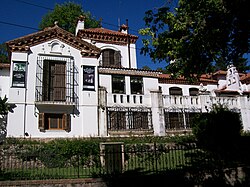
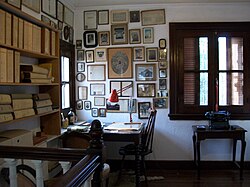
His study at El Paraíso remained the center of his creative world until his passing in 1984.
Summary of Literary Contributions
| Category | Notable Titles | Key Themes/Notes |
|---|---|---|
| Historical Novels | La saga porteña (e.g., Los ídolos, La casa) | High society and history of Buenos Aires |
| Fantasy Novels | Bomarzo, El unicornio, El laberinto | Historical fantasy and surrealism |
| Short Stories | Aquí vivieron, Misteriosa Buenos Aires | Atmospheric narratives of the city |
| Translations | Shakespeare's Sonnets, Molière, Racine | Classical European literature |
| Opera | Bomarzo (Libretto) | Collaboration with Alberto Ginastera |
Frequently Asked Questions
What is the "Buenos Aires Saga"?
The Buenos Aires Saga, or La saga porteña, is a cycle of four historical novels—Los ídolos, La casa, Los viajeros, and Invitados en El Paraíso—that chronicle the history and high society of Buenos Aires.
Which of his works won the John F. Kennedy Prize?
His novel Bomarzo won the John F. Kennedy Prize in 1964, an award he shared with Julio Cortázar for the novel Hopscotch.
What was Mujica Lainez's role beyond writing novels?
He was a versatile intellectual who worked as an art critic for La Nación, a translator of classical French and English literature, and a librettist for opera.
Where did Manuel Mujica Lainez spend his final years?
He spent his final years at his villa, known as "El Paraíso," located in Cruz Chica, Córdoba Province, Argentina.
What international honors did he receive?
He was awarded the French Legion of Honor in 1982, the Ordre des Arts et des Lettres in 1964, and was named a Commander of the Order of Merit of the Italian Republic in 1967.