ManchesterCottonopolisGreater ManchesterMancunianManchester economy

Manchester: The Industrial Powerhouse and Modern Metropolis

Manchester: The Industrial Powerhouse and Modern Metropolis Manchester, often referred to as the "Capital of the North," is a vibrant city and metropolitan borough in North West England. ...

Manchester: The Industrial Powerhouse and Modern Metropolis

Manchester, often referred to as the "Capital of the North," is a vibrant city and metropolitan borough in North West England. From its early foundations in the 1st century AD to its rise as a global center of the textile industry, Manchester has evolved from a modest town into a sprawling urban hub. Known historically as Cottonopolis due to its dominance in cotton production, the city today is a blend of Victorian grandeur and cutting-edge modern architecture.

The city is characterized by its resilience and innovation, embodied by its motto, Concilio Et Labore ("By Counsel and Work"), and its symbolic worker bee, representing the industrious spirit of its people, known as Mancunians.
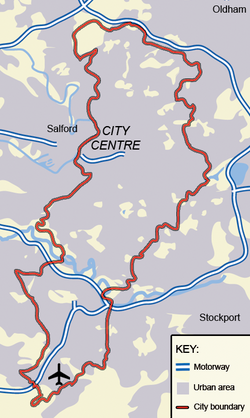
A map showing the boundary of the City of Manchester with the City Centre, Salford, and the airport also labelled. Almost all of the map, both inside and outside of the boundary, is shaded in grey, which denotes urban sprawl.
The City of Manchester. The land use is overwhelmingly urban.

Key Facts

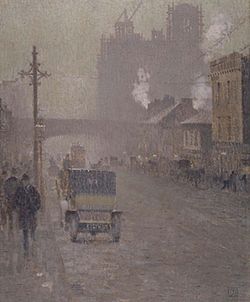
An oil painting depicting a smog-filled wide cobbled road with pavement on either side. In the background, a bridge goes over the road in front of a towering building to the right. In the foreground, there is a man walking and a small horse and cart moving away.
An oil painting of Oxford Road, Manchester, in 1910, by Valette
  • Population: 589,670 (2024 estimate).
  • City Status: Granted on March 29, 1853.
  • Economy: Significant growth in GVA (Gross Value Added) per head, reaching £61,859 in 2023.
  • Transport: Home to the UK's largest tram system, the Metrolink.
  • Demographics: A highly diverse population with 43.2% identifying as an ethnic minority as of 2021.

A Journey Through History
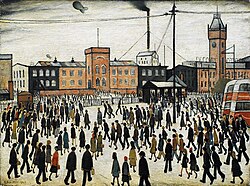
An oil panting of people walking in all directions through a bleak square wearing a variety of colours but mostly all black. The square backs onto tall yellow buildings with telegraph cables stretched around. Part of a trolleybus is visible to the right-hand side.
Going to Work by L.S. Lowry, commissioned by the War Artists' Advisory Committee in 1943

From Early Settlement to Industrialization

While Manchester's roots date back to the 1st century AD, it received its town charter in 1301. However, the city's trajectory changed forever during the Industrial Revolution. By the early 19th century, Manchester became the global heart of the cotton trade, characterized by massive mills and a rapidly growing urban population.
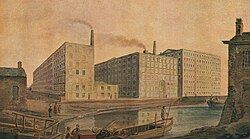
A watercolour of mills with smoking chimneys painted from the opposite side of a river. There is a wooden dock on the left hand side with a small wooden boat by the dock, floating perpendicular to the river.
McConnel & Company's cotton mills in Ancoats, c. 1820

Social Unrest and Political Evolution

The rapid industrialization brought significant social challenges. One of the most pivotal moments in the city's political history was the Peterloo massacre of 1819, where a peaceful crowd demanding parliamentary reform was attacked by cavalry, resulting in 18 deaths and hundreds of injuries.
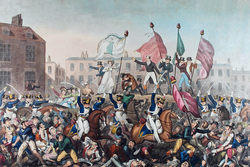
A coloured print depicting soldiers in blue and white uniforms amongst a crowd of people wearing various colours and waving unicolour flags. The people are fighting and some are on the floor.
The Peterloo massacre of 1819 resulted in 18 deaths and several hundred injured.

Modern Regeneration

Following a period of industrial decline in the mid-20th century, Manchester underwent a massive regeneration process. The city recovered from the challenges of the Second World War and the devastating 1996 bombing of Corporation Street to become a leader in media, technology, and finance.
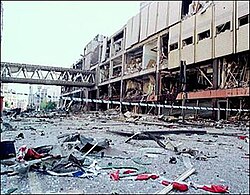
A street covered in debris. On one side is a building whose side is half-destroyed, leaving only the steel frame. The road is wet and there is crime scene tap across the centre of the photo.
Corporation Street after the bombing in 1996

Geography and Climate

A fairly young man slightly smiling at the camera against green shrubbery as a background. He is wearing square glasses, a blue tie, and a grey blazer on a white shirt.
Andy Burnham, then Mayor of Greater Manchester, in 2024

Manchester is an overwhelmingly urban landscape located in the North West region of England. Its climate is typical of the region, characterized by moderate temperatures and frequent precipitation. The city sees an average annual precipitation of 831.2 mm, with October typically being the wettest month.

Manchester Average Climate Data
Metric Winter (Jan) Summer (July) Annual Average
Mean Daily Max Temp (°C) 7.3 20.6 13.7
Mean Daily Min Temp (°C) 1.7 12.5 6.6
Average Precipitation (mm) 67.3 59.8 831.2
Sunshine Hours (Monthly) 51.4 179.0 1,411 (Yearly)

Demographics and Society

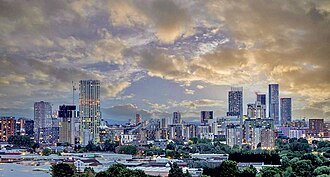
Manchester with Salford skyline

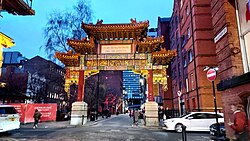
Manchester is one of the most ethnically diverse cities in the UK. According to 2021 census data, the population consists of 56.8% White, 20.9% Asian, 11.9% Black, and 5.3% Mixed ethnic groups. This diversity is reflected in the city's cultural landmarks, such as the Paifang arch in Manchester Chinatown.
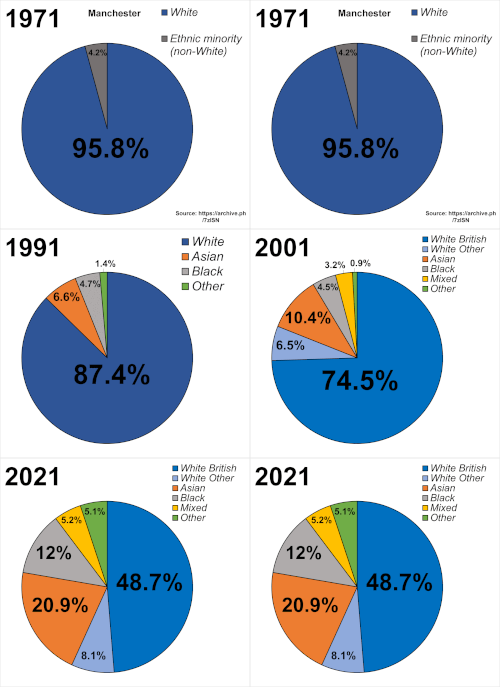
An animated gif of a series of pie charts between 1971 and 2021, which show the proportion of White people decreasing from 95.8% to 48.7% and various other demographics appearing
The ethnic demography of Manchester from 1971 to 2021

A Chinese arch structure on a street with a brick building to the right and no building to the left. There is a tree in the background and it is a clear early evening sky.
Manchester Chinatown's Paifang arch

Religious diversity is also prominent, with Christianity (36.2%), those with no religion (32.4%), and Islam (22.3%) being the largest groups.

Infrastructure and Urban Landscape
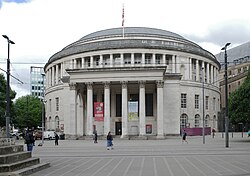
Central Library
Central Library

Architecture and Landmarks

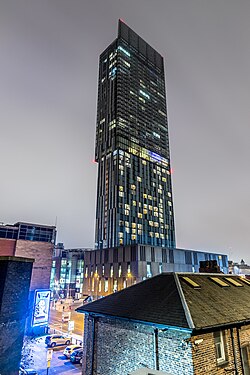
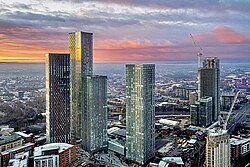
The city's skyline is a mix of the old and the new. The Manchester Town Hall stands as a premier example of Victorian-era Gothic Revival architecture, while the Beetham Tower and Deansgate Square represent the city's modern vertical expansion.
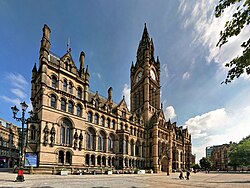
A grand Gothic Revival building as viewed from afar, with a Gothic Revival clock tower stretching high into the sky. Trees partially obstruct the view, and the sky is clear with some clouds.
Manchester Town Hall in Albert Square, the seat of local government, is an example of Victorian-era Gothic Revival architecture.

An aerial and skyline image of a city
Deansgate Square and Elizabeth's Tower

Beetham Tower
Beetham Tower

Transport Networks

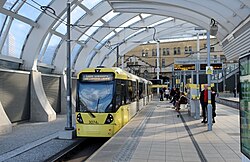
Manchester is a major transport hub. Manchester Piccadilly is the busiest of the city's four major railway stations, handling over 32 million passengers in 2019/20. The city is also served by the Metrolink, the UK's largest tram system with 64 miles of route, and the international Manchester Airport.
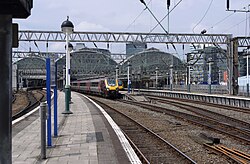
An aerial photo of a modern railway terminus station viewed from the top end a short distance away. The multiple parallel roofs of the trainshed stretch into the background against a grey sky.
Manchester Piccadilly railway station, the busiest of the four major railway stations in the Manchester station group, with over 32 million passengers using the station in 2019/20[183]

Two yellow trams sit beside one another on parallel tracks, with the one on the left slightly closer to the camera which is on the ground in the road. Both have their pantographs up which are touching contact wires. On either side there are people walking on the pavement.
Manchester Metrolink is the largest tram system in the UK, with a total route length of 64 miles (103 km).[193]

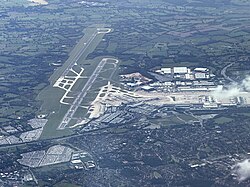
An aerial view of a large airport; from left to right there are two parallel runways and then a series of terminal buildings around a central flat area. In the foreground the airport backs onto urban sprawl but in the background it meets fields.
Manchester Airport from above

Culture, Education, and Sport

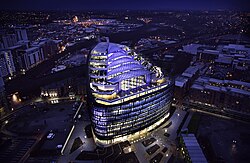
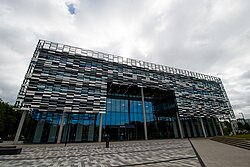
One Angel Square
One Angel Square

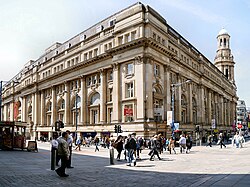
Manchester is a global center for culture and education. It is home to world-class institutions like the University of Manchester and Manchester Metropolitan University. The city's artistic heritage is preserved in the Manchester Art Gallery and the Royal Exchange theatre, the largest of its kind in the UK.
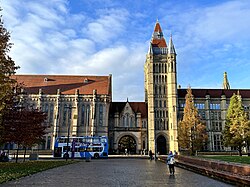
A grand gothic church-like building as viewed from a short distance away across a pedestrianised street. The building has a grand stained-glass window at the front surrounded by two cuboid towers, and a large cuboid tower at the back-right with a red brick roof.
Whitworth Building, University of Manchester

A palladian square building as viewed from its corner. Outside the front of the building is a large pedestrianised square which is quite busy with people. The back right corner of the building continues above the rest of the flat roof to become a conical tower.
The Royal Exchange, whose eponymous theatre is the largest of its kind in the UK

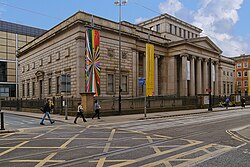
A neopalladian cuboid building as viewed centred on its corner from across the street. Halfway down the facade is a portico, and there is a central cuboid atrium that rises in the centre of the roof above the main roof height. There are regularly arranged sash windows in two storeys.
Manchester Art Gallery

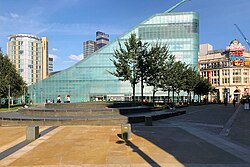
In the realm of sport, Manchester is world-renowned for football, with the Etihad Stadium serving as the home of Manchester City F.C. The city also hosts the National Football Museum, celebrating the sport's history.
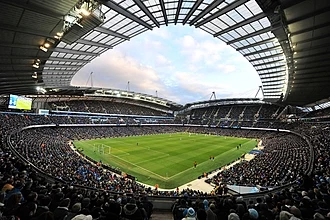
A football stadium as viewed from one corner. The photograph is a fish-eye panorama taken during a game against a blue sky. The stadium is full of fans on all four sides of the pitch, with large stands stretching up below an arched roof.
The Etihad Stadium is home to Premier League club Manchester City F.C. and host stadium for the 2002 Commonwealth Games.

A triangular prism-shaped glass building as photographed from a short distance away, with trees lined in front
The National Football Museum

Media and Innovation

The city has expanded its influence into digital media with the development of MediaCityUK, a hub for broadcasting and technology.

The now home of ITV Studios, ITV Granada, BBC, and Warner Bros. The Granada Studios pre-dated the MediaCityUK.
MediaCityUK

Economic Performance

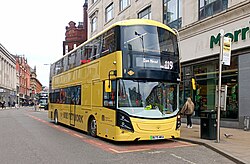
Three yellow buses line up such that the front one is just right-of centre and they are at an angle with the third one going offscreen. They are at a bus stop with tall buildings all around and someone waiting outside the first bus; the photo is taken from across the road.
Buses at Piccadilly Gardens bus station

Manchester has shown robust economic growth over the last decade. The Gross Value Added (GVA) per head has risen steadily, from £34,915 in 2013 to £61,859 in 2023, consistently outperforming the UK national average GVA growth in several key years.

Frequently Asked Questions
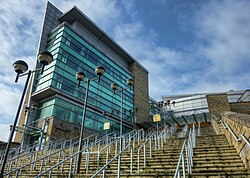
A glass and steel building on the left of a photograph, as viewed from the bottom of a large set of outdoor stairs leading up to it. The view of the building is partially obscured by lamp posts and the stairs are split up by steel railings.
The Manchester Arena, the city's premier indoor multi-use venue and one of the largest purpose-built arenas in Europe
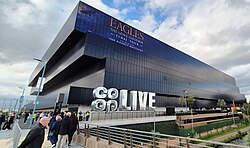
Co-Op Live Arena
Co-Op Live Arena
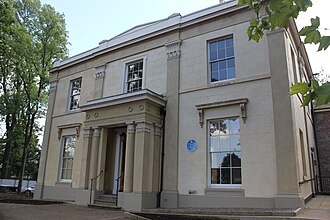
A small stucco building with sash windows. It is a cube shape with a slightly slanted roof and two storeys, as photographed from the ground in front. Trees are seen on either side of the building.
Gaskell House, where Mrs Gaskell wrote most of her novels. The house is now a museum.
A canal as photographed from a bridge over it. On the left-hand side there is a brick industrial building that is in shadow; on the right-hand side there are brick buildings with many windows facing over the canal, which is lined by brick wall.
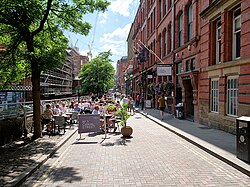
Canal Street, the centre of Manchester's gay village
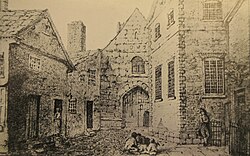
A black-and-white pencil drawing of some stone and brick buildings forming a small complex from a short distance away. The buildings each have a door and some windows, with children in the courtyard in front.
The original building of Manchester Grammar School
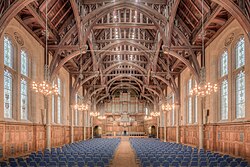
The interior of a grand hall as photographed from the back-centre. The hall is full of chairs and has a grand and intricate beamed roof with chandeliers hanging from the beams and gothic-shaped windows either side.
The interior of the hall in the Whitworth Building
Brooks Building, Manchester Metropolitan University
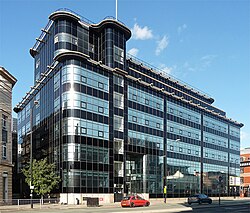
An art deco glass and steel building that is largely built from cuboids joined together, some of which have rounded corners. The photograph is taken on a sunny day from across the street.
The 1930s Art Deco Express Building on Great Ancoats Street, a remnant of Britain's "second Fleet Street"

What is the meaning of the nickname "Cottonopolis"?

Cottonopolis refers to Manchester's historical status as the leading center of the global cotton industry during the Industrial Revolution.

How large is the Manchester Metrolink?

The Manchester Metrolink is the largest tram system in the United Kingdom, featuring a total route length of 64 miles (103 km).

What is the significance of the worker bee symbol in Manchester?

The worker bee is a symbol of the city's hard-working industrial heritage and the collective effort of its citizens.

Which is the busiest railway station in Manchester?

Manchester Piccadilly is the busiest station in the Manchester station group, with over 32 million passengers using the facility in 2019/20.

What is the current ethnic composition of Manchester?

As of 2021, the population is 56.8% White, 20.9% Asian, 11.9% Black, 5.3% Mixed, and 5.1% other ethnic groups.