Mancha Húmeda Conservation and the Guadiana Basin Water Crisis
The Mancha Húmeda region, a vital ecological zone in Spain, is currently facing a severe environmental crisis. At the heart of the issue is the depletion of its wetlands, driven primarily by the overexploitation of water resources for agriculture. As the water table—the upper level of an underground surface saturated with water—continues to drop, the delicate balance of this ecosystem is under threat.
The Root of the Water Shortage
The decline of the region's wetlands is largely attributed to the Badajoz Irrigation Plan, initiated in 1952. This plan led to the over-extraction of water from the key aquifer known as "aquifer 23." Due to administrative apathy and the influence of cereal farmer lobbies, water quotas were set far beyond sustainable levels.
Currently, approximately 590 million m³ of water are attributed to users annually, which is nearly double the renewable water supply of roughly 320 million m³ per year. This deficit has prevented the aquifer from refilling, leading to a systemic collapse of the natural hydric system.
Controversial Solutions and International Pressure
In 1995, to avoid potential European Union fines, the Spanish Environment Ministry proposed a transfer project. This involved constructing an aqueduct and extensive piping to move water from the Tagus to the upper Guadiana basin. While the government stipulated that this water would be reserved for urban use and protected ecological zones rather than agriculture, the project faced heavy criticism.
Conservationists argued that the plan was a "cheap" immediate fix that ignored the possibility of aquifer recovery and attempted to replace a natural system with an artificial one. Many groups insisted that the solution must be found within the Guadiana basin itself.
The degradation became so severe that ecological groups suggested withdrawing the national park's status as a biosphere reserve. In June 2008, a UNESCO report echoed these concerns, recommending that the park either lose its status or that Spain be given a strict ultimatum to reverse the damage. Ultimately, Spain was granted additional time to implement restoration efforts.
Restoration Efforts and the Special Upper Guadiana Plan
In 2008, the "Special Upper Guadiana Plan" was launched. This €5 million, 29-year project focuses on the western Mancha aquifers. While the EU Water Directive generally requires wetlands to be restored by 2015, the complexity of the Tablas de Damiel and Mancha Húmeda has extended the deadline to 2027.
The plan introduces a water bank system designed to establish quotas based on social and environmental grounds, prioritizing water-use efficiency. In May 2009, a proposal to use recycled water to reverse wetland decline was announced, though environmentalists remained skeptical as this would not replenish the underlying aquifer.
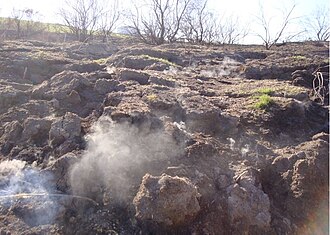
The physical consequences of this dryness became evident in the summer of 2009, when smouldering dry peat fires broke out within the National Park. While peat fires had occurred previously along the Guadiana, their appearance inside the park served as a stark symptom of ecological degradation.
The Path to Sustainability
Despite a period of heavier rainfall in early 2010, analysis indicates that weather alone cannot solve the crisis. Long-term recovery requires a significant reduction in the surface area used for irrigated cereals. Experts suggest maintaining traditional agricultura de secano (dryland farming) and horticulture, as the latter is the most efficient in terms of its extended water footprint.
The restoration plan also involves buying water rights to reassign quotas toward more efficient uses. This includes supporting small producers of vines and horticulture, who generate more income per cubic meter of water than cereal production.
However, economic hurdles remain. Spain's economic difficulties have limited available funds, and the EU's Common Agricultural Policy (as of 2010) continued to provide more subsidies for cereals than for more sustainable crops. The future of the Mancha Húmeda depends on policy revisions and the growth of a local economy based on solar electricity, ecotourism, high-quality agricultural products, and environmental services such as carbon sinks.
Key Facts
- Water Deficit: Annual water quotas (590 million m³) are nearly double the renewable supply (320 million m³).
- Primary Cause: The 1952 Badajoz Irrigation Plan and subsequent overexploitation of aquifer 23.
- Restoration Goal: The Special Upper Guadiana Plan aims for recovery by a 2027 deadline.
- Ecological Warning: UNESCO recommended the potential removal of the park's biosphere status in 2008.
- Efficiency Shift: Transitioning from irrigated cereals to horticulture and dryland farming is considered essential for recovery.
| Metric | Value |
|---|---|
| Renewable Water Available (Annual) | ~320 million m³ |
| Assigned Water Quotas (Annual) | ~590 million m³ |
| Restoration Project Budget | €5 million |
| EU Water Directive Deadline (General) | 2015 |
| EU Water Directive Deadline (Mancha Húmeda) | 2027 |
Frequently Asked Questions
What is aquifer 23 and why is it important?
Aquifer 23 is the key underground water source for the Mancha Húmeda region. Its depletion due to over-extraction for agriculture has led to the dropping of the water table and the subsequent drying of the region's wetlands.
Why was the 1995 water transfer project criticized?
Environmentalists opposed the project because it relied on an artificial aqueduct from the Tagus rather than restoring the natural hydric system of the Guadiana basin, and it assumed the depleted aquifers could not recover on their own.
What are the implications of the 2009 peat fires?
The smouldering peat fires in the National Park were viewed as a critical symptom of wetland degradation, indicating that the land had become dangerously dry.
How does the Special Upper Guadiana Plan intend to save the wetlands?
The plan utilizes a water bank system to establish quotas based on environmental and social needs, while also buying water rights to shift usage from inefficient cereal production to more efficient crops like horticulture.
What role does the EU Common Agricultural Policy play?
The policy has historically provided more subsidies for cereal production than for other crops, which contradicts the conservation goal of reducing irrigated cereal acreage to save water.