MAG-22: The Foreign Legion of Marine Aviation
In the early days of the Pacific War, a specialized unit of the United States Marine Corps emerged that would become legendary for its resilience and courage. Known as Marine Aircraft Group 22 (MAG-22), this unit earned the nickname "Foreign Legion of Marine Aviation" because, from its inception until months after the end of World War II, it never served within the continental limits of the United States.
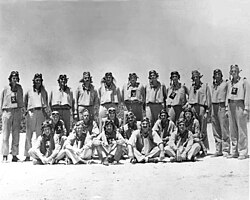
The group's journey began in January 1942 at Midway Atoll, where Lieutenant Colonel William J. Wallace took command of the MAG-21 detachment. By March 1, 1942, this detachment was officially commissioned as MAG-22, initially comprising squadrons VMF-221, VMF-222, VMSB-241, and VMSB-242.
The group's first taste of combat occurred on March 10, 1942, when a four-plane section from VMF-221, led by Captain James L. Neefus, shot down a Japanese Kawanishi H6K patrol bomber. This victory was celebrated with a bottle of bourbon from the group commander and later recognized by Admiral Chester W. Nimitz.
The Defense of Midway
On June 4, 1942, MAG-22 faced its most pivotal trial during the Battle of Midway. Defending the atoll were VMF-221 and VMSB-241. VMF-221, flying Brewster F2A-3 Buffaloes and Grumman F4F-3 Wildcats, intercepted a massive Japanese force of 108 aircraft. In a fierce 15-minute engagement, the Marines shot down 32 enemy planes, though the cost was staggering: only 10 of the 25 Marine pilots returned, with only two aircraft remaining operational.
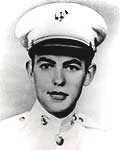
Simultaneously, VMSB-241 launched attacks using Vought SB2U Vindicators and Douglas SBD-2 Dauntless dive-bombers. Despite using obsolete equipment that required dangerous glide-bombing tactics, they managed to damage the Japanese aircraft carrier Akagi. The following day, Captain Richard E. Fleming pressed an attack on the cruiser Mikuma; though his plane was set ablaze by anti-aircraft fire, he maintained his course to achieve a near-miss before crashing. Captain Fleming was posthumously awarded the Congressional Medal of Honor.
The defense of Midway was a victory of skill over numbers. Outnumbered 2:1 and flying inferior aircraft, MAG-22 downed 43 of the 108 enemy aircraft (including 25 Aichi D3A "Val" dive-bombers and 18 Mitsubishi A6M Zeros) and damaged three ships. For their gallantry, the group received the Presidential Unit Citation.
Campaigns in the Marshall Islands
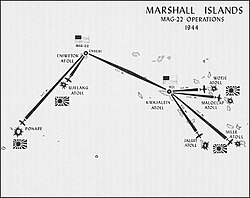
Following Midway, MAG-22 conducted patrols until February 1944, when it joined the 4th Marine Aircraft Wing at Eniwetok Atoll. Now equipped with Vought F4U Corsairs and Grumman F6F Hellcats, the group operated across several atolls:
- VMF-113: Covered landings at Ujelang Atoll and helped neutralize Wotje, Maloelap, and Mili Atolls.
- VMF-422: Conducted interdiction missions at Roi-Namuron and hosted Charles Lindbergh during strike missions against Wotje Atoll.
- VMF(N)-533: Provided critical night defense operations over Eniwetok.
Combat over Ponape
In March 1944, VMF-113 Corsairs escorted Army Airforce B-25s over Ponape, a key Japanese supply center. Despite being attacked by 12 Japanese aircraft, the Marines suffered zero losses and shot down eight enemy planes, effectively neutralizing enemy air forces in the area for the remainder of the campaign.
The Battle of Okinawa
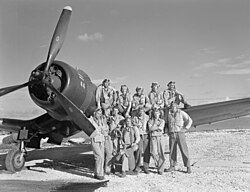
By May 1945, MAG-22 was integrated into the Tactical Air Force, Tenth Army, operating from Ie Shima. Their primary objective was maintaining air superiority to protect the 5th Fleet from kamikaze (suicide) attacks.
During the Kikusiu raids, Marine pilots faced waves of up to 165 aircraft. In one notable engagement, First Lieutenant John W. Leaper of VMF-314 shot down two "Betty" bombers. After his windshield was shattered and his ammunition exhausted, Leaper used his propeller to ram a Japanese "Zeke" fighter. Despite his wing exploding, he successfully bailed out and was rescued from the water.
Beyond air combat, VMTB-131 provided vital resupply missions. When heavy rains flooded ground routes near Shuri Castle, Marine pilots executed 163 critical supply drops to troops low on food and ammunition.
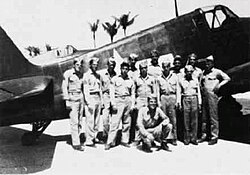
By the end of the Okinawa campaign, MAG-22 had flown 22,912 combat hours and contributed to 637 downed Japanese aircraft. VMF(N)-533 became the most successful night fighter squadron of the war, with Captain Robert Baird becoming the only Marine night ace of the conflict.
Key Facts
- Nickname: "Foreign Legion of Marine Aviation" due to continuous overseas service.
- Midway Success: Downed 43 enemy aircraft and damaged three ships despite being outnumbered.
- Night Combat: VMF(N)-533 was the war's most successful Marine night fighter squadron.
- Okinawa Impact: Contributed to approximately 40% of all close air support missions.
- Honors: Recipient of two Presidential Unit Citations.
| Phase | Primary Aircraft | Key Objective | Major Achievement |
|---|---|---|---|
| Midway (1942) | F2A-3, F4F-3, SB2U, SBD-2 | Island Defense | Downed 43 enemy aircraft; damaged 3 ships |
| Marshalls (1944) | F4U Corsair, F6F Hellcat | Interdiction & Neutralization | Cleared enemy air from Ponape |
| Okinawa (1945) | F4U Corsair, F6F Hellcat | Air Superiority & Resupply | 637 total enemy aircraft downed (group total) |
Marine Aerial Navigation School (MANS)
Parallel to the combat history of MAG-22, the Marine Corps developed its own specialized navigation training. Starting in 1942 with officers trained at the Weems School of Navigation, the program evolved from a ground school at MCAS Cherry Point to a full flight-support operation.
Reactivated in 1952 during the Korean War, the school trained navigators using C-54s and R4D-6/8 aircraft. Over the decades, the school moved from Cherry Point to NAS Pensacola, then to NAS Corpus Christi, and eventually to Mather AFB and Randolph AFB. Today, MANS continues to qualify enlisted Marines in the "Scientific Art of Navigation" for tactical transport aircraft.
In May 2000, the legacy of this training lineage was preserved when the Marine Aviation Detachment NAS Corpus Christi was redesignated as Marine Aviation Training Support Group 22.
Frequently Asked Questions
Why was MAG-22 called the "Foreign Legion of Marine Aviation"?
The group earned this name because it served exclusively on Pacific islands from its commissioning in 1942 until several months after the end of World War II, never operating within the continental United States during that period.
What was the significance of MAG-22's role at the Battle of Midway?
Despite being outnumbered and using some obsolete aircraft, MAG-22 acted as the spearhead of the victory, disrupting Japanese bombing forces and inflicting heavy damage on the Japanese Naval Striking Force, including the carrier Akagi.
Who was the only Marine night ace of World War II?
Captain Robert Baird of VMF(N)-533 was the only Marine night ace of the war, credited with six enemy aircraft shot down.
How did MAG-22 assist ground troops during the Battle of Okinawa?
Beyond air combat, VMTB-131 performed critical resupply missions, making 163 drops of food and ammunition to troops near Shuri Castle when heavy rains made ground supply routes impassable.
What is the current mission of the Marine Aerial Navigation School?
The school's mission is to train and qualify enlisted Marines as navigators for tactical transport aircraft in support of the Fleet Marine Force.