Madeleine Albright: The Legacy of a Diplomatic Trailblazer
Madeleine Albright was a towering figure in international diplomacy, breaking significant gender barriers to become the first woman to serve as the United States Secretary of State. Born into a world of political upheaval in Czechoslovakia, her life journey from a refugee child to one of the most powerful diplomats in American history reflects a lifelong commitment to democratic values and global stability.
Throughout her career, Albright was known for her assertive approach to foreign policy and her ability to navigate the complex geopolitical landscapes of the late 20th century. Whether representing the U.S. at the United Nations or leading the State Department, she remained a pivotal architect of the Bill Clinton administration's international strategy.
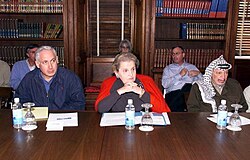
Key Facts
- First Female Secretary of State: Served from January 23, 1997, to January 20, 2001.
- UN Ambassadorship: Served as the 20th U.S. Ambassador to the United Nations (1993–1997).
- Early Life: Born Marie Jana Korbelová in Prague, Czechoslovakia, in 1937.
- Highest Honor: Recipient of the Presidential Medal of Freedom in 2012.
- Education: Earned degrees from Wellesley College (BA) and Columbia University (MA, PhD).
Early Life and Academic Foundation
Born in Prague as Marie Jana Korbelová, Albright's early years were shaped by the political instability of Czechoslovakia. She eventually moved to the United States, gaining citizenship in 1957. Her academic pursuits provided the intellectual framework for her future career, studying at Wellesley College and later attending Johns Hopkins University before completing her Master's and PhD at Columbia University.

Rise to Diplomatic Prominence
Ambassador to the United Nations
Albright's ascent in the U.S. government accelerated under President Bill Clinton. From January 27, 1993, to January 21, 1997, she served as the 20th United States Ambassador to the United Nations. In this role, she acted as the primary voice for U.S. interests on the global stage, managing critical multilateral negotiations.
Secretary of State
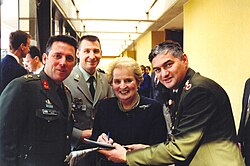
On January 23, 1997, Albright made history by becoming the 64th U.S. Secretary of State. During her tenure, she worked closely with Deputy Secretary Strobe Talbott to implement a proactive foreign policy. Her leadership was characterized by a belief in American engagement and the promotion of democracy worldwide.
Post-Government Career and Later Years
After leaving office in 2001, Albright remained active in public life. She founded the Albright Stonebridge Group and Albright Capital Management LLC, blending her diplomatic expertise with strategic business investments. She also dedicated herself to academia, serving as a professor at Georgetown University's Mortara Center for International Studies.
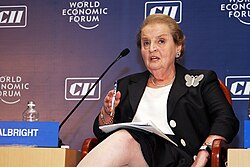
In her later years, she became a vocal critic of anti-democratic trends, frequently warning against the rise of fascism and advocating for the importance of diplomacy in maintaining national security.
Controversies and Challenges
Albright's career was not without criticism. She faced significant scrutiny over the implementation of sanctions against Iraq and her role in the conflicts in the Balkans. Additionally, she dealt with legal disputes regarding art ownership related to her father's history in Prague.
Summary of Career Milestones
| Role | Period | Key Focus/President |
|---|---|---|
| U.S. Ambassador to the UN | 1993–1997 | Bill Clinton |
| U.S. Secretary of State | 1997–2001 | Bill Clinton |
| Academic/Consultant | 2001–2022 | Georgetown University / Private Sector |

Frequently Asked Questions
Who was the first female U.S. Secretary of State?
Madeleine Albright was the first woman to hold the position of U.S. Secretary of State, serving from 1997 to 2001.
Where was Madeleine Albright born?
She was born in Prague, Czechoslovakia, as Marie Jana Korbelová.
What other high-ranking diplomatic role did she hold?
Before becoming Secretary of State, she served as the 20th United States Ambassador to the United Nations.
What was her educational background?
Albright held a BA from Wellesley College and both an MA and a PhD from Columbia University.
When did Madeleine Albright pass away?
Madeleine Albright died on March 23, 2022, at the age of 84.