Lytton Strachey: Early Life, Education, and the Cambridge Years
Lytton Strachey was born into a family of significant intellectual and social standing, a background that would profoundly shape his trajectory as a writer and thinker. Born on 1 March 1880 at Stowey House in Clapham Common, London, he was the fifth son and 11th child of Lieutenant General Sir Richard Strachey, a British colonial officer, and Jane Grant, a prominent advocate for the women's suffrage movement.
Named Giles Lytton after an ancestor and the first Earl of Lytton—who served as his godfather and was a contemporary of Sir Richard during the latter's tenure as Viceroy of India—Lytton grew up in a bustling household of thirteen children. Among his ten surviving siblings were his sister Dorothy and his youngest brother, the psychoanalyst James Strachey.
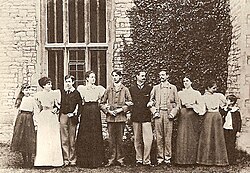
Formative Years and Early Schooling
When Lytton was four, the family relocated to 69 Lancaster Gate near Kensington Gardens. Under the influence of Lady Strachey, who was passionate about literature and languages, Lytton was encouraged to write verse and perform plays from a young age. His mother, believing he possessed the potential to be a great artist, sought an "enlightened" education for him, which included the study of French starting in 1887.
Strachey's early education began at Parkstone in Dorset. It was here that his talent for acting emerged; he was particularly noted for his ability to portray female roles, a penchant for dressing as a woman that he enjoyed for the purpose of entertaining and confusing others.
Academic Transitions and Challenges
In 1893, Lytton moved to Abbotsholme School in Derbyshire. However, the school's requirement for daily manual labor proved difficult for Strachey, who possessed a fragile physique. This led to his transfer to Leamington College. Although he initially suffered from severe bullying—which his father encouraged him to "grin and bear"—Strachey eventually excelled academically and saw an improvement in his health, despite recurring illnesses.
At age 17, Lytton attended the University of Liverpool. During this period, he formed a pivotal bond with Walter Raleigh, a professor of modern literature who became the most influential figure in his life prior to his time at Cambridge.
The Cambridge Experience
Lytton Strachey entered Trinity College, Cambridge, as a Pensioner on 30 September 1899. His academic progression was steady: he became an Exhibitioner in 1900 and a Scholar in 1902. He earned the Chancellor's Medal for English Verse in 1902 and received his BA in June 1903 after achieving a second class in the History Tripos (the final examinations for the history degree).
Despite his academic success, Strachey's time at Cambridge was punctuated by health struggles, specifically heart palpitations that forced him to leave the university periodically for recovery.
Intellectual Circles and the Bloomsbury Roots
Cambridge provided the social and intellectual foundation for Strachey's later life. He co-founded the Midnight Society with Clive Bell, Leonard Woolf, Saxon Sydney-Turner, and A. J. Robertson—a group later cited by Bell as the origin of the famous Bloomsbury Group. He also developed close ties with Thoby Stephen and his sisters, Virginia and Vanessa Stephen.
Strachey was also a member of the Cambridge Apostles, an elite secret society. Within this circle, the group discussed a doctrine known as "Higher Sodomy," which sought to distinguish the homosexual acts of the intellectual elite from those of the general population.
During these years, Strachey was influenced by several prominent thinkers, including Bertrand Russell, John Maynard Keynes, and G. E. Moore. Moore's philosophy was especially impactful, emphasizing the summum bonum (the highest good) as the achievement of high-quality humanity and the intensification of experience through the contemplation of great art.
Professional Aspirations and Return to London
In 1903, Strachey attempted to enter the Civil Service's education department. Despite strong recommendations from his tutors, he was unsuccessful. He subsequently spent two years (1903–1905) writing a 400-page dissertation on Warren Hastings, an 18th-century Indian imperialist, in hopes of securing a fellowship at Trinity College. When the fellowship was not granted, Strachey returned to London in October 1905.
Key Facts
- Birth: 1 March 1880, London.
- Parents: Lieutenant General Sir Richard Strachey and Jane Grant.
- Education: Parkstone, Abbotsholme, Leamington College, University of Liverpool, and Trinity College, Cambridge.
- Academic Honors: Chancellor's Medal for English Verse (1902).
- Key Associations: Co-founder of the Midnight Society; member of the Cambridge Apostles.
- Major Influence: G. E. Moore's philosophy on the summum bonum.
| Institution | Key Experience/Outcome | Period/Year |
|---|---|---|
| Parkstone, Dorset | Developed acting skills and interest in female roles | Early childhood |
| Abbotsholme School | Struggled with manual labor requirements | 1893 |
| Leamington College | Overcame bullying to become a top pupil | Mid-1890s |
| University of Liverpool | Mentored by Professor Walter Raleigh | 1897–1899 |
| Trinity College, Cambridge | BA in History; Chancellor's Medal for English Verse | 1899–1905 |
Frequently Asked Questions
Who were Lytton Strachey's parents?
He was the son of Lieutenant General Sir Richard Strachey, a British colonial officer, and Jane Grant, a leading supporter of the women's suffrage movement.
What was the Midnight Society?
The Midnight Society was a group formed at Trinity College by Lytton Strachey, Clive Bell, Leonard Woolf, Saxon Sydney-Turner, and A. J. Robertson. It is considered by Clive Bell to be the precursor to the Bloomsbury Group.
What was the "Higher Sodomy" doctrine?
This was an elitist doctrine formulated by the Cambridge Apostles that differentiated the homosexual acts of intelligent men from those of "ordinary" men.
Why did Strachey leave the University of Liverpool for Cambridge?
After being recommended for Lincoln College, Oxford, by examiners who noted his shyness, his mother took the suggestion as an insult and decided he should attend Trinity College, Cambridge, instead.
What was the subject of Strachey's fellowship dissertation?
Strachey wrote a 400-page dissertation on Warren Hastings, an 18th-century Indian imperialist, though it ultimately failed to secure him a fellowship.