Lydia Thompson and the Rise of American Burlesque
In the late 19th century, the American theatrical landscape was transformed by the arrival of Lydia Thompson and her troupe, the "British Blondes." Bringing a novel form of entertainment from England, Thompson didn't just perform; she adapted a specific genre of theatre to suit the sensibilities and tastes of middle-class New York audiences, effectively launching a new era of performance art in the United States.
The Arrival of the British Blondes
In August 1868, Lydia Thompson sailed to the United States with her fiancé, Henderson, and a small theatrical troupe. They introduced burlesque—a genre characterized by wit, parody, song, dance, and spectacle—to an American public unfamiliar with the form. Thompson's approach involved reworking the lyrics of popular songs and adding local, topical references to English plays to make them more relatable to New Yorkers.
The troupe's first American production in 1868 was an adaptation of F. C. Burnand's 1863 burlesque Ixion. The show was an immediate success, blending rhymed couplets and comic puns with strong, clever female characters. The British Blondes became the most popular entertainment in New York during the 1868–1869 season, utilizing a mix of satire, improvisation, cross-dressing, and extravagant stage effects.
Controversy and Public Backlash
While initially drawing diverse crowds, including many women, the troupe soon faced a wave of "anti-burlesque hysteria." By the summer of 1869, the New York press began to attack the shows, which were colloquially dismissed as "leg-shows." Critics described the performances as a "disgraceful spectacle" and an "idiotic parody of masculinity," while Shakespeare scholar Richard Grant White labeled the genre "monstrously incongruous and unnatural."
This hostility extended beyond the press. In February 1870, following insults directed at the dancers' virtue by Wilbur F. Storey, owner of the Chicago Times, Thompson, Henderson, and colleague Pauline Markham took drastic action. They horsewhipped Storey at gunpoint, leading to their arrest and fines. Despite the legal trouble, the incident only increased the troupe's publicity and popularity as they continued their tour through California and Nevada.
Return to England and Later Career
Thompson married Henderson on July 28, 1873, and the troupe returned to England in 1874. Thompson resumed her starring roles in London and provincial productions, including Bluebeard, Robinson Crusoe, and Carmen, or, Sold for a Song. Critics praised her irresistible influence over audiences, and some credited her with saving the dying art of burlesque.
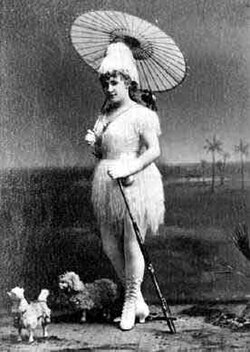
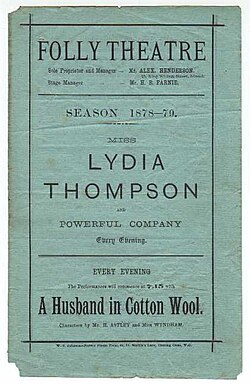
In 1876, Henderson purchased the Folly Theatre, which became a dedicated burlesque house with Thompson in the lead roles. Although she returned to America several times and remained popular, her career began to decline in the late 1880s. After a stint managing the Royal Strand Theatre in 1887 and a role in the French vaudeville-opérette Babette in 1888, her voice was judged inadequate for certain roles.
By 1899, Thompson had depleted her funds, leading to a benefit night at the Lyceum Theatre where she performed a "farewell address" written by W. S. Gilbert. Her final stage appearance occurred in 1904 in A Queen's Romance.
Key Facts
- Genre Pioneer: Lydia Thompson is credited with originating the American school of burlesque.
- The British Blondes: Her troupe was the premier New York entertainment of the 1868–1869 season.
- Notable Works: Her successful adaptations included Ixion and Bluebeard.
- Legal Incident: Thompson was fined for horsewhipping Wilbur F. Storey in 1870.
- Legacy: Her daughter, Zeffie Agnes Lydia Tilbury, became a noted film actress, appearing in The Grapes of Wrath (1940).
| Year/Period | Event/Milestone | Location |
|---|---|---|
| 1868 | Debut of Ixion and arrival of British Blondes | New York, USA |
| 1870 | Horsewhipping of Wilbur F. Storey | USA |
| 1873 | Marriage to Henderson | Westminster, UK |
| 1876 | Opening of the Folly Theatre as a burlesque house | UK |
| 1887 | Management of Royal Strand Theatre | London, UK |
| 1904 | Final stage performance in A Queen's Romance | UK |
Frequently Asked Questions
What was the nature of the burlesque Thompson introduced to America?
Thompson's burlesque was a sophisticated blend of parody, satire, song, and dance. It featured rhymed couplets, comic puns, and strong female characters, adapted with local references to appeal to middle-class audiences.
Why did the American public's perception of her shows change?
While initially popular, a wave of "anti-burlesque hysteria" in the press during 1869 shifted public opinion. Critics began to view the shows as indecent "leg-shows" that transgressed the boundaries of propriety.
Who were the British Blondes?
The British Blondes were the theatrical troupe headed by Lydia Thompson. They were instrumental in popularizing burlesque in the US and launched the careers of several actors, including Pauline Markham and Willie Edouin.
How did Lydia Thompson's career end?
Her career declined in the late 1880s and 1890s due to financial difficulties and critical reception of her voice. She gave her final performance in 1904 and died in London at the age of 70.
Did Lydia Thompson have any lasting family legacy in the arts?
Yes, her daughter Zeffie Agnes Lydia Tilbury became a successful actress on the London stage and in cinema, notably playing the grandmother in The Grapes of Wrath (1940) and Tobacco Road (1941).