LSU New Orleans: A Legacy of Research and Resilience
Located in the heart of Louisiana's most vibrant city, LSU New Orleans (LSUNO)—known as the University of New Orleans (UNO) from 1974 to 2026—stands as a cornerstone of public higher education. As the largest public university and one of only two doctoral research universities in the Greater New Orleans region, it provides a critical academic hub for the community and the state.
The university is classified as an "R2: Doctoral Universities – High research activity" institution. It comprises eight schools and colleges, offering a comprehensive array of 46 bachelor's, 40 master's, and 17 doctoral degree programs. LSUNO is particularly renowned for its specialized offerings, including the only undergraduate mechanical and electrical engineering programs in New Orleans, the state's only graduate hospitality and tourism program, and one of the few schools of naval architecture and marine engineering in the United States.
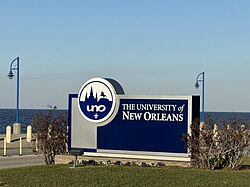
Key Facts
- Established: 1956 (Opened for classes in 1958).
- Classification: Public research university (R2 High Research Activity).
- Student Population: Approximately 5,200 students (3,800 undergraduates; 1,400 postgraduates).
- Campus Size: 195-acre urban campus.
- Athletic Identity: Known as the Privateers, competing in NCAA Division I (Southland Conference).
- Academic Strength: Only PAB-accredited urban planning program in Louisiana.
Institutional History and Evolution
The university was born from the vision of State Senator Theodore M. Hickey, who authored the act establishing the institution in 1956 to fill a void in public higher education within the New Orleans metropolitan area. Originally founded as a branch of Louisiana State University, it was named Louisiana State University in New Orleans.
The campus was developed on the site of the former Naval Air Station New Orleans, leased by the Orleans Levee Board. Opening in 1958, the university made history as the first racially integrated public university in the American South. Over the decades, its administrative structure evolved from a dean-led department to a separate campus within the LSU System of Higher Education in 1962, led by a chancellor.
While the institution operated as the University of New Orleans for nearly five decades, it was transferred to the University of Louisiana system in 2011. However, in 2025, state lawmakers voted to return the university to the LSU system, effective July 2026, at which point it will officially be renamed LSU New Orleans.
Overcoming Adversity: Katrina and COVID-19
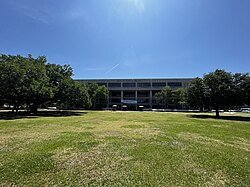
The university's resilience has been tested by significant environmental and global crises. During Hurricane Katrina in 2005, the campus served as a staging area for the National Guard. While the main campus sat on relatively high ground, levee breaches caused flooding in the Engineering Building and several residential halls. LSUNO demonstrated agility by becoming the first large damaged university in the city to reopen, utilizing web-based courses in October 2005 before the physical campus reopened in December.
More recently, the COVID-19 pandemic created severe enrollment challenges. A shift toward non-traditional online education and subsequent hurricanes led to record-low enrollment numbers. This financial strain resulted in a $10 million budget deficit, leading to budget cuts of over 15% in 2024 and mandatory employee furloughs in 2025.
Campus Life and Infrastructure
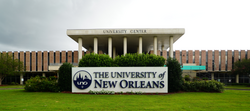
The 195-acre urban campus features several key landmarks that serve as the center of student activity, including the Administration Building, the University Center, and the Earl K. Long Library.
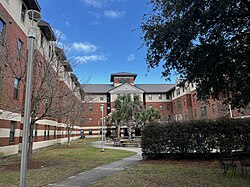
Residential life is centered around three main options: Pontchartrain Halls, Privateer Place, and Lafitte Village. Notably, the former Bienville Hall was demolished in 2023 to make way for the Hynes-LSUNO Charter School.
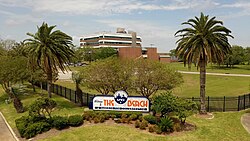
Beyond the main academic buildings, the university hosts the Research and Technology Park, often referred to as "The Beach," which bridges the gap between academic research and industrial application.
Athletics and Student Spirit
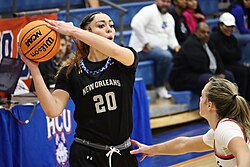
The Privateers compete in NCAA Division I as members of the Southland Conference. With 14 varsity sports teams, the university maintains a strong competitive presence in baseball, basketball, volleyball, and track and field.
University Overview Summary
| Category | Details |
|---|---|
| Colors | Privateer Purple and Gold |
| Mascot | Captain BrUNO |
| Endowment | $25.8 million (2021) |
| Accreditation | SACS |
| Staffing | 571 full-time; 160 part-time academic staff |
Notable Alumni and Faculty
The university has fostered a diverse array of talent. Notable alumni include comedian Ellen DeGeneres, Khan Academy founder Sal Khan, and R&B artist Frank Ocean. The faculty has also been distinguished by figures such as historian Stephen E. Ambrose and jazz educator Ellis Marsalis, Jr.
Frequently Asked Questions
What is the relationship between UNO and LSU?
Originally founded as a branch of LSU in 1956, the institution became the University of New Orleans (UNO) in 1974. After a period under the University of Louisiana system starting in 2011, it is scheduled to return to the LSU system in July 2026 and be renamed LSU New Orleans.
What makes LSUNO's academic programs unique?
LSUNO offers the only undergraduate mechanical and electrical engineering programs in New Orleans, the only graduate hospitality and tourism program in Louisiana, and one of the few naval architecture and marine engineering schools in the U.S.
How did the university respond to Hurricane Katrina?
Despite flooding in some buildings, the university was a pioneer in recovery, reopening virtually via web-based courses in October 2005, just two months after the storm.
What are the current athletic affiliations of the university?
The university's teams, known as the Privateers, are members of NCAA Division I and compete within the Southland Conference.