Loyola University New Orleans: A Legacy of Jesuit Education
Founded on the principles of the Society of Jesus, Loyola University New Orleans stands as a premier private institution in the heart of Louisiana. With a rich history spanning over a century, the university blends academic rigor with a commitment to faith and service, guided by its Latin motto, Deo et Patriae ("For God and country").
From its humble beginnings on a former plantation to its current status as a recognized center of excellence, Loyola has remained a cornerstone of the New Orleans intellectual landscape.
Key Facts
- Established: Founded in 1904; chartered as a university on July 10, 1912.
- Affiliation: Roman Catholic (Jesuit).
- Student Population: 4,351 students as of fall 2022.
- Endowment: $244.4 million (2024).
- Mascot: Havoc T. Wolf (Nickname: Wolf Pack).
- Campuses: A main 19-acre campus and a 4-acre Broadway campus.
History and Evolution
Founding and Early Years
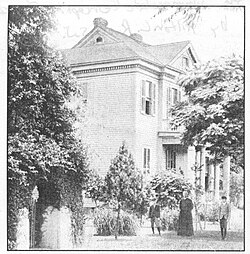
Loyola began in 1904 as Loyola College, established by the Society of Jesus on a portion of the Foucher Plantation. The university's origin is marked by a storied anecdote: Albert Biever, the first president, was reportedly given a nickel for streetcar fare and instructed by his superiors to travel uptown via the St. Charles Streetcar to found the institution.
Initially, classes were held in a residence behind the Most Holy Name of Jesus Church. The university's first permanent structure, Marquette Hall, was completed in 1910. By 1912, following a reorganization of Jesuit schools in the city, the institution was officially chartered as Loyola University.
Academic Expansion
The university grew rapidly during its first two decades, establishing the School of Law and School of Dentistry in 1914, followed by the College of Pharmacy in 1919. The mid-20th century brought further infrastructure growth, including the Joseph A. Danna Student Center and the twelve-story Henrietta Buddig Hall in the 1960s.
Resilience After Hurricane Katrina
In August 2005, Hurricane Katrina forced the evacuation of the campus. While the university suffered minimal wind damage and no building breaches from floodwaters, the devastation of New Orleans led to the cancellation of the fall 2005 semester. Despite this, 91 percent of undergraduate students returned for the spring 2006 term.
The recovery was guided by the "Pathways - Toward Our Second Century" strategic plan, which restructured academic programs to ensure long-term sustainability. By 2006, Loyola became the first New Orleans college to hold commencement ceremonies following the storm.
Academic Excellence and Colleges
Loyola is recognized for its high academic standards, ranking 10th among Southern regional universities in the 2017 U.S. News & World Report. The university maintains a student-to-faculty ratio of 11 to 1.
Specialized Colleges
- College of Arts and Sciences: The foundational academic core of the university.
- Joseph A. Butt, S.J., College of Business: Focused on professional business education.
- College of Music and Fine Arts: The only Jesuit college of music in the U.S., it incorporates the New Orleans Conservatory of Music and Dramatic Art (est. 1919) and the Thelonious Monk Institute of Jazz Performance.
- College of Law: Established in 1914, it now operates from the Broadway campus.
- College of Nursing and Health: Dedicated to healthcare professional training.
Research and Institutes
The university hosts several specialized centers, including the Jesuit Social Research Institute (JSRI), the Twomey Center for Peace Through Justice, and the Lindy Boggs National Center for Community Literacy.
Campus Infrastructure
The Main Campus
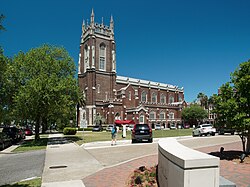
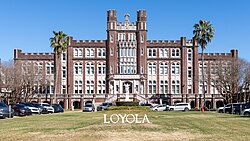
Marquette Hall remains one of the most iconic structures on campus. Originally the primary site for classes and the first library, it now serves largely as an administrative building and houses the Theatre Arts program's main theatre.
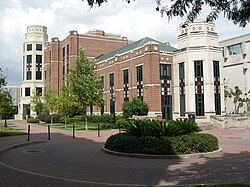
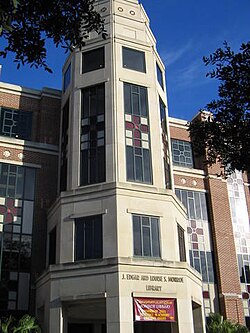
The J. Edgar and Louise S. Monroe Library, completed in 1999, serves as the academic hub. This 150,000-square-foot facility houses 377,000 books and periodicals and is highly ranked by The Princeton Review for its resources.
The Broadway Campus
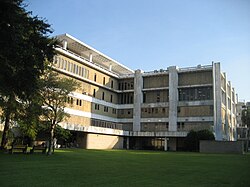
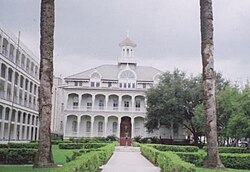
Purchased in 1984 from St. Mary's Dominican College, the 4-acre Broadway campus is home to the College of Law. Its centerpiece is Greenville Hall, a Registered Historic Place built in 1889.
Student Life and Athletics
Campus Culture
The Dr. Joseph A. Danna Center is the heart of student activity, housing dining services (including the "O.R." or Orleans Room), the bookstore, and student offices. Student expression is led by The Maroon, a student-run weekly newspaper established in 1923 and a multi-time winner of the National Pacemaker Award.
The Wolf Pack
Loyola's athletic teams, known as the Wolf Pack, compete in the National Association of Intercollegiate Athletics (NAIA) within the Southern States Athletic Conference (SSAC). Their mascot, Havoc T. Wolf, represents the university's competitive spirit.
University Overview
| Category | Details |
|---|---|
| President | Xavier Cole |
| Total Students (2022) | 4,351 |
| Undergraduates / Postgraduates | 3,205 / 1,146 |
| Campus Size | 23 Acres Total |
| Colors | Maroon, Gold & Metallic Gold |
Frequently Asked Questions
Who founded Loyola University New Orleans?
The university was founded in 1904 by the Society of Jesus (Jesuits), with Albert Biever serving as the first president.
What is the significance of the Broadway Campus?
The Broadway Campus, acquired in 1984, is the dedicated home of the College of Law and features the historic Greenville Hall.
How did Hurricane Katrina affect the university?
While the campus suffered minimal physical damage, the university canceled the fall 2005 semester. It recovered through a strategic plan called "Pathways," and the majority of students returned by spring 2006.
What makes the College of Music and Fine Arts unique?
It is the only Jesuit college of music in the United States and hosts the prestigious Thelonious Monk Institute of Jazz Performance.
Who is the current president of the university?
The current president is Xavier Cole.