Long Ball Tactics in Association Football
In association football, a long ball is a strategic pass attempt that moves the ball a significant distance across the pitch via a single aerial kick. Typically initiated by a goalkeeper or defender, the ball is sent directly to an attacking player, effectively bypassing the midfield. Unlike a precise pass to a teammate's feet, the long ball usually requires the attacker to challenge the opposing defense in the air, with other teammates positioning themselves to claim possession if the ball breaks loose.
This technique is particularly potent for teams featuring tall or fast strikers. It can also function as a long-distance through pass designed to breach the defensive line and trigger a foot race between the striker and the defender. While critics often dismiss the style as primitive or boring, it remains a highly effective tool for counter-attacking and is often utilized when weather conditions or specific player profiles favor a more direct approach.
It is important to distinguish between a precise long pass and "long ball play." The latter is generally characterized by a more aimless "hoofing" of the ball high into the air toward the general vicinity of the forwards, allowing them time to arrive at the drop zone while the ball is in flight.
Key Facts
- Definition: A long aerial kick from defense to attack that bypasses the midfield.
- Ideal Personnel: Most effective with strikers who possess significant height or speed.
- Strategic Use: Often used in counter-attacks, lower-league football, or as a desperate measure late in a match.
- Statistical Origin: Popularized by Charles Reep in the 1950s based on goal-scoring patterns.
- Requirement: High-level execution requires intelligent movement, dribbling, and clinical finishing.
The Statistical Basis of Long Ball Theory
The theoretical foundation of the long ball was established in 1950s England by Charles Reep, a retired RAF Wing Commander and amateur statistician. Reep analyzed the number of passes leading to goals and the field positions from which those passes originated.
Reep's Core Concepts
- Gulleys: The optimal zones between the corner flag and the six-yard box for delivering the final pass into the penalty area.
- 3-Pass Optimisation Rule: The observation that a higher percentage of goals are scored in moves involving only three passes.
- 9 Shots Per Goal: The maxim that, on average, one goal is scored for every nine shots taken.
- 12.3 Yard Position: The mean distance from the goal from which most goals are scored.
These theories were further promoted by Charles Hughes in The Winning Formula: The Football Association Soccer Skills and Tactics, which argued that the majority of goals are scored within five passes.
Critical Analysis
Football historian Jonathan Wilson has criticized Reep's analysis as flawed. Wilson argues that while three-pass moves may result in a high percentage of goals, they also account for a higher percentage of all shots. This suggests that moves with more passes actually have a higher success ratio. Furthermore, Wilson notes that this trend is more pronounced in higher-quality teams, suggesting that increased passing complexity is more effective at elite levels.
Effectiveness and Implementation
The long ball strategy has been a point of contention, particularly regarding the England national team. During the 1990s, Charles Hughes used his role as head of coaching at the FA to promote direct play. Proponents argue that direct play is consistently successful; for instance, the 1994 World Cup-winning Brazil team scored the most goals from moves of three passes or fewer.
Beyond elite competition, the long ball is frequently used in lower-level football where players may lack the technical cohesion for intricate build-up play. It is also a common tactic for teams needing a goal in the final minutes of a game when time precludes a gradual approach.
| Scenario | Reason for Use | Expected Outcome |
|---|---|---|
| Counter-Attack | Catch defenders off-guard | Quick transition to goal-scoring chance |
| Lower League Play | Lack of technical passing skill | Direct pressure on opposing defense |
| Late-Game Pressure | Insufficient time for build-up | Immediate ball placement in attacking third |
| Elite Tactical Shift | Compressing opponent's defense | Creating "secondary ball" opportunities |
Notable Proponents and Examples
Many managers have utilized the long ball, including Sam Allardyce, Tony Pulis, Jack Charlton, and Steve Bruce, among others. While often associated with weaker teams, its execution at the world-class level demonstrates that it requires significant skill, imagination, and creativity.
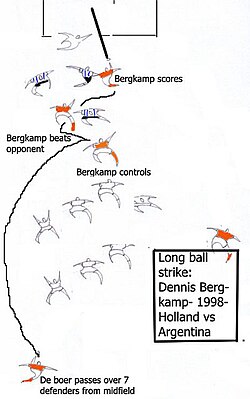
A landmark example occurred during the 1998 FIFA World Cup, when Netherlands striker Dennis Bergkamp scored against Argentina. The move began with a daring long pass from Frank de Boer that curled over seven opponents. Bergkamp's elite control and finish illustrated that the long ball is not merely "pumping" the ball upfield, but can be a precise tool of creativity.
Similarly, the Norwegian national team under Egil Olsen utilized the "Flo Pass." This involved long crosses from the left back to Jostein Flo, who would head the ball to midfielders or the striker. This approach helped Norway reach two World Cups. A notable instance was Tore André Flo's goal against Brazil in 1998, initiated by a massive pass from Stig Inge Bjørnebye.
The tactic can also be used as a specific game-plan switch. In the 2013–14 UEFA Champions League quarter-final, Chelsea employed a direct approach against PSG in the closing minutes. By going direct, Chelsea forced PSG's defensive line to compress, allowing Chelsea to dominate the "secondary balls" (the loose balls following the initial long pass), eventually leading to a winning goal by Demba Ba.
Frequently Asked Questions
Is the long ball the same as a long pass?
Not necessarily. A precise long pass to a specific teammate is an individual skill. "Long ball play" refers to a team strategy of repeatedly kicking the ball high into a general area, relying on percentages and physical battles to win possession.
Why is the long ball often criticized?
It is often viewed as boring or primitive because it bypasses the creative midfield play and technical build-up associated with more aesthetic styles of football.
Who is Charles Reep?
Charles Reep was an amateur statistician and retired RAF Wing Commander who developed the "long ball theory" in the 1950s, suggesting that fewer passes lead to a higher probability of scoring.
Can the long ball be effective for elite teams?
Yes. When combined with intelligent running, high-level dribbling, and clinical finishing, it can be a devastating counter-attacking tool or a way to break down a compressed defense.
What is the "Flo Pass"?
The Flo Pass was a tactical hallmark of the Norwegian national team, involving long balls targeted at Jostein Flo, who would then flick the ball on to other attackers.