Understanding Liverworts: The Ancient, Non-Vascular Wonders of the Plant World
Dating back as far as 472 million years, liverworts are among the oldest lineages of land plants. Belonging to the division Marchantiophyta, these non-vascular plants—meaning they lack the specialized tissues used by higher plants to transport water and nutrients—are a fascinating group of organisms that have survived through vast geological eras. Often referred to as hepatics, their division name is derived from the genus Marchantia, which was named by French botanist Jean Marchant in honor of his father.
While they are often overlooked due to their small size, liverworts play a significant role in their ecosystems. They are distributed globally in nearly every habitat, from the freezing Arctic to arid deserts, though they most commonly thrive in humid environments. Whether growing on rocks, trees, or soil, these plants represent a unique branch of the evolutionary tree.
Physical Characteristics and Diversity
There are approximately 9,000 known species of liverworts. They are generally quite small, typically measuring between 2 and 20 mm in width, with individual plants rarely exceeding 10 cm in length. Based on their physical structure, liverworts are categorized into two primary forms: thallose and leafy.
Thallose liverworts consist of a thallus—a prostrate, flattened, and often ribbon-like plant body that lacks true leaves or stems. In contrast, leafy liverworts possess flattened stems with overlapping scales or leaves arranged in one or more ranks. At least 85% of all liverwort species belong to this leafy group.
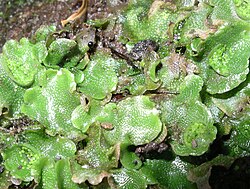
Distinguishing liverworts from their close relatives, the mosses, requires a keen eye or a microscope. One of the most reliable indicators is the presence of rhizoids—small, root-like structures used for attachment. In liverworts, these are single-celled, whereas in mosses, they are multicellular. Additionally, leafy liverworts often feature leaves arranged in three ranks and lack a costa (a midrib in the leaf). Another unique biological marker is the presence of oil bodies, which are membrane-bound structures containing isoprenoids found in the cells of most liverworts.
The Complex Life Cycle of Liverworts
Like other bryophytes, liverworts follow a gametophyte-dominant life cycle. This means the main plant body is the gametophyte, the stage that produces gametes (sex cells). During this stage, the cells are haploid, meaning they carry only a single set of genetic information. This is a sharp contrast to animals and vascular plants, where the visible plant is the diploid stage (carrying two sets of genetic information).
Liverworts can be either dioicous, where male and female reproductive organs are on separate plants, or monoicous, where both types of organs are found on the same plant. For fertilization to occur, the biflagellate sperm—which possess two whip-like tails for swimming—must travel through a thin film of water to reach the egg held within the archegonium. This movement can be aided by raindrops, which have even been observed "firing" sperm through the air to reach plants nearby.
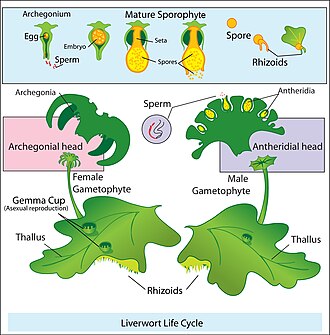
Once fertilization is successful, a diploid sporophyte begins to develop. The sporophyte is typically short-lived and consists of three parts: a foot that anchors it and absorbs nutrients, a seta (a stalk), and a capsule where spores are produced. Unlike many other land plants, the sporophyte of a liverwort lacks an apical meristem, which is the specialized tissue responsible for growth at the tips of plants.
Asexual Reproduction via Gemmae
Beyond sexual reproduction, some thallose species, such as Marchantia polymorpha, utilize asexual methods to spread. They produce small, disc-shaped structures called gemmae within shallow cups on the plant body. When rain splashes into these cups, the gemmae are dispersed, allowing the plant to create rapid clones of itself. This mechanism is a primary way certain species spread through environments like greenhouses.
Symbiosis and Ecology
Liverworts often engage in symbiosis, a close and often beneficial relationship with other organisms. Thalloid liverworts frequently host symbiotic glomeromycete fungi, which form root-like structures called arbuscules. Other species, such as those in the Aneuraceae family, associate with basidiomycete fungi. These relationships are essential for the survival and nutrient uptake of many species in their natural habitats.
Scientific and Economic Importance
In recent years, liverworts have become vital to the scientific community. The genome of Marchantia polymorpha was sequenced in 2017, making it a premier model organism for molecular studies. Because they have fast generation times, compact genomes, and a haploid-dominant life cycle, they are ideal for testing genetic engineering tools like CRISPR systems. Researchers can use liverworts to study plant biology and synthetic biology rapidly before applying those findings to more complex flowering plants.
Classification Summary
While classification can vary among botanists, the following table provides a general overview of the major classes within the division Marchantiophyta.
| Class | Representative Orders |
|---|---|
| Haplomitriopsida | Calobryales, Treubiales |
| Marchantiopsida | Blasiales, Lunulariales, Marchantiales, Neohodgsoniales, Sphaerocarpales |
| Jungermanniopsida | Fossombroniales, Jungermanniales, Metzgeriales, Pallaviciniales, Pelliales, Pleuroziales, Porellales, Ptilidiales |
Key Facts
- Estimated Species: Approximately 9,000 species exist worldwide.
- Life Cycle: Gametophyte-dominant, with haploid cells making up the main plant body.
- Size: Typically 2–20 mm wide and less than 10 cm long.
- Distinguishing Feature: They possess unique, membrane-bound oil bodies.
- Reproduction: Use water for sperm to swim; also use asexual gemmae for cloning.
- Scientific Value: Used as model organisms for rapid genetic engineering and genomics.
Frequently Asked Questions
How can I tell a liverwort apart from a moss?
The most reliable way is to look at the rhizoids; liverworts have single-celled rhizoids, while mosses have multicellular ones. You can also look for a thallus (a flattened body) or leaves arranged in three ranks, which are common in liverworts but not mosses.
What does it mean that liverworts are "non-vascular"?
Non-vascular means the plants lack the specialized internal "plumbing" (xylem and phloem) that larger plants use to transport water and minerals from roots to leaves. This is why they stay small and usually require moist environments.
How do liverworts reproduce without seeds?
Liverworts reproduce through spores produced in a capsule during their sexual life cycle. They can also reproduce asexually by using gemmae, which are small clusters of cells that break off and grow into new plants.
Why are liverworts important for genetic research?
Because they have a haploid-dominant life cycle, any genetic changes are immediately visible in the plant. Combined with their fast growth and ability to be grown in petri dishes, they are excellent for testing new biotechnology and CRISPR tools.
Where are liverworts most commonly found?
While they are found globally, they are most abundant in humid locations. However, specialized species have adapted to survive in extreme environments like the Arctic and even deserts.