Lise Meitner: The Physicist Who Cracked the Atom
Lise Meitner was a pioneering Austrian-Swedish nuclear physicist whose intellectual rigor and persistence led to one of the most significant scientific breakthroughs of the 20th century: the discovery of nuclear fission. Despite facing systemic gender discrimination and the perils of political exile, Meitner's work provided the theoretical foundation for understanding how a heavy atomic nucleus can split, a discovery that fundamentally altered the course of human history.
Throughout her career, Meitner collaborated with leading minds of her era, most notably chemist Otto Hahn. While her contributions were often overshadowed during her lifetime, her legacy is now cemented not only in the textbooks of physics but also in the periodic table itself.
Key Facts
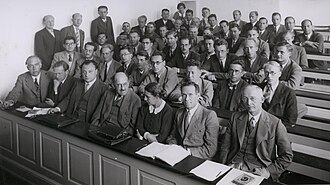
![Physicists and chemists in Berlin in 1920. Front row, left to right: Hertha Sponer, Albert Einstein, Ingrid Franck, James Franck, Lise Meitner, Fritz Haber, and Otto Hahn. Back row, left to right: Walter Grotrian, Wilhelm Westphal, Otto von Baeyer [de], Peter Pringsheim [de] and Gustav Hertz](/images/93/55/935511a71784cfb0d567586eee53a663e172be385e94efcaa597a059e4871fd1.jpg)
- Primary Achievement: Provided the first theoretical explanation of nuclear fission.
- Other Discoveries: Contributed to the discovery of protactinium and independently discovered the Auger effect.
- Academic Legacy: Nominated for the Nobel Prize 49 times across Physics and Chemistry.
- Lasting Honor: Element 109, meitnerium, was named in her honor in 1997.
- Career Span: Worked across the University of Vienna, University of Berlin, and KTH Royal Institute of Technology.
Early Life and Academic Foundations
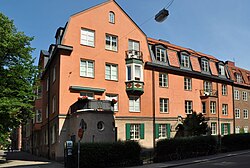
![Former Kaiser Wilhelm Institute for Chemistry building in Berlin. Badly damaged by bombing during World War II, it was restored and became part of the Free University of Berlin in 1948. It was renamed the Otto Hahn Building in 1956, and the Hahn-Meitner Building in 2010.[46][47]](/images/91/ea/91ea858eddda759947b5071454825d2dfb86710cd7b4aa9e44cc7ed099e8c4c5.jpg)
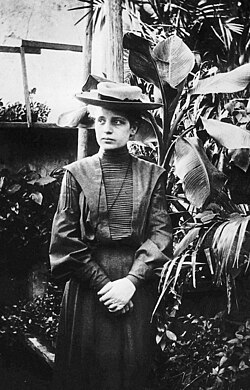
Born Elise Meitner in Vienna, Austria-Hungary, in 1878, she pursued a rigorous education in a time when women were largely excluded from higher academia. She earned her doctorate in philosophy from the University of Vienna in 1906, with a thesis focusing on heat conduction in inhomogeneous bodies (the movement of heat through materials that are not uniform).
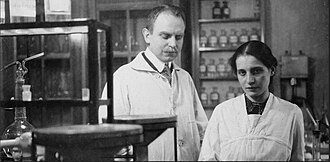
Meitner later moved to Berlin, where she earned her habilitation (the qualification required to teach at a university) from the University of Berlin. It was here that she began her long-term professional partnership with Otto Hahn at the Kaiser Wilhelm Institute for Chemistry.
![Meitner and Hahn in their laboratory, in 1913. When a colleague she did not recognise said that they had met before, Meitner replied: "You probably mistake me for Professor Hahn."[28]](/images/63/91/6391c6563d8c96ae89572f1f56549e78b2919f97f81a9d2b1d3b0714592a3dfc.jpg)
Scientific Breakthroughs and the Path to Fission
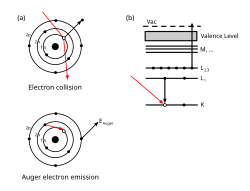
Meitner's early research was marked by a series of high-impact discoveries. Between 1917 and 1918, she contributed to the discovery of protactinium, an element that fills a gap in the periodic table between thorium and uranium. In 1922, she independently discovered the Auger effect—a physical phenomenon where an electron is emitted from an atom after a core electron is removed.
The Discovery of Nuclear Fission
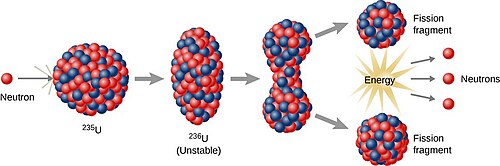
The pinnacle of Meitner's career came in the late 1930s. In mid-1938, Otto Hahn and Fritz Strassmann observed that bombarding uranium with neutrons produced isotopes of barium. While the chemists were puzzled by these results, Meitner, who had been forced to flee Nazi Germany for Sweden, worked with her nephew, physicist Otto Robert Frisch, to interpret the data.
Meitner realized that the uranium nucleus was not merely chipping, but splitting in half. On January 13, 1939, Frisch replicated the process, and in February 1939, they published their findings in Nature, coining the term fission to describe the process. This discovery revealed that a massive amount of energy is released when a nucleus splits, providing the theoretical basis for both nuclear reactors and atomic weapons.
Exile and the Nobel Controversy
Meitner's life was deeply impacted by the rise of the Nazi regime. As a woman of Jewish descent, she became stateless in 1938 and sought refuge in Sweden, where she lived for many years.
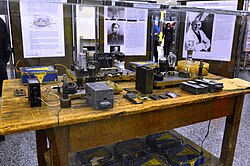
The recognition of the discovery of nuclear fission remains one of the most debated topics in scientific history. In 1944, the Nobel Prize in Chemistry was awarded solely to Otto Hahn. Despite being nominated 19 times for Chemistry and 30 times for Physics, Meitner never received the prize. Many historians and scientists have since described this exclusion as unjust, noting that without Meitner's theoretical guidance, Hahn might not have understood the significance of his experimental results.
![This was touted for many years as the table and experimental apparatus with which Otto Hahn discovered nuclear fission in 1938. The table and instruments are representative of the ones used, but not necessarily the originals, and would not have been together on the one table in the same room. Pressure from historians, scientists and feminists caused the Deutsches Museum to alter the display in 1988 to acknowledge the role of Meitner, Frisch and Strassmann.[99]](/images/c6/24/c62438208dcc0f2bf8dca3959afdbc3d6dd37027b98db40f4d46da007aa18dd4.jpg)
Later Years and Legacy
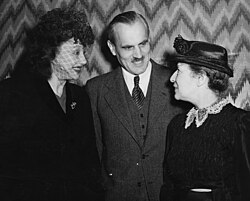
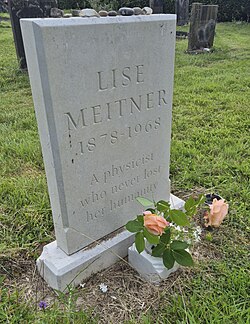
In her later years, Meitner continued to engage with the scientific community, visiting institutions like Bryn Mawr College and receiving numerous prestigious awards, including the Max Planck Medal and the Enrico Fermi Award. She passed away on October 27, 1968, in Cambridge, England, at the age of 89.
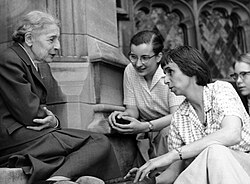
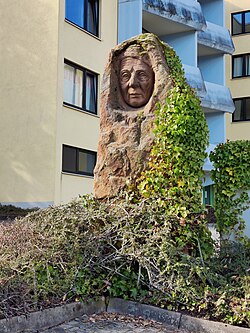
Today, Meitner is remembered as a trailblazer for women in science. Her name is honored through statues at Humboldt University of Berlin and the naming of the Hahn-Meitner Building in Berlin, reflecting a modern effort to acknowledge her equal role in the discovery of fission.
![Statue of Meitner by Anna Franziska Schwarzbach [de] at Humboldt University of Berlin](/images/96/40/9640def520abc1f2583183b7318d1fbb1c68fc7353cea79acda1ee0516f43f4f.jpg)
| Category | Details |
|---|---|
| Born/Died | 1878 (Vienna) – 1968 (Cambridge) |
| Key Discoveries | Nuclear Fission, Protactinium, Auger Effect |
| Major Institutions | Kaiser Wilhelm Institute, University of Berlin, KTH Royal Institute of Technology |
| Key Collaborators | Otto Hahn, Otto Robert Frisch |
| Posthumous Honor | Element 109 (Meitnerium) |
Frequently Asked Questions
Why was Lise Meitner not awarded the Nobel Prize for nuclear fission?
The 1944 Nobel Prize in Chemistry was awarded solely to Otto Hahn. While Meitner provided the essential theoretical interpretation of the experimental data, the Nobel Committee focused on the chemical discovery. Many peers and historians consider her exclusion an injustice given her instrumental role.
What is the Auger effect?
The Auger effect is a process where an atom transitions from an excited state to a lower energy state by emitting an electron (an Auger electron) rather than emitting a photon. Meitner discovered this independently in 1922.
How did Meitner contribute to the discovery of protactinium?
Working with Otto Hahn between 1917 and 1918, Meitner helped identify the mother isotope of actinium, which led to the discovery of element 91, known as protactinium.
What is the significance of the element Meitnerium?
Named in 1997, meitnerium (element 109) serves as a permanent scientific tribute to Lise Meitner, recognizing her immense contributions to nuclear physics despite the lack of a Nobel Prize.
What was the role of Otto Robert Frisch in her work?
Otto Robert Frisch was Meitner's nephew and a fellow physicist. He collaborated with her in late 1938 to interpret Hahn's data and was the one who experimentally replicated the fission process in January 1939.