Limited Overs Cricket: Formats, Rules, and History
Limited overs cricket, commonly referred to as white ball cricket, is a dynamic version of the sport designed to be completed within a single day. Unlike traditional Test or first-class matches, which can span up to five days, limited overs cricket imposes a strict maximum number of overs (sets of six legal balls) that each team can bowl.
This format has surged in popularity among spectators because it encourages aggressive, high-risk batting and frequently leads to dramatic, cliffhanger finishes. Most importantly, it allows fans to experience an entire match without the multi-day commitment required by the longer forms of the game.
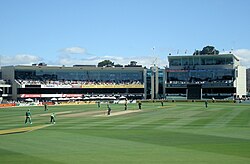
Key Facts
- Timeframes: Matches range from 1.5 hours (T10) to 8 hours (List A).
- Equipment: White balls are used instead of red to ensure visibility under floodlights.
- Structure: Each team bats once, with a fixed limit on the number of overs.
- Tiebreakers: Tied matches are often decided by a Super Over, where each team bats for one over with two wickets in hand.
- Bowling Limits: To ensure a variety of bowlers are used, individual bowlers are typically limited to 20% of the total overs.
Common Formats of Limited Overs Cricket
While the 50-over game is the gold standard for international competition, several other formats have emerged to further shorten game time and attract new audiences.
One Day Internationals (ODI) and List A
One Day Internationals are the premier international limited-overs format, now uniformly fixed at 50 overs per side. List A cricket serves as the domestic equivalent to ODIs, with innings typically ranging between 40 and 60 overs. Because rain can interrupt play, important matches often schedule a "reserve" day to ensure a result is reached.
Twenty20 (T20)
Introduced in England in 2003, Twenty20 limits each side to 20 overs (120 legal balls). This format is highly popular globally and has led to the creation of numerous professional franchise leagues.
T10 and 100-Ball Cricket
To further condense the experience, T10 cricket limits teams to 10 overs, resulting in a 90-minute game. Similarly, 100-ball cricket, launched in England in 2021, provides 100 deliveries per side with overs consisting of 5 balls each, fitting the game into roughly 2.5 hours.
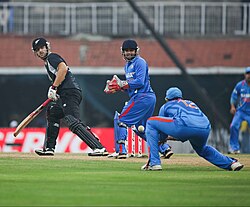
Technical Rules and Restrictions
Bowling and Fielding
To prevent a team from relying solely on two high-stamina bowlers, competitive games restrict the number of overs any one bowler can deliver. For example, in a 50-over match, a bowler is limited to 10 overs; in a 20-over match, the limit is four. An exception occurred in U.S. Pro Cricket, where bowlers were limited to five overs.
The Use of White Balls
White balls are used instead of traditional red ones because they are easier to see under stadium floodlights during day-night matches. While intended to be identical to red balls, some players suggest the harder surface of the white ball causes it to swing more.
Evolution and History
The concept of a 50-over tournament first appeared in 1951 at the All India Pooja Cricket Tournament in Kochi, Kerala, credited to KV Kelappan Thampuran. In England, the Midlands Knock-Out Cup (1962) used 65-over innings and drew significant television interest, paving the way for the Gillette Cup in 1963.
The first Limited Overs International (LOI) took place on January 5, 1971, between Australia and England in Melbourne. The quadrennial Cricket World Cup followed in 1975. Many modern aesthetics, such as colored clothing, were introduced via Kerry Packer's "rebel" World Series Cricket.
Major Tournaments and Classifications
The International Cricket Council (ICC) oversees the primary global competitions, including the Cricket World Cup and the ICC Champions Trophy. Additionally, the ICC World Cricket League provides competition for national teams with Associate or Affiliate status.
List A Classification
List A is a statistical category created by the Association of Cricket Statisticians and Historians to track career records for high-level one-day matches. It includes ODIs and premier domestic tournaments but excludes friendly matches, festival games, and World Cup warm-ups.
| Country | Notable Tournament(s) | Format |
|---|---|---|
| Australia | Marsh One-Day Cup, Big Bash League | 50 / 20 overs |
| England | Royal London One-Day Cup, T20 Blast, The Hundred | 50 / 20 / 100-ball |
| India | Vijay Hazare Trophy, Indian Premier League | 50 / 20 overs |
| South Africa | CSA One-Day Cup, CSA T20 League | 50 / 20 overs |
| West Indies | Super50 Cup, Caribbean Premier League, The 6ixty | 50 / 20 / 10 overs |
| Pakistan | Pakistan Cup, Pakistan Super League | 50 / 20 overs |
Notable Records
- Highest List A Total: 574 for 6 by Bihar against Arunachal Pradesh (2025).
- Highest International Total: 498 for 4 by England against Netherlands (2022).
- Highest Individual Score: 272 by Narayan Jagadeesan (List A); 264 by Rohit Sharma (International).
- Most Runs in an Over: 36 runs (6 sixes), achieved by Herschelle Gibbs, Yuvraj Singh, Kieron Pollard, Jaskaran Malhotra, Dipendra Singh Airee, and Darius Visser.
- Lowest ODI Total: 35, recorded by both Zimbabwe (2004) and the United States (2020).
Frequently Asked Questions
What is the difference between ODI and List A cricket?
ODI refers specifically to international matches between national teams, while List A is a broader classification that includes ODIs as well as the highest level of domestic one-day competitions.
Why are white balls used in limited overs cricket?
White balls are used because they are significantly more visible than red balls when matches are played under stadium floodlights during the evening.
How does a Super Over work?
A Super Over is a tiebreaker where each team bats for one over. Each team is allowed only two wickets; if they lose two wickets, their innings ends regardless of how many balls remain.
What are the bowling restrictions in a 50-over match?
In a standard 50-over match, no single bowler can bowl more than 10 overs, which is 20% of the total innings.
What is 100-ball cricket?
100-ball cricket is a shortened format where each team faces 100 deliveries. Unlike traditional cricket, the "overs" in this format consist of 5 balls each instead of 6.