Limburg an der Lahn: A Journey Through Medieval History
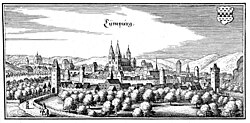
Perched upon the crags overlooking the Lahn river, Limburg an der Lahn stands as a testament to the strategic and commercial vitality of medieval Germany. From its origins as a protective outpost for a river ford to its evolution into a significant religious and administrative center, the town's history is woven into the broader tapestry of European power struggles and urban development.
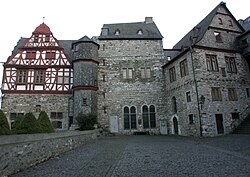
The story of Limburg began around 800 A.D. with the construction of the first castle buildings, designed primarily to protect a vital ford over the Lahn. By 910, the settlement—then known as Lintpurc—appeared in official documents when Louis the Child granted an estate to Konrad Kurzbold. Kurzbold established the foundation for Saint George's Monastery Church, a site that would eventually evolve into the town's architectural crown jewel.
The Rise of a Medieval Trading Hub
Limburg's growth was accelerated by its location on the Via Publica, a major long-distance trade route. The construction of a wooden bridge across the Lahn in 1150 further cemented its importance, as the primary road connecting Cologne and Frankfurt am Main began to run directly through the town.
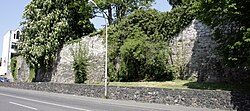
By the early 13th century, Limburg Castle had been rebuilt in its current form, and the community was granted official town rights in 1214. The town's rapid expansion is still evident today through the remains of its fortification walls, built in stages between 1130 and 1340, spanning roughly one thousand metres.
Social Stratification and Urban Conflict
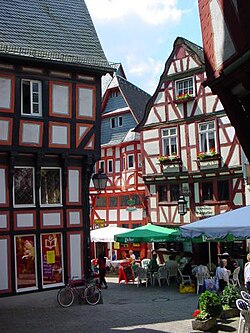
The town's layout reflected a strict social hierarchy. The wealthy merchant elite lived in houses near the castle tower, protected by the first town wall. In contrast, simple craftsmen resided in the area now known as the Rossmarkt (Horse Market). These residents were only included within the fortifications after the second wall was built, yet they were denied a voice in town governance and bore the primary financial burden of the town's operation. It took until 1458 for these citizens to finally secure the right to send two representatives to the town council.
Religious Landmarks and Political Shifts
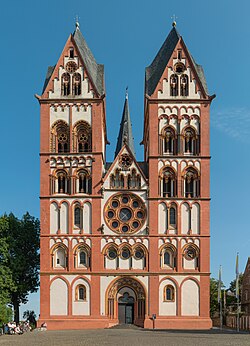
The spiritual heart of the town, Saint George's Cathedral (Sankt-Georgs-Dom), was consecrated in 1235 on the site of the original monastery church. Despite its grandeur, the town faced numerous hardships, including a devastating fire in 1289 and subsequent outbreaks of the Black Death between 1349 and 1365.
Politically, the town transitioned through several owners. After being held by the Lords of Ysenburg, a half share of the town was pledged to the Electorate of Trier in 1344, with full ownership passing to Trier by 1420. This period saw a gradual decline in the town's autonomy, culminating in the unrest of 1525 during the German Peasants' War. Local citizens attempted to demand equality in taxation and trade, but these concessions were ultimately overturned by Archbishop Richard.
Transition to the Modern Era
The 19th century brought sweeping changes. In 1806, Limburg became part of the Duchy of Nassau, and by 1818, the restrictive town walls were torn down. The town's status grew as it became a Catholic episcopal seat in 1827 and a railway hub by 1862. Following the Austro-Prussian War in 1866, the region passed to Prussian control.
Key Facts
- First Mention: Documented as "Lintpurc" in 910 A.D.
- Strategic Importance: Developed as a protection point for a Lahn river ford and a stop on the Via Publica.
- Architectural Heritage: Home to the Römer 2-4-6, one of Germany's oldest half-timbered houses.
- Fortifications: Town walls were constructed in three phases (1130, 1230, 1340) before being demolished in 1818.
- Religious Status: Became a Catholic episcopal seat in 1827.
| Period/Year | Key Event | Significance |
|---|---|---|
| c. 800 A.D. | First castle buildings | Protection of the Lahn ford |
| 1150 | Wooden bridge built | Connected Cologne and Frankfurt trade |
| 1214 | Town rights granted | Official recognition as a town |
| 1235 | Cathedral consecrated | Establishment of Saint George's Cathedral |
| 1420 | Trier ownership | Full transition to the Electorate of Trier |
| 1806 | Duchy of Nassau | Shift in territorial administration |
| 1866 | Prussian annexation | Result of the Austro-Prussian War |
Frequently Asked Questions
What is the significance of the Römer 2-4-6?
The Römer 2-4-6 is recognized as one of the oldest half-timbered houses in Germany, built following the devastating town fire of 1289.
What was the "Free State Bottleneck"?
Between 1919 and 1923, Limburg served as the capital of the Free State Bottleneck (Freistaat Flaschenhals), a short-lived entity created when the town was cut off from the Weimar Republic's administration during the Allied occupation of the Rhineland.
How did the town's social structure affect its governance?
The town was divided between a wealthy merchant elite and simple craftsmen. The merchants held the political power and lived within the first wall, while the craftsmen in the Rossmarkt area paid the majority of the taxes but were denied council representation until 1458.
What role did Limburg play during the World Wars?
During World War I, it hosted a major prisoner-of-war camp for Irish members of the British Army. In World War II, the German Army established the Dulag G camp for Polish prisoners of war from August 1939 until January 1941.