Let's Get Wellington Moving: The Rise and Fall of a Massive Transit Vision
For nearly a decade, Wellington sought a transformative solution to its chronic congestion and aging infrastructure. The initiative known as Let's Get Wellington Moving (LGWM) emerged as an ambitious attempt to shift the city's reliance from private vehicles to a modern, integrated public transport network. What began as a collaborative effort between local and central government evolved into a multi-billion dollar proposal that sparked intense debate over the future of urban mobility in New Zealand's capital.
The Evolution of the Proposal
The project's roots trace back to 2014 with the formation of the Ngāūranga to Airport Governance Group, a partnership between the city council, regional council, and Waka Kotahi (the New Zealand Transport Agency). Initial plans focused on a bridge over the Basin Reserve, but these were halted by a Board of Inquiry and a subsequent High Court ruling in 2015.
In 2016, the partners rebranded the effort as "Let's Get Wellington Moving." This new iteration shifted focus toward transport behaviour change, moving beyond specific corridors to address how residents moved throughout the city. By 2017, the Labour Government prioritized public transport funding, leading to the exploration of various transport scenarios.
A pivotal 2019 study highlighted the stark difference in efficiency between transit modes: a projected light rail line could move 12,000 passengers per hour, compared to just 4,000 people per hour in private vehicles. This study also suggested a second two-lane Mount Victoria Tunnel for road traffic or a dual-track rail tunnel.
The NZ$6.4 Billion Transport Package
In May 2019, a comprehensive transport package valued at NZ$6.4 billion was announced. The plan aimed to overhaul the city center and key arteries through several strategic interventions:
- The Golden Mile Revitalisation: A project to prioritize pedestrians and public transport from the Beehive end of Lambton Quay to the end of Courtenay Place. This included widening footpaths by up to 75%, removing most on-street parking, and implementing bus-only lanes.
- CBD Speed Limits: Reducing speed limits from 50 km/h to 30 km/h, excluding main arterial roads.
- Mass Transit: A high-capacity line linking the railway station with the Hospital, Newtown, Miramar, and the Airport, with options including electric buses, trackless trams, or light rail.
- Mount Victoria Tunnel: A second tunnel prioritized for buses, walking, and cycling.
Expanding the Vision: Light Rail and Cycling
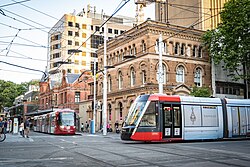
By 2021, the project's scope became more defined. A light rail and bus rapid transit project was revealed with four route options. One prominent proposal involved a line to Island Bay via Newtown. The timeline suggested a finalized design by 2027, with construction beginning in 2028 and taking between 8 to 15 years to complete.
Parallel to the mass transit plans, the Paneke Pōneke bike network was introduced. This plan aimed to build 147km of cycleways over a decade, with the city council constructing 90km and LGWM contributing 34km of inner-city routes.
![The proposed South Coast light rail, which would have been a line from the Wellington railway station to Island Bay. [47]](/images/7c/00/7c00300ef436bc4b21f967d2e7a7619f0a4051990134caaef13ea2e1bd834755.png)
In 2022, the government committed to an estimated NZ$7.4 billion project. Finance Minister Grant Robertson identified the "southern" route to Island Bay as the preferred choice due to its potential for housing and neighborhood growth. This plan also proposed converting the existing Mount Victoria Tunnel into a dedicated space for walking and cycling, while the new tunnel would provide two lanes for cars and two for public transport.
Key Facts
- Total Estimated Cost: Increased from NZ$6.4 billion (2019) to NZ$7.4 billion (2022).
- Capacity Comparison: Light rail (12,000 passengers/hr) vs. private vehicles (4,000 passengers/hr).
- Cycling Goals: 147km of total cycleways via the Paneke Pōneke plan.
- Golden Mile Changes: Footpaths to be widened by up to 75% with most on-street parking removed.
- Preferred Route: The "southern" light rail route to Island Bay.
| Component | Proposed Feature | Primary Goal |
|---|---|---|
| Mass Transit | Light Rail / Trackless Trams / Electric Buses | High-capacity movement to Airport/Island Bay |
| Mount Victoria Tunnel | Second Tunnel (4 lanes) | Separate road traffic from walking/cycling |
| Golden Mile | Pedestrian-first zone | Prioritize public transport over private cars |
| Paneke Pōneke | 147km Cycleway Network | Connect city center to major suburbs |
The Demise of the Project
Despite the ambitious plans, internal and external pressures mounted. A September 2020 external review revealed that the program was at risk of failure. The consultants cited under-resourcing, staff shortages, a lack of strategic leadership, and bureaucratic inefficiency. Critics, including journalists and local councillors, described the project as unaccountable and slow.
The political tide turned in 2023. The National Party campaigned against the project, with Chris Bishop describing it as a "toxic mess." Upon taking office in November 2023, the new National Government announced its intention to withdraw central government support from LGWM, with the sole exception of the second Mount Victoria Tunnel.
Despite efforts by Wellington Mayor Tory Whanau to persuade the government—including a proposal to visit light rail systems in Sydney or Canberra—the project was officially scrapped in mid-December 2023. Minister of Transport Simeon Brown ordered the NZTA to cease funding for LGWM and various associated local council projects focused on walking, cycling, and public transport.
Reaction and Aftermath
The cancellation sparked significant backlash from environmental and transit advocates. Green Party spokeswoman Julie Anne Genter argued that focusing only on the tunnel and Basin works would be disruptive without improving traffic flow. MP Tamatha Paul emphasized the need for basic reliability in bus services and safety.
Patrick Morgan of the Cycling Action Network criticized the shift, suggesting that the government was returning to failed 1960s-era ideas by attempting to "build your way out of congestion." Mayor Whanau concluded that scrapping the light rail would hinder city growth and fail to address the climate crisis.
Frequently Asked Questions
What was the primary goal of Let's Get Wellington Moving?
The project aimed to change transport behavior in Wellington by shifting the focus from private vehicle use to a high-capacity mass transit system, improved cycling networks, and pedestrian-friendly city center designs.
Why was the southern route preferred for the light rail?
Finance Minister Grant Robertson stated that the southern route to Island Bay was preferred because of its significant potential to stimulate new housing and neighborhood growth.
What happened to the Paneke Pōneke bike network?
The plan aimed for 147km of cycleways, with the city council and LGWM sharing construction duties. However, the government eventually ordered the NZTA to cease funding for various local council projects promoting cycling and walking associated with LGWM.
Why was the project eventually cancelled?
The project faced internal issues including under-resourcing and a lack of leadership, as well as external political opposition. The National Government deemed it a "toxic mess" and scrapped it in December 2023 to refocus priorities.
Is the second Mount Victoria Tunnel still being planned?
Yes, the new National Government indicated that it would withdraw from LGWM except for the second Mount Victoria Tunnel.