Let Me In: The Making of the American Adaptation
The journey of Let Me In began as a complex balancing act between honoring a beloved original and creating a distinct American identity. Based on the novel by John Ajvide Lindqvist and following the success of the Swedish film Let the Right One In, this adaptation sought to translate a haunting coming-of-age story into a new cultural context while preserving its emotional core.
Key Facts
- Director: Matt Reeves.
- Production Company: Hammer Films.
- Setting: A small town in New Mexico during the early 1980s.
- Lead Cast: Kodi Smit-McPhee, Chloë Grace Moretz, and Richard Jenkins.
- Cinematography: Greig Fraser, chosen for his expertise in natural light.
- Composer: Michael Giacchino.
Development and Creative Vision
Interest in an English-language version started in mid-2007. Hammer Films eventually acquired the rights at the 2008 Tribeca Film Festival. While the original Swedish director, Tomas Alfredson, declined to direct the remake—arguing that remakes are typically only necessary when the original is poor—director Matt Reeves approached the project with deep respect for both the book and the Swedish film.
Reeves emphasized that he was not simply "remaking" the Swedish movie, but rather creating a new film based on Lindqvist's novel. He was particularly drawn to the personal, human elements of the story, which reminded him of his own childhood. To ensure a fresh interpretation, Reeves instructed his actors not to watch the original film before filming.
Adapting the Story for America
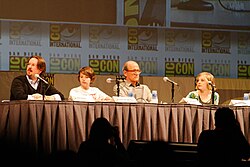
To ground the story in an American context, Reeves moved the setting from Stockholm to Los Alamos, New Mexico, and renamed the protagonists Owen and Abby. Despite pressure to change the characters' ages, Reeves insisted on keeping them young to preserve the childlike innocence essential to the narrative.
The choice of the 1980s setting was a deliberate thematic decision. Reeves used the era's political climate—specifically Ronald Reagan's "evil empire" speech—to mirror Owen's internal struggle. By framing evil as something "Other" or external, the film explores how a young boy grapples with dark feelings and isolation within a religious American town.
Casting and Filming
The lead roles were filled by Kodi Smit-McPhee and Chloë Grace Moretz, both of whom came highly recommended by directors John Hillcoat and Matthew Vaughn. Richard Jenkins joined the cast as Abby's adult companion. To help the young leads inhabit their roles, Reeves followed advice from Steven Spielberg, encouraging the children to keep in-character diaries to share their perspectives with him.
Principal photography took place between November 2009 and January 2010 in Albuquerque and Los Alamos, New Mexico. To achieve a naturalistic look, Reeves hired cinematographer Greig Fraser, whose work with natural light in Bright Star served as a primary inspiration.
Technical Execution and Visual Effects
Method Studios handled the visual effects, utilizing Houdini software for complex sequences. One of the most challenging scenes was a car crash designed to look like a single, uncut first-person shot. This was achieved by combining a live-action plate of the car swerving with a mechanical "rotisserie" model of the car spinning against a blue screen.
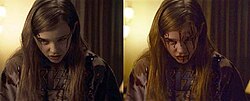
Another technical highlight was the sequence where Abby begins to bleed upon entering Owen's home. To ensure the blood flow matched the emotional timing of the scene, the team avoided traditional on-set prosthetics. Instead, they filmed Moretz with minimal reference blood and used software to render the gradual release of blood in post-production.
Music and Sound
The score, composed by Michael Giacchino, was designed as a balancing act between sentimentality and terror. Giacchino developed specific musical themes for each character to help the audience track their emotional arcs. The process involved significant collaboration with Reeves to determine when the music should heighten the tension and when silence would be more effective.
| Category | Details |
|---|---|
| Setting | Los Alamos, New Mexico (1980s) |
| Key Cast | Kodi Smit-McPhee, Chloë Grace Moretz, Richard Jenkins |
| VFX Studio | Method Studios |
| Score | Michael Giacchino |
| Filming Locations | Albuquerque and Los Alamos, NM |
Frequently Asked Questions
Did the original director support the remake?
No, Tomas Alfredson expressed that he was not in favor of remaking his film, stating that remakes should only happen if the original was bad.
How did the American version differ from the Swedish original?
The setting was moved to New Mexico, the characters were renamed Owen and Abby, and the film incorporated 1980s American political themes, such as the "evil empire" mindset.
How were the child actors guided during production?
Following a suggestion from Steven Spielberg, the lead child actors kept diaries in character to help them explore their roles and share their perspectives with director Matt Reeves.
What technique was used for the bleeding effect on Abby?
Instead of using heavy on-set prosthetics, Method Studios used Houdini software to track Chloë Grace Moretz's movements and render the blood flow digitally in post-production for better emotional timing.
Why did Matt Reeves insist on keeping the characters' ages?
Reeves believed that changing the ages would ruin the essence of the story and destroy the necessary element of childlike innocence.