Lesser Striped Swallow
The Lesser Striped Swallow (Cecropis abyssinica) is a large, striking member of the swallow family (Hirundinidae) native to Sub-Saharan Africa. Known for its distinctive plumage and architectural nesting habits, this species is a common sight across a vast range of African landscapes, often thriving in close proximity to human settlements.
Key Facts
- Scientific Name: Cecropis abyssinica
- Conservation Status: Least Concern (IUCN 3.1)
- Primary Range: Sub-Saharan Africa, from Sierra Leone to eastern South Africa.
- Diet: Primarily flying insects, occasionally small fruits.
- Nesting: Bowl-shaped mud nests with tubular entrances.
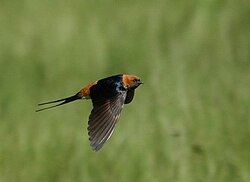
- Distinctive Feature: Dark blue upperparts with a red rump and rufous-chestnut head.
Physical Description and Identification
Measuring between 15 and 20 cm in length, the Lesser Striped Swallow is characterized by its vibrant coloration. It possesses dark blue upperparts contrasted by a deep red rump and a rufous-chestnut crown, nape, and sides of the head. Its underparts are white with prominent dark streaking, while the flight feathers of the upper and underwings are blackish-brown. The underwing coverts are tawny in color.
The tail is blackish with notably long outer feathers, which are slightly longer in males than in females. Juvenile birds are generally duller and browner, exhibiting less contrast and shorter outer tail feathers. Depending on the region, there are five or six subspecies that vary primarily in the extent of the streaking on their underparts.
When distinguishing it from the larger Greater Striped Swallow (Hirundo cucullata), the Lesser Striped Swallow displays heavier and darker underpart striping, a deeper red rump, and a brighter head color.
Distribution and Habitat
This species is endemic to Sub-Saharan Africa, breeding from Sierra Leone and southern Sudan south into eastern South Africa. While relatively sedentary, it is partially migratory; birds in South Africa typically winter further north, and West African populations move away from the northern reaches of their breeding range during the dry season.
The Lesser Striped Swallow prefers wooded, mainly lowland habitats and avoids highly open areas. In montane grasslands (high-altitude grasslands), it is typically replaced by the Greater Striped Swallow. Because of its adaptability, it is frequently found around human habitations.
While primarily African, rare sightings have occurred outside its typical range, including a single record in Oman and a first-time record for the Western Palaearctic in Kuwait as of May 2025.
Behavior and Diet
The flight of the Lesser Striped Swallow is erratic, a characteristic common to many insectivores that hunt on the wing. Its diet consists mainly of flying insects, though it has been observed eating small fruits. Its vocalization is described as a nasal "zeh zeh zeh zeh zeh."
Breeding and Nesting
The breeding habits of the Lesser Striped Swallow are marked by impressive engineering. They construct bowl-shaped mud nests featuring a tubular entrance, typically attached to the underside of a structure. These nests are lined with soft materials and are often reused in subsequent years.
While they naturally build nests in caves, under rock overhangs, or on tree branches, the species has successfully adapted to man-made structures. They frequently utilize bridges, culverts, and buildings, generally preferring the highest available site.
The reproductive cycle typically involves a clutch of three glossy white eggs, which may occasionally feature brown spots. The female handles incubation alone for 14 to 16 days. Once the eggs hatch, both parents share the responsibility of feeding the chicks. Fledging occurs after 17 to 19 days, although young birds often return to the nest to roost for several days after their first flight.
Species Summary
| Feature | Details |
|---|---|
| Length | 15–20 cm |
| Plumage | Dark blue upperparts, red rump, rufous head, streaked white underparts |
| Habitat | Lowland wooded areas and human settlements |
| Clutch Size | Typically 3 eggs |
| Incubation Period | 14–16 days |
| Fledging Period | 17–19 days |
Frequently Asked Questions
How can you tell a Lesser Striped Swallow apart from a Greater Striped Swallow?
The Lesser Striped Swallow has brighter head coloration, a deeper red rump, and heavier, darker streaking on its underparts compared to the Greater Striped Swallow.
Where does the Lesser Striped Swallow typically build its nest?
They build tubular mud nests on the underside of structures such as cave ceilings, rock overhangs, tree branches, and man-made structures like bridges and buildings.
Is the Lesser Striped Swallow a migratory bird?
It is partially migratory. For example, populations in South Africa winter further north, and West African birds migrate away from the north of their breeding range during the dry season.
What do Lesser Striped Swallows eat?
Their diet consists primarily of flying insects, although they are also known to consume small fruits.
What is the conservation status of this species?
The Lesser Striped Swallow is classified as Least Concern according to the IUCN 3.1 criteria.