Lesser Germany: The Political Evolution of Kleindeutschland
In the history of European nation-building, few concepts were as contentious as the "German question." At the heart of this debate were two competing visions for a unified nation: Greater Germany (Großdeutschland) and Lesser Germany (Kleindeutschland). While the former sought to include the multinational Austrian Empire, the latter proposed a unification that explicitly excluded the Habsburgs, paving the way for a state dominated by Prussia.
The "Lesser German solution" eventually became the blueprint for the modern German state. This transition from a fragmented collection of principalities to a centralized empire was marked by revolutionary fervor, diplomatic maneuvering, and decisive military conflict.
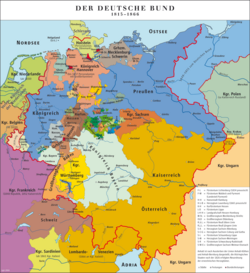
Key Facts
- Definition: Lesser Germany (Kleindeutschland) refers to a German unification model that excluded the Austrian Empire.
- Primary Driver: The Kingdom of Prussia was the leading force behind the Lesser German solution.
- Turning Point: The Austro-Prussian War of 1866 led to the dissolution of the German Confederation and the rise of Prussian hegemony.
- Outcome: In 1871, the North German Confederation and southern states formed the Deutsches Reich, realizing the Lesser Germany vision.
- Contrast: Greater Germany sought to incorporate all German-speaking lands, including those under Austrian rule.
The Revolutionary Era (1848–1850)
Following the Congress of Vienna in 1815, the German states were organized into the German Confederation. This was a loose association where member states like Prussia and Austria only partially belonged; their vast external territories—such as East Prussia or the Hungarian lands—were considered bundesfremd (foreign to the confederation) and lacked the military protections afforded to the Bundesgebiet (federal territory).
The revolutions of 1848 sparked a push for a formal constitution. The elected National Assembly initially hoped to include Austria's federal territories. However, a fundamental conflict emerged: the Austrian government refused to divide its empire, while the National Assembly feared that including all of Austria would import unsustainable nationality conflicts, particularly regarding Hungarian and Czech populations.
The Shift Toward Prussia
By March 1849, the "Lesser German" faction gained the majority. They proposed a constitution that elected the Prussian king as German Emperor. This plan also attempted to expand borders by annexing Prussian-ruled Polish territories, such as the Grand Duchy of Posen, based on the belief that these lands could be successfully Germanized. These attempts were met with armed resistance during the Greater Poland uprising.
Despite the assembly's efforts, the Prussian king refused the crown in April 1849, rejecting the liberal framework of the Frankfurt Constitution. He instead pursued unification on his own absolutist terms, later known as the Erfurt Union, which continued to exclude Austria.
The Path to Unification (1850–1871)
After 1850, Austria temporarily regained influence, forcing Prussia to pause its union plans. However, the balance of power shifted by 1860. Austria was weakened by the Italian War, while Prussia actively courted the national movement to strengthen its position.
The Conflict of 1866
Tensions peaked in 1866 when Prussia proposed transforming the German Confederation into a federal state without Austria. This led to the Austro-Prussian War. Prussia's victory resulted in the dissolution of the old Confederation and the creation of the North German Confederation.
Prussia expanded this new state to include East Prussia and Polish-speaking territories like the Province of Posen and West Prussia. While seen as a victory for unification, these annexations alienated the Polish majority through forced Germanization and the Kulturkampf (a culture struggle against the influence of the Catholic Church).
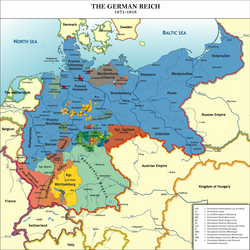
The Final Integration
The final step occurred during the Franco-Prussian War (1870–1871). The southern German states, bound by military conventions, allied with the North German Confederation. Weakened and unable to support France, the Austrian government finally accepted the reality of a Lesser Germany in December 1870. By 1871, the south German states joined the North, and the Deutsches Reich was established.
Summary of German Unification Models
| Feature | Lesser Germany (Kleindeutschland) | Greater Germany (Großdeutschland) |
|---|---|---|
| Austrian Inclusion | Excluded | Included (or German-speaking parts) |
| Leading Power | Prussia | Austria (Habsburgs) |
| Primary Goal | Homogeneous federal state under Prussia | Broad union of all German-speaking peoples |
| Historical Result | Realized in 1871 as the Deutsches Reich | Remained a political ideal/goal |
Frequently Asked Questions
What is the main difference between Lesser Germany and Greater Germany?
The primary difference is the role of Austria. Lesser Germany (Kleindeutschland) envisioned a unified German state that excluded the Austrian Empire, while Greater Germany (Großdeutschland) sought to include Austria or its German-speaking territories.
Why did the National Assembly of 1848 eventually favor the Lesser German solution?
The assembly realized that including the entire Austrian Empire would bring complex nationality conflicts into the new state. Since the Austrian government refused to separate its German territories from its non-German ones (like Hungary), the assembly opted for a Prussian-led state instead.
What was the significance of the Austro-Prussian War of 1866?
The war ended in a Prussian victory, which led to the dissolution of the German Confederation and effectively removed Austria from German political affairs, allowing Prussia to establish the North German Confederation.
What happened to the Polish territories during this process?
Prussia annexed territories such as the Province of Posen and West Prussia into the North German Confederation. However, policies of Germanization and the Kulturkampf irrevocably alienated the Polish population from the Prussian state.
When did the term "Lesser Germany" lose its common usage?
The term lost much of its significance after 1871. Once the Deutsches Reich was established without Austria, this specific version of Germany became the standard definition of the nation.