Leafbirds: The Vibrant Green Songbirds of Asia
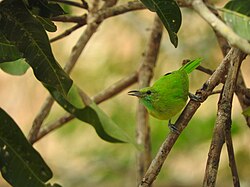
The leafbirds (family Chloropseidae) are a group of small passerine birds—perching birds with feet adapted for gripping branches—found throughout the Indian subcontinent and Southeast Asia. Named for their striking green plumage that allows them to blend seamlessly into the forest canopy, these birds are celebrated for their beauty and melodic songs.
While they may resemble bulbuls in shape, leafbirds are distinguished by their vivid colors and unique taxonomic history. Currently, the family is monogeneric, meaning all species are classified under a single genus: Chloropsis.
Key Facts
- Distribution: Found across the Indian subcontinent and Southeast Asia.
- Appearance: Predominantly green plumage; many species exhibit sexual dimorphism.
- Diet: Primarily insects, supplemented by fruit and nectar.
- Conservation: Over half of the species are threatened or near threatened.
- Behavior: Known for melodious songs and the ability to mimic other sounds.
Taxonomy and Origins
The genus Chloropsis was established in 1827 by English naturalists William Jardine and Prideaux Selby. The name is derived from the Ancient Greek words khlōros (green) and opsis (appearance). Originally, leafbirds were grouped with ioras and fairy-bluebirds in the family Irenidae. However, in 1960, American ornithologist Alexander Wetmore moved them into their own dedicated family, Chloropseidae.
Modern science continues to refine these relationships. A comprehensive molecular phylogenetic study published in 2019 confirmed that Chloropseidae is the sister family to the Irenidae (fairy-bluebirds).
Physical Characteristics
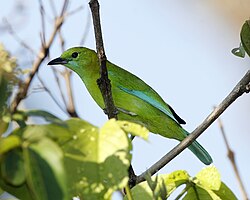
Leafbirds are small, ranging from 14 to 21 cm in length and weighing between 15 and 48 g. Their most defining feature is their bright green plumage, though many species are sexually dimorphic, meaning males and females look different.
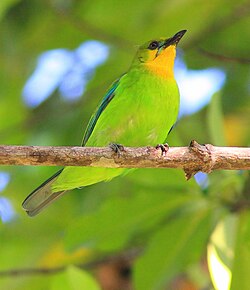
In highly dimorphic species, such as the orange-bellied leafbird, the differences are stark. Typically, males possess more vibrant colors and a distinct blue or black face mask, while females have duller plumage and a reduced or absent mask. The Philippine leafbird is a notable exception, showing no sexual dimorphism. Juvenile birds generally resemble a duller version of the female.
Beyond their looks, leafbirds are auditory masters. Their songs are melodious, and several species are skilled mimics. Interestingly, like bulbuls, leafbirds may drop body feathers when handled, a defense mechanism that may confuse predators such as snakes.
Distribution and Habitat
Leafbirds are arboreal, meaning they spend their lives in trees and shrubs. While most prefer evergreen forests, some species have adapted to different environments:
- Deciduous monsoon forests: Inhabited by the golden-fronted and Jerdon's leafbirds.
- Deciduous forests: Inhabited by the orange-bellied leafbird.
- Montane regions: The blue-masked leafbird rarely descends below 1,000 meters.
The family reaches altitudes up to 2,500 meters. While some species like the golden-fronted leafbird are widespread across mainland Asia, others are endemic (native to a single geographic location). For example, the yellow-throated leafbird is found only on the island of Palawan in the Philippines.
Behavior and Ecology
Leafbirds primarily forage in the canopy. They are nimble movers, gleaning insects from the ends of branches. They are also capable of hover-gleaning—briefly hovering in mid-air to pluck prey—and will chase insects into the air or down to the forest floor. While they eat fruit and nectar, the extent of their nectar consumption varies by region, being more common in Southern Asia than Southeast Asia.
Their nesting habits are unusual for tropical Asian passerines. Instead of nesting low in the forest, leafbirds build open-cup nests made of fine stems, rootlets, and leaf parts near the tree crown. These nests are often attached to vertical twigs or hanging from horizontal shoots. Females typically lay 2 to 3 pinkish eggs, with an incubation period of approximately 14 days performed by the female, sometimes supported by the male.
Conservation and Human Impact
Due to their beauty and singing ability, leafbirds are highly sought after as cagebirds, particularly within Asia. This demand has led to local population depletion. Combined with massive deforestation, these factors have placed the family at risk.
Currently, over half of the species are threatened or near threatened. The Sumatran, blue-winged, and greater green leafbirds are listed as endangered due to trapping. The Philippine leafbird is vulnerable due to habitat loss, while the blue-masked and lesser green leafbirds are categorized as near threatened.
Leafbird Species Summary
| Common Name | Scientific Name | Primary Distribution |
|---|---|---|
| Philippine leafbird | C. flavipennis | Philippines (Leyte, Mindanao, Cebu) |
| Yellow-throated leafbird | C. palawanensis | Philippines (Palawan) |
| Greater green leafbird | C. sonnerati | Brunei, Indonesia, Malaysia, Myanmar, Singapore, Thailand |
| Lesser green leafbird | C. cyanopogon | Brunei, Indonesia, Malaysia, Myanmar, Singapore, Thailand |
| Blue-winged leafbird | C. moluccensis | Borneo, Southern Sumatra |
| Javan leafbird | C. cochinchinensis | Java |
| Jerdon's leafbird | C. jerdoni | India, Sri Lanka |
| Bornean leafbird | C. kinabaluensis | Borneo |
| Golden-fronted leafbird | C. aurifrons | Indian subcontinent, SW China, SE Asia, Sumatra |
| Sumatran leafbird | C. media | Indonesia |
| Orange-bellied leafbird | C. hardwickii | Himalayas, Yunnan, Southeast Asia |
| Blue-masked leafbird | C. venusta | Sumatra |
Frequently Asked Questions
Why are they called leafbirds?
They are called leafbirds because of their predominant green plumage, which allows them to blend in with the leaves of the forest canopy.
Are leafbirds endangered?
Yes, over half of the species are either threatened or near threatened. Species like the Sumatran, blue-winged, and greater green leafbirds are endangered primarily due to the cagebird trade and habitat loss.
What do leafbirds eat?
Their diet consists mainly of insects, which they glean from branches or catch in the air, supplemented by fruit and nectar.
How do male and female leafbirds differ?
In most species, males are more brightly colored and possess a blue or black face mask, while females have duller plumage and a less extensive or absent mask. However, the Philippine leafbird shows no such difference.
Where do leafbirds build their nests?
Unlike many other tropical Asian passerines, leafbirds build their open-cup nests high up in the tree crown on the ends of branches.