Leaf Warblers
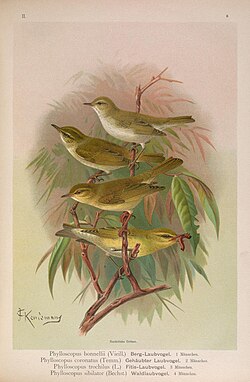
Leaf warblers are small, active, insectivorous passerine birds (perching birds) belonging to the genus Phylloscopus. Known for their restless energy and agility, these birds are often seen flicking their wings as they glean insects from the foliage of trees and bushes. They are versatile foragers, operating across various forest strata, from the high canopy down to the understorey.
While many species possess subtle, muted plumage, they are often distinguished by their unique songs. Most leaf warblers are markedly territorial in both their breeding and wintering grounds, and those inhabiting temperate regions are typically strong migrants.
Key Facts
- Family: Phylloscopidae (established in 2006).
- Genus: Phylloscopus, which currently contains 80 species.
- Diet: Primarily insectivorous, catching prey on the wing or gleaning from leaves.
- Size: Very small, with body masses ranging from 3.5g to 17g.
- Distribution: Found across Eurasia, Africa, and Wallacea, with some breeding as far east as Alaska.
- Identification: Often identified more reliably by song than by their greenish or brownish plumage.
Physical Description
Leaf warblers are characterized by their small size and generally understated coloration. Most species exhibit greenish or brownish upperparts and off-white or yellowish underparts, with plumage that remains relatively consistent throughout the seasons. Their total length typically ranges from 9 to 14.5 cm.
A key anatomical detail used to distinguish them from similar birds, such as Abroscopus species, is the number of tail feathers; leaf warblers possess 12, whereas Abroscopus species have 10. In terms of mass, they are among the lightest passerines in the world, with the Chinese leaf warbler being a notable example of this extreme lightness.
Distribution and Habitat
The family is widely distributed across Eurasia, extending into Africa and Wallacea. The Arctic warbler represents the easternmost breeding limit, reaching as far as Alaska. Many species are long-distance migrants, breeding at high latitudes in Eurasia before traveling to India, southeastern Asia, or Africa for the winter.
An example of this migratory behavior is Tickell's leaf warbler, which breeds in high-elevation scrub on the Tibetan Plateau and in the Himalayas, subsequently moving south to the Himalayan foothills of Burma and India during the winter. Their preferred habitats are primarily forests and scrublands, where many species dwell in the canopy or sub-canopy.
Taxonomy and Classification
The genus Phylloscopus was established in 1826 by German zoologist Friedrich Boie. The name is derived from the Ancient Greek words phullon (leaf) and skopos (seeker). The willow warbler (Phylloscopus trochilus) serves as the type species for the genus.
Historically, these birds were grouped within the Old World warbler family. However, in 2006, Swedish ornithologist Per Alström and colleagues introduced the family Phylloscopidae. Originally, this family included the genus Seicercus, but a 2018 molecular phylogeny study revealed that Seicercus was embedded within Phylloscopus. Consequently, the two were merged, leaving Phylloscopus as the sole genus in the family.
| Rank | Name |
|---|---|
| Kingdom | Animalia |
| Phylum | Chordata |
| Class | Aves |
| Order | Passeriformes |
| Superfamily | Aegithaloidea |
| Family | Phylloscopidae |
| Genus | Phylloscopus |
Frequently Asked Questions
How many species of leaf warblers are there?
There are currently 80 species within the genus Phylloscopus.
What do leaf warblers eat?
They are insectivorous birds that feed by gleaning insects from leaves or catching them while flying.
How can you tell a leaf warbler apart from other similar birds?
Beyond their distinctive songs, they can be distinguished from similar birds like Abroscopus by their tail feathers; leaf warblers have 12 tail feathers, while Abroscopus species have 10.
Where are leaf warblers found?
They are found across Eurasia, Africa, and Wallacea, with some species breeding as far east as Alaska.
Why was the taxonomy of leaf warblers changed in 2018?
A molecular phylogeny study found that the genus Seicercus was embedded within Phylloscopus, leading researchers to merge the two genera into one.