Launch Vehicles: The Engineering Behind Reaching Orbit
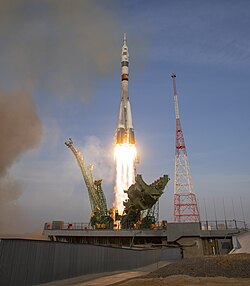
A launch vehicle is a rocket-powered machine designed to transport a payload—such as a crewed spacecraft or a satellite—from the Earth's surface or lower atmosphere into outer space. While the most recognizable form is the multistage, ballistic missile-shaped rocket, the term also encompasses diverse systems like the Space Shuttle. Because these vehicles require advanced aerodynamics and complex technologies, they are characterized by high operating costs.
To achieve a successful orbital mission, a vehicle must lift its payload to the boundary of space, approximately 150 km (93 mi) high, and accelerate it to a horizontal velocity of at least 7,814 m/s (17,480 mph). Vehicles that launch payloads to lower velocities or at steeper angles are classified as suborbital vehicles.
Key Facts
- Orbital Velocity: At least 7,814 m/s is required to maintain orbit.
- Propellants: Common fuels include liquid hydrogen, kerosene, solid fuel, liquid oxygen, and hypergolic propellants.
- Classification: Vehicles are categorized by their payload capacity to Low Earth Orbit (LEO).
- Reusability: Modern innovation focuses on recovering boosters to reduce costs.
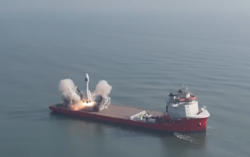
- Launch Platforms: Rockets can launch from land, fixed ocean platforms, mobile ocean platforms, submarines, or even from the air.
Classifying Launch Capacity
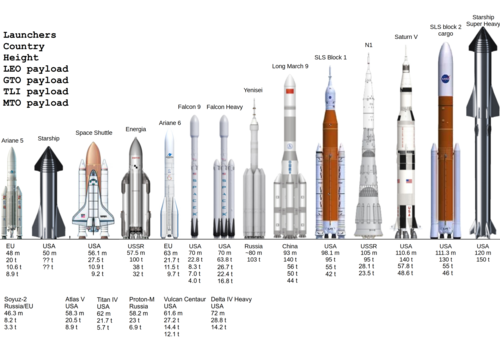
NASA classifies launch vehicles based on their ability to deliver mass to Low Earth Orbit (LEO). This classification helps mission planners select the appropriate vehicle for specific satellite or crew requirements.
| Class | Payload Mass Range | Example Vehicle |
|---|---|---|
| Small-lift | < 2,000 kg (4,400 lb) | Vega |
| Medium-lift | 2,000 to 20,000 kg (4,400 to 44,100 lb) | Soyuz ST |
| Heavy-lift | 20,000 to 50,000 kg (44,000 to 110,000 lb) | Ariane 5 |
| Super-heavy lift | > 50,000 kg (110,000 lb) | Saturn V |
The Evolution of Spaceflight
Following the Space Race, the era of spaceflight has shifted toward international cooperation and increased commercial involvement. While interplanetary probes have visited every planet in our solar system, humans have maintained long-term presence in orbit via stations like Mir and the International Space Station (ISS). China has also joined the ranks of nations capable of independent crewed missions.
The commercial sector has revolutionized the industry through the development of reusable booster systems. A landmark moment occurred in 2020 when SpaceX became the first commercial operator to successfully launch a crewed mission to the ISS using the Crew Dragon Demo-2.
Expendable vs. Reusable Systems
Historically, most launch vehicles have been expendable, meaning they are designed for one-time use. In these systems, boosters separate from the payload and are destroyed during reentry or upon hitting the ground. However, the industry is moving toward reusable launch vehicles, which are designed to be recovered and flown again.
As of 2023, most operational reusable vehicles are partially reusable. This typically involves recovering the first stage (the primary booster) while other components remain expendable. For instance, the Space Shuttle recovered its orbiter and solid rocket boosters, but the large external fuel tank was not reused. In contrast, the SpaceX Falcon 9 is a prominent example of a vehicle designed for booster recovery.
Vertical and Horizontal Landing Technologies
The ability to return a vehicle to its launch site has evolved significantly. Between 1980 and 2010, the US Space Shuttle and the Soviet Buran demonstrated the ability to return the spaceplane portion of a vehicle via horizontal landing. More recently, private companies like SpaceX and Blue Origin have mastered vertical landing.
SpaceX has successfully landed Falcon 9 first stages on both land-based pads and sea-based platforms since 2015. Blue Origin has achieved similar success with its suborbital New Shepard vehicle. Looking forward, the SpaceX Starship aims for full reuse of both the booster and the upper stage, a design intended to support massive payloads for interplanetary missions.
Advanced Mission Architectures
Distributed Launch and Refueling
Distributed launch is a strategy where multiple spacecraft launches are used to achieve a single complex goal. This is essential for constructing massive structures like the ISS or for performing in-space propellant transfer. By refueling a vehicle in orbit, mission architects can significantly increase its delta-V—the change in velocity required to perform maneuvers—enabling deep-space or cislunar missions that a single launch could not support.
Frequently Asked Questions
What is the difference between orbital and suborbital flight?
An orbital vehicle must reach a specific altitude (approx. 150 km) and a high horizontal velocity (7,814 m/s) to stay in orbit. Suborbital vehicles reach lower velocities or are launched at steeper angles that do not result in a stable orbit.
How are rockets classified?
Rockets are primarily classified by their payload capacity to Low Earth Orbit (LEO), ranging from small-lift to super-heavy lift vehicles.
What does it mean if a rocket is "partially reusable"?
Partial reusability means that only certain components of the rocket, such as the first-stage booster or specific engines, are recovered and refurbished for future flights, while other parts are discarded.
What is a sounding rocket?
Sounding rockets are similar to small-lift launch vehicles but are generally even smaller and are not designed to place payloads into orbit.
Why is horizontal velocity so important in spaceflight?
To achieve orbit, a vehicle must travel horizontally at extreme speeds to prevent gravity from pulling it back to Earth, effectively "falling" around the planet instead of into it.