Land Command: The Evolution of British Army Operational Control
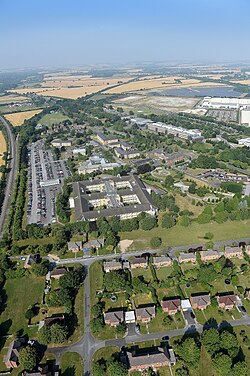
From 1995 to 2008, Land Command (also known as HQ Land) served as the primary military command and formation for the British Army. Headquartered at Erskine Barracks in Fugglestone St Peter, Wiltshire, this command centralized the management of combat and combat support troops, streamlining how the United Kingdom projected military power both at home and abroad.
The establishment of Land Command marked a significant shift in military administration, moving away from fragmented regional commands toward a unified structure that could better prioritize operational commitments and reduce overhead costs.
Key Facts
- Operational Period: 1995 to 2008.
- Headquarters: Originally Erskine Barracks, Wiltshire; later moved to Marlborough Lines, Andover.
- Scope: Controlled approximately 72% of the Army's manpower, including regular troops, reservists, and civil servants.
- Primary Goal: To unify combat and combat support units under a single commander-in-chief to improve operational efficiency.
- Successor: Amalgamated with HQ Adjutant General in 2008 to become HQ Land Forces.
The Path to Centralization: Predecessors of Land Command
The drive toward a centralized command began in 1967 within the Ministry of Defence. This led to the creation of the Army Strategic Command (STRATCO) on April 1, 1968. STRATCO was formed following the government's decision to withdraw British troops from bases east of Suez, shifting the focus of defense toward Europe and the North Atlantic.
STRATCO's primary mission was to manage strategic reserves and ensure that field force units were properly trained, equipped, and prepared for overseas deployment. It managed commitments to NATO, bilateral agreements, and residual colonial responsibilities. The command consisted of the 3rd and 5th Infantry Divisions, though the 5th Division functioned largely as a holding organization and was disbanded in 1970.
Between 1972 and the mid-1990s, responsibility for land forces in the British Isles fell to United Kingdom Land Forces (UKLF), which operated alongside the British Army of the Rhine (BAOR).
The Era of HQ Land Command (1995–2008)
On April 1, 1995, HQ Land Command was officially established, assuming control of nearly all British Army combat and combat support units. This included troops in the UK, Germany, Nepal, Brunei, and training units in Canada, Kenya, and Belize. At its inception, the command comprised 69,200 regular troops, 59,700 reservists, and 14,200 civil servants.
By consolidating these forces, the commander-in-chief—initially General Sir John Wilsey—could more effectively manage the Arms Plot (the routine rotation of infantry, artillery, and armoured units) and the Operational Tour Plot for duties in the UN, the Falkland Islands, and Northern Ireland.
Despite its broad reach, certain units remained outside its jurisdiction, including British Forces Cyprus, the Falkland Islands, units under the Director Special Forces, and Headquarters Northern Ireland. In Northern Ireland, the General Officer Commanding reported directly to the Secretary of State for Northern Ireland to support civil power.
Organizational Structure and Components
Land Command initially operated through eight formations led by Major Generals. However, a 2003 reorganization known as the LAND mark split the command into two distinct sub-organizations:
- Field Army: Focused on deployable forces, including the 1st Armoured Division, 3rd Mechanised Division, Theatre Troops, and Joint Helicopter Command.
- Regional Forces: Responsible for regenerative divisions (2nd, 4th, and 5th Divisions), London District, and the UK Support Command in Germany.
The regenerative divisions acted as military districts within the UK, capable of generating field formations only in the event of a general war. These were eventually disbanded in 2012. Meanwhile, the London District focused on the defense of the capital and the administration of ceremonial units, such as those at the Tower of London.
Deployable and Specialist Brigades
By the turn of the millennium, the Army maintained seven genuinely deployable brigade groups, including the 16 Air Assault Brigade (formed in 1999). In 2007, the 11 Light Brigade was temporarily created to manage rotations for Operation Herrick in Afghanistan.
Specialist logistics were handled by 101 and 102 Logistic Brigades, while the 104th Logistic Support Brigade managed the specialized units required for overseas deployment, such as port units and pioneers.
Other regional brigades focused on administering Territorial Army units and coordinating support for civil authorities, such as during the 2001 foot and mouth disease outbreak.
| Period | Command Name | Primary Focus | Key Headquarters |
|---|---|---|---|
| 1968–1971 | Army Strategic Command (STRATCO) | Strategic reserves and post-Suez transition | Erskine Barracks |
| 1972–1995 | UK Land Forces (UKLF) | Land forces within the British Isles | Wilton |
| 1995–2008 | Land Command (HQ Land) | Unified combat and combat support control | Erskine Barracks |
| 2008–Present | HQ Land Forces | Amalgamated command (Project Hyperion) | Marlborough Lines |
Frequently Asked Questions
What was the primary purpose of creating Land Command in 1995?
The primary purpose was to bring virtually all of the British Army's conventional fighting forces under a single command. This allowed the military to better prioritize operational commitments and reduce the high overhead costs associated with maintaining separate four-star commands in the UK and Germany.
Which units were not under the control of Land Command?
Major exceptions included British Forces Cyprus, the Falkland Islands, units under the Director Special Forces, and Headquarters Northern Ireland.
What was the difference between the Field Army and Regional Forces?
The Field Army consisted of deployable divisions and troops ready for immediate overseas action. Regional Forces managed regenerative divisions that functioned as military districts within the UK, providing administration and home defense support.
What happened to Land Command in 2008?
Under 'Project Hyperion,' HQ Land Command amalgamated with HQ Adjutant General to become HQ Land Forces. Following this change, the headquarters eventually moved to Marlborough Lines in Andover on June 23, 2010.
What was the role of the 16 Air Assault Brigade?
Formed in 1999 as part of the Strategic Defence Review, the 16 Air Assault Brigade was created by merging the 24 Airmobile Brigade and elements of the 5th Airborne Brigade to serve as one of the Army's primary deployable brigade groups.