Lake Carnegie: A Historic Hub for Rowing and Recreation in New Jersey
Located in the heart of central New Jersey, Lake Carnegie is more than just a scenic reservoir; it is a cornerstone of athletic excellence and a site of significant historical value. Straddling the borders of Princeton, West Windsor, Plainsboro, and South Brunswick across Mercer and Middlesex counties, the lake serves as a vital resource for both the academic community and the general public.
The reservoir was created by damming the Millstone River, though its lower section follows the valley of the Stony Brook, its largest tributary. Along its eastern shore lies the Delaware and Raritan Canal and its accompanying tow path, adding to the area's scenic and historical appeal.
Key Facts
- Established: 1906, funded by philanthropist Andrew Carnegie.
- Primary Use: Home to the Princeton University rowing team and the US Olympic rowing team.
- Historic Status: Listed on the National Register of Historic Places (NRHP) and New Jersey Register of Historic Places (NJRHP) since 1990.
- Geography: A 262-acre reservoir fed by the Millstone River.
- Public Access: Open for fishing, ice skating, and picnicking.
The History of Lake Carnegie
Before the lake existed, Princeton's varsity crew was forced to practice on the narrow Delaware and Raritan Canal, where they had to navigate around commercial shipping traffic. The dream of a dedicated rowing lake persisted for years but lacked funding until a chance encounter in 1902.
Howard Russell Butler, a member of the class of 1876, was commissioned to paint a portrait of Andrew Carnegie. During the sessions, Carnegie spoke of the lochs he had built in Scotland. Butler shared the rowing team's aspirations, prompting Carnegie to investigate the feasibility of the project. After a New York engineering firm estimated the cost at $118,000, Carnegie authorized the construction.
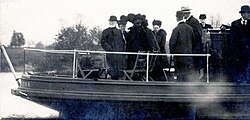
To keep land prices low and avoid local suspicion, Princeton alumni first purchased the necessary farmland before selling it to Carnegie. Construction began in 1905, and the lake officially opened on December 5, 1906. The ceremony was attended by Carnegie and then-University President Woodrow Wilson. A humorous exchange later occurred when Wilson sought a second donation; Carnegie replied, "I have already given you a lake," to which Wilson reportedly responded, "We needed bread and you gave us cake."
Over the decades, the lake has attracted notable figures; Albert Einstein, who moved to Princeton in 1933, was known to sail on its waters frequently.
Architecture and Design
The Lake Carnegie Historic District is recognized for its specific aesthetic and structural contributions. The boathouse, designed by architect Pennington Satterthwaite, features the Mission Gothic style, while the overall landscape was shaped by landscape architect Howard Russell Butler.
| Feature | Detail |
|---|---|
| Total Area | 262 acres (106 ha) |
| Primary Inflow/Outflow | Millstone River |
| NRHP Reference No. | 90001000 |
| NJRHP No. | 1747 |
| Uniform Depth (1971) | 9 feet (at 35 feet from shoreline) |
Environmental Challenges and Water Quality
Maintaining the lake has presented several technical challenges. Due to its initial shallow depth, the reservoir suffered from siltation (the accumulation of sediments) carried by the Stony Brook, as well as flooding. To combat this, the lake has been dredged three times: in 1927, the late 1930s, and 1971.
Water quality has also declined due to rapid population growth in surrounding towns, which led to sewage runoff from the Millstone River. In 2002, the U.S. Environmental Protection Agency (EPA) rated the lake as "impaired," meaning it cannot support all its designated uses. Pollution sources include:
- Automotive waste (oil and gas)
- Chemicals from fertilizers and pesticides
- Litter and goose droppings
These issues have resulted in unsafe mercury levels, leading to official advisories regarding fish consumption. However, local volunteer groups continue to work toward restoration through water testing, litter removal, and educational outreach.
Frequently Asked Questions
Who funded the creation of Lake Carnegie?
The lake was funded by the noted businessman and philanthropist Andrew Carnegie, who donated the money for its construction to Princeton University.
What sports are primarily associated with the lake?
The lake is most famous for rowing, serving as the training ground for both the Princeton University varsity crew and the US Olympic rowing team.
Can the general public use Lake Carnegie?
Yes, while privately owned, the lake is available for public activities including fishing, picnicking, and ice skating.
What fish species can be found in the lake?
Common species include largemouth bass, carp, pickerel, crappie, and channel catfish, with occasional rainbow and brown trout entering from the Stony Brook.
Why is there a fish consumption advisory for the lake?
The EPA has identified the lake as impaired due to various pollutants, and unsafe levels of mercury have led to advisories regarding the consumption of fish caught in the reservoir.