Kingston, New Jersey: A Historic Village on the Millstone River
Nestled along the banks of the Millstone River in the Raritan Valley region, Kingston, New Jersey, is a unique community that bridges two counties. As an unincorporated community and a census-designated place (CDP), Kingston spans the border of South Brunswick Township in Middlesex County and Franklin Township in Somerset County. Its proximity to Princeton in Mercer County further integrates it into the cultural and historical fabric of central New Jersey.
Kingston holds a rare distinction: it is the only village center officially designated by the New Jersey State Planning Commission. To maintain its distinct character, the Kingston Village Advisory Committee was established in 2001, consisting of members from both South Brunswick and Franklin townships who meet annually to address local issues.
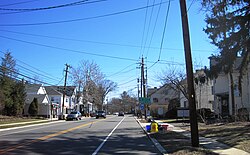
Key Facts
- Location: Spans Middlesex and Somerset Counties (South Brunswick and Franklin Townships).
- Population: 1,581 residents as of the 2020 census.
- Geography: Situated along the Millstone River and New Jersey Route 27.
- Historic Status: Home to six sites or districts listed on the National Register of Historic Places.
- Unique Designation: The only officially designated village center by the NJ State Planning Commission.
History and Early Settlement
The foundations of Kingston were laid in the early 18th century when Jediah Higgins purchased 1,000 acres of land from Native Americans. The village's early prominence was driven by its strategic location on the Lenape Assunpink Trail at the crossing of the Millstone River, eventually becoming a key segment of the King's Highway.
Because it sat at the intersection of a heavily traveled road and a navigable river, Kingston evolved into a bustling commercial hub characterized by its mills and taverns. This combination of water and road transport made it one of the most active villages in the region during its early years.
Geography and Infrastructure
The heart of the village is New Jersey Route 27, which serves as Main Street. This thoroughfare connects Kingston to the center of Princeton (3.5 miles southwest) and the Middlesex county seat of New Brunswick (12 miles northeast).
The community covers a total area of 1.94 square miles, with 1.87 square miles of land and 0.07 square miles of water. The Millstone River, which defines the western edge of the village, flows north as a tributary of the Raritan River, contributing to the watershed of Lower New York Bay.
Demographics and Population Trends
Since first appearing as a CDP in the 1990 census, Kingston has seen steady population growth. The 2020 census recorded a total population of 1,581, with the majority (1,272) residing in South Brunswick Township and 309 in Franklin Township.
| Census Year | Total Population | Percentage Change |
|---|---|---|
| 1990 | 1,047 | — |
| 2000 | 1,292 | +23.4% |
| 2010 | 1,493 | +15.6% |
| 2020 | 1,581 | +5.9% |
Racial Composition (2020 Census)
The community has become increasingly diverse over the last two decades. As of 2020, the population consists of 55.34% White (Non-Hispanic), 20.37% Asian (Non-Hispanic), 13.09% Hispanic or Latino, 6.70% Black or African American (Non-Hispanic), and 3.35% Mixed race or Multiracial.
Religious Heritage
Kingston Presbyterian Church
Organized in 1723, the Kingston Presbyterian Church began in a log building by the Millstone River. After the original structure burned in 1791, a new building was erected in 1792. By 1852, the congregation moved to a larger facility on Main Street, which was expanded in the late 1940s and late 1980s to include Sunday school rooms and a new kitchen.
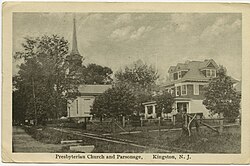
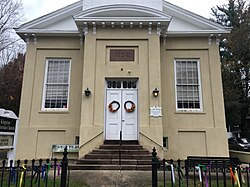
The church experienced a decline in the late 1700s as the nearby village of Princeton expanded, but entered a period of renewed growth starting in 1800, eventually sending foreign missionaries to China.
Kingston United Methodist Church
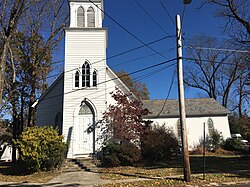
The Methodist presence in Kingston began in February 1878, sparked by revival meetings led by evangelist Miss Lizzie Sharp. A group of local residents formed a congregation and purchased a site on Church Street for $250. Construction began on September 20, 1878, and the church was dedicated on January 30, 1879.
Historic Landmarks and Notable Figures
Kingston is deeply integrated into the Millstone River Valley Scenic Byway and is surrounded by five historic districts. Several sites are listed on the National Register of Historic Places:
- Rockingham Historic Site: George Washington's final wartime headquarters in 1783.
- Delaware and Raritan Canal Historic District
- Kingston Mill Historic District
- Kingston Village Historic District
- King's Highway Historic District
- Princeton Nurseries Historic District
The community has also been associated with notable individuals, including folk singer Cynthia Gooding and physicist and New Jersey General Assembly member Andrew Zwicker.
Frequently Asked Questions
Which counties does Kingston, New Jersey span?
Kingston is located along the border of Middlesex County (South Brunswick Township) and Somerset County (Franklin Township).
What makes Kingston's designation unique in New Jersey?
Kingston is the only village center that has been officially designated by the New Jersey State Planning Commission.
What is the significance of the Rockingham Historic Site?
Rockingham served as George Washington's last wartime headquarters in 1783 and is listed on the National Register of Historic Places.
How has the population of Kingston changed since 1990?
The population has grown steadily from 1,047 residents in 1990 to 1,581 residents by the 2020 census.
What major road serves as the main street of the village?
New Jersey Route 27 serves as Kingston's Main Street, connecting the village to Princeton and New Brunswick.