Korean Fortresses: The Architecture of a Mountain Nation
Korea has long been described as a "country of fortresses," a reputation earned through a unique military architectural tradition that spans centuries. From the era of the Three Kingdoms to the Joseon dynasty, Koreans developed a sophisticated system of fortifications tailored to the peninsula's rugged geography. With nearly 2,400 mountain fortress sites discovered across the region, these structures represent a profound intersection of strategic defense and environmental adaptation.
Key Facts
- Scale: Approximately 2,400 mountain fortress sites have been identified in Korea.
- Origins: The tradition was pioneered by the Goguryeo kingdom and later adopted by Baekje and Silla.
- Material: Unlike Chinese brick-based fortifications, Korean fortresses were built using a stone culture.
- Strategic Design: Mountain fortresses (sanseong) served as emergency refuges for city dwellers during invasions.
- Global Reach: Korean-style fortifications influenced early construction in Japan via Baekje immigrants.
- UNESCO Recognition: Both Hwaseong Fortress and Namhansanseong are designated World Heritage Sites.
The Evolution and Philosophy of Korean Fortifications
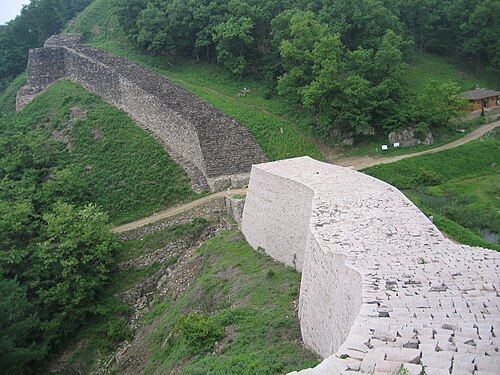
The development of Korean fortresses was deeply rooted in a stone culture. While Chinese fortifications typically relied on an "earth culture"—utilizing bricks and stamped earth on flat plains—Korean engineers utilized the natural mountainous terrain, constructing walls from stone. This approach allowed the fortifications to blend into the landscape, maximizing the defensive advantages of steep slopes.
This architectural style originated with the Goguryeo kingdom and eventually spread to the neighboring Baekje and Silla kingdoms. The tradition was further refined during the Goryeo and Joseon periods. The influence of this style extended beyond the peninsula; ruins of Goguryeo fortresses have been found in present-day China and Mongolia, and early fortifications in Japan were supervised by immigrants of Baekje origin.
Among the most famous early examples is the Ansi Fortress, which is noted for successfully defending against Tang Taizong during the Goguryeo–Tang War.
Types of Korean Fortresses
Korean fortifications are categorized by their location and purpose. The most prominent types include:
- Sanseong: Mountain fortresses used as strategic retreats.
- Eupseong: City fortresses designed to protect urban centers.
- Other specialized types: Including pyeongjiseong, gwanseong, jangseong, and chaekseong.
Mountain Fortresses (Sanseong)
Mountain fortresses were the most common type of fortification because they countered the primary threat of the era: mounted archers from the North. These invaders generally lacked the expertise or capacity to conduct complex mountain sieges. Consequently, these fortresses often featured a single-layered wall and a main entrance supplemented by secret exits.
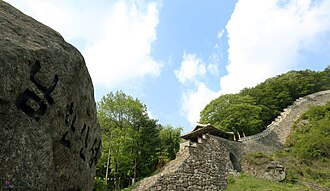
Larger sanseong often functioned as self-sustaining communities. They frequently contained wells and Buddhist temples, where monks were responsible for maintaining the walls and tending to small farms. Some even housed a HaengGung—a secondary royal palace designed to accommodate the King during times of crisis. Examples of fortresses containing HaengGungs include Namhansanseong, Bukhansanseong, and Jindo Sanseong.
City Walls (Eupseong)
City walls typically served as the first line of defense for towns and villages. These walls were generally short and straight, rarely exceeding 10 feet in height. Unlike Japanese walls, Korean walls were built upright, a design made possible by the lack of significant earthquake activity on the peninsula. Their relatively short height compared to Chinese walls is attributed to the long periods of peace during the Joseon dynasty and the reliance on nearby mountain fortresses for ultimate refuge.
Certain city walls featured specialized architecture, such as Water Gates, which allowed rivers to flow in and out of the city without compromising security. While towers are rare in older city walls—such as the Seoul City Wall—they appear in later constructions like the Hwaseong Fortress.
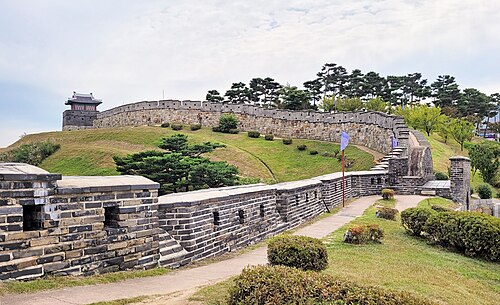
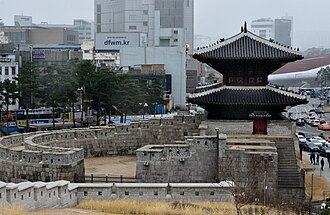
Some city gates were further protected by a smaller outer wall, a feature seen at Paldalmun in Suwon and Dongdaemun in Seoul.
Summary of Korean Fortress Characteristics
| Feature | Mountain Fortress (Sanseong) | City Wall (Eupseong) |
|---|---|---|
| Primary Purpose | Emergency refuge and strategic defense | Daily urban protection |
| Terrain | Steep mountainous slopes | Flat or undulating city land |
| Key Features | HaengGung (Royal Palaces), secret entrances | Water Gates, guarded city gates |
| Wall Height | Variable based on terrain | Typically under 10 feet |
| Strategic Advantage | Difficult for mounted archers to siege | Controlled entry/exit to urban centers |
Frequently Asked Questions
How do Korean fortresses differ from Chinese fortresses?
Korean fortresses were based on a stone culture and built into natural mountainous terrain, whereas Chinese fortresses were based on an earth culture, utilizing bricks and stamped earth on flat land.
What was the purpose of a HaengGung?
A HaengGung was a small royal palace located within a fortress, designed to provide a secure residence for the King if he had to flee the capital during an emergency.
Why were mountain fortresses more common than city walls?
Most invaders of Korea were mounted archers from the North who lacked the experience and capacity to conduct mountain sieges, making high-altitude fortifications highly effective.
Which Korean fortresses are recognized by UNESCO?
The Hwaseong Fortress and Namhansanseong are both designated as UNESCO World Heritage Sites.
What is a Water Gate?
A Water Gate is a specialized architectural feature in some Korean city walls that allows river water to flow into and out of the city while maintaining the wall's defensive integrity.