Exploring Korea University: A Legacy of Liberty, Justice, and Truth
Founded over a century ago, Korea University stands as one of South Korea's most prestigious private research universities. Guided by its motto, Libertas, Justitia, Veritas (Liberty, Justice, and Truth), the institution has evolved from a small nationalistic college into a global academic powerhouse. Located in the Seongbuk District of Seoul, the university is recognized not only for its rigorous academic standards but also for its deep historical significance in the shaping of modern Korea.
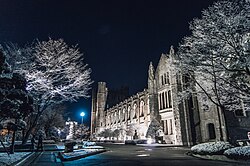
Key Facts
- Established: May 5, 1905 (formerly Bosung College)
- Motto: Liberty, Justice, Truth
- Campus Location: Seongbuk District, Seoul, South Korea
- Official Colors: Crimson
- Mascot: Hwanho (the Tiger)
- Global Ranking: 61st in the 2026 QS World University Rankings
A Rich Historical Journey
The Bosung College Era
The university's roots trace back to May 5, 1905, when it was established as Bosung College. Founded by Lee Yong-Ik, the Treasurer of the Royal Household, the institution operated under the principle that "Education Saves the Country." With a royal grant from Emperor Gojong, the college initially offered two-year programs in Law and Plutology. During the colonial period (1910–1945), Bosung College served as a vital symbol of national pride and identity.
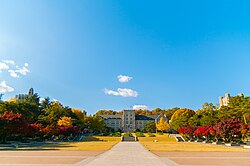
Post-Independence and Expansion
Following the Korean War, the university temporarily relocated to Daegu before returning to its Seoul roots. The mid-1950s marked a period of significant growth, characterized by academic restructuring and the establishment of specialized research institutes. A major milestone occurred in 1971 when the university integrated several colleges from Woosuk University, including Medicine, Liberal Arts, and Sciences, significantly expanding its academic scope.
The 1970s and 1980s saw a rapid development of infrastructure and specialized departments. The university opened a massive Central Library in 1978 and established the Korea University Medical Center, which eventually expanded to include multiple hospitals such as Haewha, Guro, Yeoju, and Ansan. During this era, the university also established a branch campus in Jochiwon to accommodate growing enrollment.
![The protest held by Korea University students against the authoritarian rule of Syngman Rhee played a pivotal role in sparking the April Revolution[18][19]](/images/33/f5/33f531b2b8bfc9b32c407f8ce04bf6c1636979d81b913e685ead155795359c69.jpg)
Modern Innovation and Global Standing
Entering the 21st century, Korea University has focused on internationalization and interdisciplinary research. The university has formed academic partnerships with institutions like the University of British Columbia and has achieved international certifications for its business programs, including AACSB and EQUIS. Today, the university is a leader in diverse fields ranging from Artificial Intelligence to Biotechnology.
Academic Excellence and Rankings
Korea University offers a vast array of academic programs organized into 27 colleges and schools. With 69 academic departments, students can pursue specialized studies in fields such as Law, Business, Engineering, Medicine, and Media and Communication. The university is also known for its cutting-edge interdisciplinary programs, including Financial Engineering, Brain and Cognitive Sciences, and Smart Mobility.
Global Recognition
The university consistently ranks among the top institutions in Asia and the world. Its reputation is reflected in several major global indices:
| Ranking Organization | Category | Rank/Position |
|---|---|---|
| QS World University Rankings | General (2026) | 61 |
| QS Asia | General | 13 |
| THE World | General | =156 |
| ARWU World | Research | 201–300 |
Campus Life and Facilities
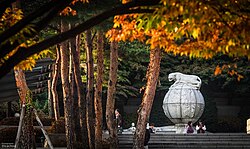
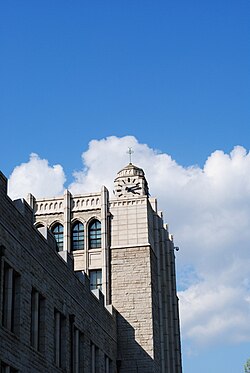
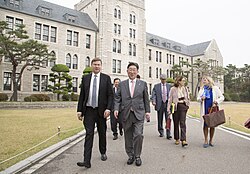
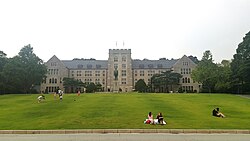
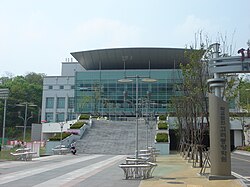
The sprawling 233.8-acre urban campus is a blend of historic architecture and modern technological hubs. Facilities range from the massive LG-POSCO Building to specialized research centers like the Institute of Viral Diseases, which is a WHO Research Collaborative Institution. The campus also supports a vibrant student life, characterized by the famous rivalry with Yonsei University and a strong sense of community represented by the "Tigers" nickname.
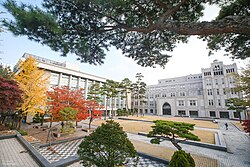
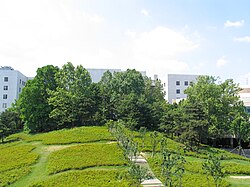
For students focused on the sciences, the campus provides advanced environments such as the Science Library and the Aegineung area, ensuring that research and study are supported by world-class infrastructure.
Frequently Asked Questions
What is the motto of Korea University?
The official motto is "Libertas, Justitia, Veritas," which translates to "Liberty, Justice, and Truth" in English.
How does Korea University rank globally?
In the 2026 QS World University Rankings, Korea University is ranked 61st in the world. It also holds a strong position in Asia, ranking 13th in the QS Asia rankings.
What are the university's official colors and mascot?
The official color of Korea University is Crimson, and the mascot is the Tiger, known as Hwanho.
Does Korea University have multiple campuses?
Yes, in addition to the main campus in Seoul, the university also operates the Sejong Campus, which was established in 1980.
Is the business school internationally recognized?
Yes, the business programs have obtained international certifications from the AACSB (Association to Advance Collegiate Schools of Business) and EQUIS (European Quality Improvement System).