Kitbuqa Noyan: The Mongol General and the Battle of Ain Jalut
In the mid-13th century, the Mongol Empire expanded with a speed and brutality that reshaped the map of the known world. Among the key figures of this expansion was Kitbuqa Noyan, a high-ranking general and confidant of Hulagu Khan. An Eastern Christian from the Naimans—a group subservient to the Mongol Empire—Kitbuqa played a pivotal role in the Mongol conquests of the Middle East, eventually becoming the face of the empire's ambition in the Levant.
Key Facts
- Identity: An Eastern Christian of the Naiman people.
- Role: Lieutenant and general under Hulagu Khan of the Ilkhanate.
- Major Achievements: Participated in the sack of Baghdad (1258) and the conquest of Damascus (1260).
- Defining Defeat: Captured and executed at the Battle of Ain Jalut in 1260.
- Historical Significance: His defeat marked the first major halt to Mongol westward expansion.
Rise Through the Mongol Ranks
Kitbuqa's military career was defined by his loyalty to Hulagu Khan. In 1252, under the orders of Möngke Khan, Kitbuqa was appointed to lead the advance guard of Hulagu's army. His primary objective was the neutralization of the fortresses held by the Nizari Ismailis.
As the army pushed into western Persia, Kitbuqa managed a series of successful sieges. His strategic value was further proven in 1258 during the sack of Baghdad, where he commanded one of the army's flanks. By 1260, he assisted in the conquest of Damascus, cementing his status as one of the most capable generals in the Ilkhanate army.
Historical accounts from the Templar of Tyre describe a triumphant entry into Damascus featuring three Christian leaders: Kitbuqa, Hethum I of Armenia, and Bohemond VI of Antioch. While modern historians view this specific narrative as apocryphal, it highlights Kitbuqa's unique position as a Christian general leading a Mongol force.
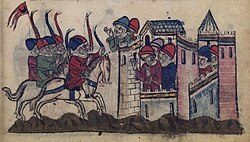
Command of the Levant
The trajectory of Kitbuqa's career shifted when internal turmoil struck the Mongol Empire. Following the death of the Great Khan Möngke, Hulagu Khan withdrew the majority of his forces to attend a ceremony in Mongolia. Kitbuqa was left in command of the remaining troops in Syria and Palestine.
During this period, Kitbuqa was noted for his favorable treatment of local Christians, a gesture attributed to his own lineage and faith. His primary mission was to maintain peace in the region while continuing the Mongol push south toward the Mamluk Sultanate, based in Cairo.
| Period/Event | Role/Action | Outcome |
|---|---|---|
| 1252 | Advance Guard Leader | Sieges of Nizari Ismaili fortresses |
| 1258 | Flank Commander | Sack of Baghdad |
| 1260 | Regional Commander | Conquest of Damascus |
| 1260 (Sept) | Army Commander | Defeat and death at Ain Jalut |
The Battle of Ain Jalut
In the spring of 1260, Kitbuqa led a force estimated between 10,000 and 20,000 troops in an attempt to invade Egypt. However, the Mamluks had strategically negotiated a passive truce with the Crusaders, allowing Mamluk forces to move north through Crusader territory and resupply near Acre.
The two forces clashed at the Battle of Ain Jalut (meaning "Spring of Goliath") in Galilee. The depleted Mongol army was decisively defeated, and Kitbuqa was captured. Even in captivity, Kitbuqa remained defiant; when brought before the Mamluk sultan, he taunted the Mamluk emirs for betraying their own masters, contrasting it with his own unwavering loyalty to Hulagu.
Kitbuqa was executed by the veteran Mamluk Jamal al-Din Akoush al-Shamsy. Despite being enemies, Mamluk histories record Kitbuqa with respect, depicting him as a courageous warrior who chose death in battle over the shame of retreat.
Legacy and Historical Impact
The defeat at Ain Jalut was a watershed moment in world history. It was the first time a Mongol advance had been decisively halted and failed to be avenged. While the Mongols continued to invade other regions like Japan, Poland, and Hungary, their westward expansion into Arabia and deeper into Africa was effectively stopped.
The expected retaliation from Hulagu Khan never materialized due to a conflict between Hulagu and his cousin Berke of the Golden Horde. This internal division, coupled with the loss of Kitbuqa, signaled the beginning of the end for the Mongol Empire's expansion in the West.
Frequently Asked Questions
Who was Kitbuqa Noyan?
Kitbuqa Noyan was an Eastern Christian general of the Naiman people who served as a high-ranking lieutenant to Hulagu Khan during the Mongol invasions of the Middle East.
What was the significance of the Battle of Ain Jalut?
The Battle of Ain Jalut was the first major defeat of the Mongol army in the West, halting their expansion into Egypt and Arabia and marking a turning point in the Mongol Empire's territorial growth.
Why was Kitbuqa's religious background notable?
As an Eastern Christian, Kitbuqa was known to honor and protect Christians in the territories he controlled, and he is often associated with other Christian rulers of the era in historical accounts of the conquest of Damascus.
How did Kitbuqa die?
Kitbuqa was captured by the Mamluks during the Battle of Ain Jalut in September 1260 and was subsequently executed by Jamal al-Din Akoush al-Shamsy after refusing to submit with humility.
Why didn't Hulagu Khan avenge Kitbuqa's death?
Hulagu was unable to launch a retaliatory strike because of an internal power struggle and conflict with his cousin Berke, the leader of the Mongol Golden Horde.