Kings Cross Engine Sheds: A History of Railway Infrastructure
The operational heart of any major railway terminus lies in its engine sheds—the specialized facilities used for the storage, maintenance, and preparation of locomotives. At Kings Cross, the evolution of these buildings reflects the shifting partnerships and growing demands of the British railway network during the 19th and early 20th centuries.
The Main Running Shed
Constructed in 1850, the Main Shed served as a primary hub for locomotive operations. It featured twenty-five roads (the parallel tracks leading into the shed) to accommodate a large fleet. Unlike many sheds of the era, it lacked a turntable in front; instead, the building was designed with a shallow curve, giving the structure a distinctive architectural appearance.
The Midland Roundhouse
In December 1857, the Midland Railway (MR) negotiated running powers with the Great Northern Railway (GNR) to operate on the main line from Hitchin to King's Cross. As part of this agreement, the GNR funded the construction of engine sheds for the MR. In return, the Midland Railway paid for its water consumption and a six percent interest rate for the rent of the premises.
The resulting facility, known as the Roundhouse or the Derby Shed, opened in 1859. It became a significant installation, featuring twenty-four roads arranged around a central turntable with a diameter of forty feet.
This arrangement changed by 1861 when the Midland Railway established its own Goods and Minerals Station at Agar Town. Following their departure, the Great Northern Railway repurposed the Roundhouse first as a carriage and wagon shop, and later as a running shed for tank locos (locomotives that carry their own water and fuel in tanks rather than a separate tender). The Roundhouse was eventually demolished in 1931, and the site was used for open-air stabling until the construction of the Met Shed.
The Met Shed
Following the demolition of the Roundhouse, the Met (Metropolitan) Shed was established in 1932. This facility was a hybrid construction: the front section utilized part of the original 1850 running shed, while the rear was formed from an 1862 extension of the carriage and wagon shops. The Met Shed was dedicated to housing the tank engines and locomotives responsible for the inner and outer suburban services operating out of Kings Cross.
Site Access and Layout
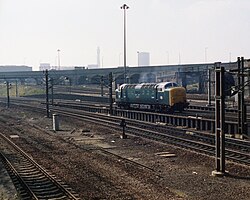
The geography of the site was defined by the flow of traffic. Most sidings from the Top Shed and the Kings Cross Goods Yard converged at the Freight Terminal junction near Belle Isle. This convergence created a characteristic fan-shaped layout for both the Top Shed and the Goods Yard areas.
Key Facts
- Main Shed (1850): Featured 25 roads and a unique shallow-curve design.
- Midland Roundhouse (1859): Included a 40-foot diameter turntable and 24 roads.
- Financial Agreement: The GNR built the Roundhouse; the MR paid rent (6% interest) and water costs.
- Met Shed (1932): A combined structure serving suburban services.
- Layout: The area near Belle Isle featured a fan-shaped layout due to the Freight Terminal junction.
| Facility | Opened/Built | Key Feature | Primary Use |
|---|---|---|---|
| Main Shed | 1850 | 25 roads, curved shape | General locomotive running |
| Midland Roundhouse | 1859 | 40ft turntable, 24 roads | Midland Railway engines / Tank locos |
| Met Shed | 1932 | Hybrid construction | Suburban services |
Frequently Asked Questions
Why was the Main Shed built in a curve?
The Main Shed was built in a shallow curve because there was no turntable located in front of it, and this design gave the building its unique appearance.
What was the agreement between the GNR and the Midland Railway?
The Great Northern Railway provided the engine sheds at its own cost, while the Midland Railway paid for water usage and a six percent interest rate for the rent of the premises.
What happened to the Roundhouse after the Midland Railway left?
The Great Northern Railway took over the facility, using it first as a carriage and wagon shop and later as a running shed for tank locomotives before its demolition in 1931.
What locomotives were housed in the Met Shed?
The Met Shed housed tank engines and locomotives that operated the inner and outer suburban services from Kings Cross.
What caused the fan-shaped layout of the Top Shed and Goods Yard?
The layout was caused by the way most sidings funneled down into the Freight Terminal junction near Belle Isle.