King's College London: A Legacy of Academic Excellence and Innovation
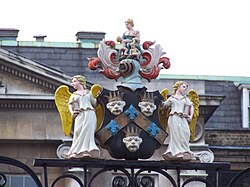
King's College London (KCL) is a prestigious public research university located in the heart of England's capital. Known by its Latin name Collegium Regale Londinense, the institution operates under the motto Sancte et Sapienter ("With Holiness and Wisdom"). As a member of the elite Russell Group and the University of London, KCL has established itself as a global leader in research, teaching, and healthcare education.
From its royal foundations to its modern status as a powerhouse of innovation, the university blends historic tradition with cutting-edge scientific advancement. Today, it serves a diverse student body of over 40,000 individuals across multiple urban campuses.
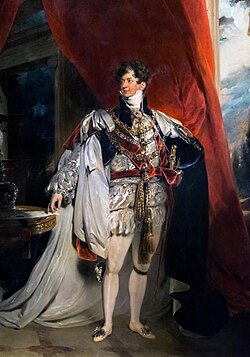
Key Facts
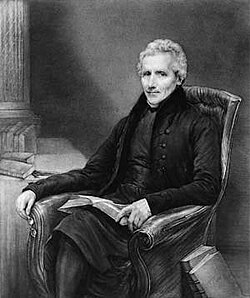
- Established: 14 August 1829 (with medical teaching dating back to 1561).
- Current Patron: King Charles III.
- Student Population: 40,870 students (2024/25), including 23,200 undergraduates and 17,670 postgraduates.
- Financial Standing: An endowment of £340.8 million (2025) and a budget of £1.377 billion (2024/25).
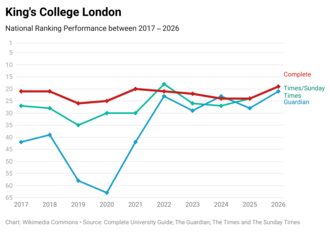
- Global Standing: Ranked 37th in the QS 2027 rankings and 38th in THE 2026.
- Mascot: Reggie the Lion.
A Storied History
Foundation and Early Conflict
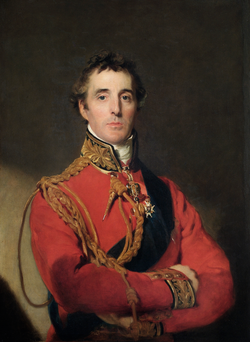
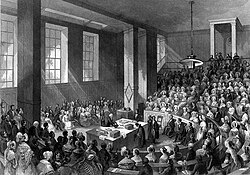
The university was formally established in 1829, though its roots in medical education extend much further back to 1561. The foundation was not without drama; the Duke of Wellington, then prime minister, famously fought a duel in Battersea Fields on March 21, 1829, over his support for the rights of Irish Catholics and the independence of the newly formed college.
Evolution Through the Centuries
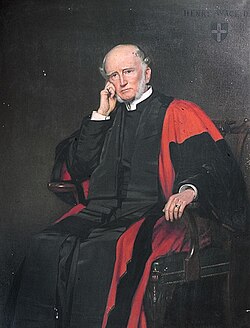
Throughout the 19th and 20th centuries, the institution's governance was shaped by several Acts of Parliament, including the King's College London Acts of 1882, 1903, and 1978. These legislative milestones helped transition the college into the modern university structure it maintains today. During the Second World War, the university demonstrated resilience, with students being evacuated to the University of Bristol to ensure the continuity of their education.
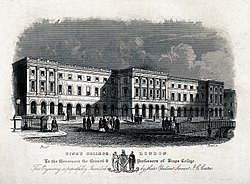

Campus and Infrastructure
King's College London utilizes an urban campus model, integrating its facilities directly into the fabric of London. This allows students and staff to work in close proximity to the city's political, legal, and cultural centers.
The Strand Campus
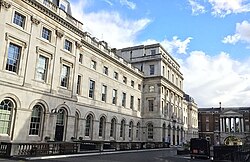
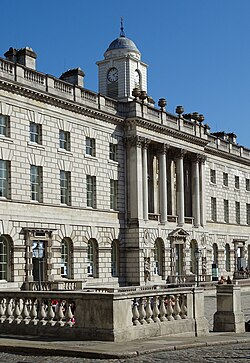
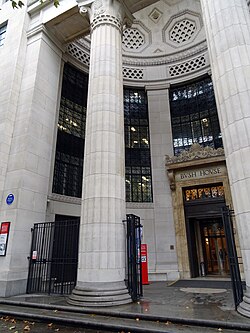
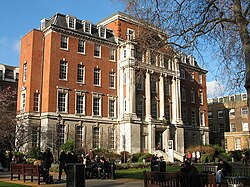
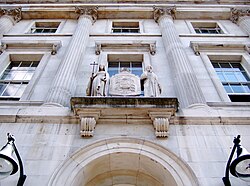
The Strand Campus is the university's most iconic site. It features the Grade I listed King's Building, designed by Sir Robert Smirke, and the Embankment terrace entrance overlooking the River Thames. The campus also houses the Dickson Poon School of Law within the East Wing of Somerset House and the King's Business School in Bush House.
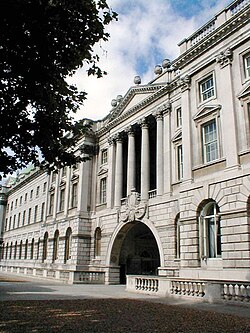
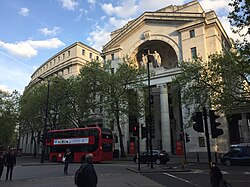
Specialized Campuses
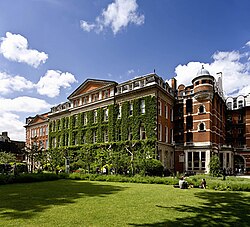
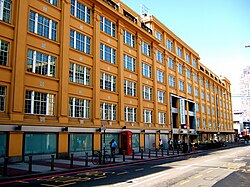
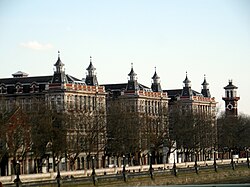
- Guy's Campus: A hub for the faculty of life sciences and medicine, featuring the Hodgkin Building.
- Waterloo Campus: Home to the Franklin-Wilkins Building.
- St Thomas' Campus: Closely integrated with St Thomas' Hospital.
- Denmark Hill Campus: Further expanding the university's medical and research reach.
Libraries and Collections
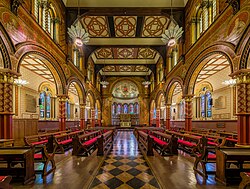
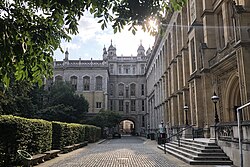
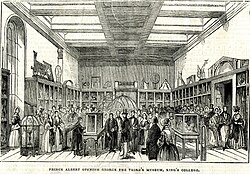
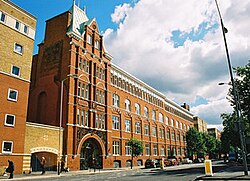
The Maughan Library stands as a crown jewel of the university's infrastructure. Following a £35 million renovation, it became the largest new university library in the UK since World War II. The university also maintains the King George III Museum and various anatomy museums.
![The Maughan Library. Following a £35M renovation, it is the largest new university library in the United Kingdom since World War II[52]](/images/98/c6/98c6ef5c995af7f82861dbaf469806e784261e9e584912de82a8732ce2cfa070.jpg)
Academic Structure and Performance
The university is organized into several specialized faculties that cover a vast spectrum of human knowledge, from the arts to advanced medicine.
Faculties and Schools
- Faculty of Arts and Humanities
- Faculty of Natural, Mathematical & Engineering Sciences
- Faculty of Social Science and Public Policy
- Faculty of Life Sciences and Medicine (including the Institute of Psychiatry, Psychology and Neuroscience)
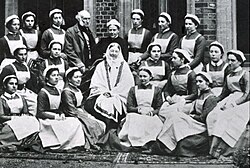
- Florence Nightingale Faculty of Nursing, Midwifery and Palliative Care
- Faculty of Dentistry, Oral and Craniofacial Sciences
- Dickson Poon School of Law
- King's Business School
Admissions and Selectivity
KCL is highly competitive. In 2025, the university received 75,835 applications, accepting 8,375 students, resulting in an application-to-acceptance ratio of 9.1. The student body is internationally diverse, with 33% of applicants coming from non-EU international backgrounds.
| Metric | Value |
|---|---|
| Total Students | 40,870 |
| Academic Staff | 6,355 |
| Administrative Staff | 5,260 |
| Annual Budget | £1.377 Billion |
| Endowment (2025) | £340.8 Million |
Student Life and Culture

Student life at King's is characterized by a vibrant mix of academic rigor and social tradition. The King's College London Students' Union (KCLSU) oversees a wide array of societies, music groups, and a student-led think tank.
Traditions and Rivalries
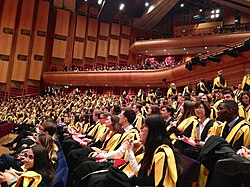
The university maintains a historic rivalry with University College London (UCL), most visibly expressed during the annual varsity rugby match. Other traditions include the Macadam Cup and the use of academic dress designed by Vivienne Westwood.




Notable Figures
The university has been home to some of the world's most influential thinkers and creators. Notable alumni include Nobel Prize winner in Physics Peter Higgs, Nobel Peace Prize laureate Desmond Tutu, science fiction pioneer Sir Arthur C. Clarke, and writer Virginia Woolf.
Frequently Asked Questions

When was King's College London founded?
The university was established on 14 August 1829, although its medical school has recorded teaching as far back as 1561.
What are the main campuses of KCL?
The university operates across several urban sites, primarily the Strand Campus, Guy's Campus, Waterloo Campus, St Thomas' Campus, and Denmark Hill Campus.
How competitive is admission to King's College London?
Admission is very competitive. For the 2025 cycle, the application-to-accepted ratio was 9.1, with over 75,000 applications for roughly 8,300 spots.
Who is the current patron of the university?
The current Royal Patron of King's College London is King Charles III.
What is the significance of the Maughan Library?
The Maughan Library is one of the university's most significant assets; following a £35 million renovation, it is the largest new university library in the UK since World War II.