Kilogram: The Evolution of the World's Standard of Mass
For centuries, the measurement of mass relied on physical objects—tangible pieces of metal kept in secure vaults. However, the kilogram, the fundamental unit of mass in the International System of Units (SI), has undergone a profound scientific transformation. Moving away from man-made artifacts, the kilogram is now anchored to the immutable laws of physics.
Key Facts
- Symbol: kg
- Current Definition: Based on the fixed numerical value of the Planck constant (h).
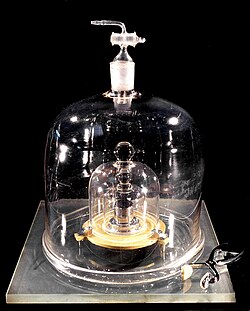
- Historical Standard: The International Prototype of the Kilogram (IPK), a platinum–iridium cylinder.
- 2019 Redefinition: Shifted from a physical artifact to fundamental physical constants.
- Water Connection: The current definition remains consistent with the original 1795 definition (the mass of one litre of water) within 30 parts per million.
A Brief History of Mass Standards
The concept of the kilogram dates back to the French Revolution. In 1795, it was provisionally defined as the mass of one cubic centimetre of water at the melting point of ice (0 °C). This was later refined to reflect the temperature of water's maximum density, approximately 4 °C.
As measurement needs became more precise, the standards evolved:
- 1799: The Kilogramme des Archives, a platinum prototype, was introduced.
- 1889: The International Prototype of the Kilogram (IPK), a cylinder made of platinum–iridium, became the global standard for the metric system.
- 2019: The reliance on physical artifacts ended, replaced by a definition based on universal constants.
The 2019 Redefinition: From Artifacts to Constants
For 130 years, the IPK served as the world's standard. However, relying on a single physical object presented risks; if the object changed mass due to environmental factors, the entire system of measurement would be affected. To solve this, the General Conference on Weights and Measures (CGPM) approved a new definition that took effect on May 20, 2019.
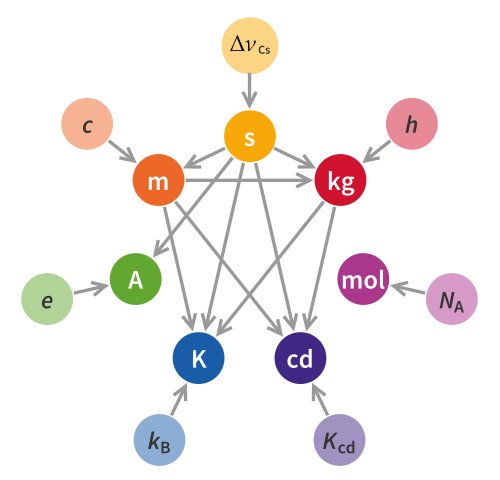
The kilogram is now defined by fixing the numerical value of the Planck constant (h) to 6.626 070 15 × 10 kg⋅m²⋅s⁻¹. This definition links the kilogram to other fundamental constants, including the speed of light (c) and the atomic transition frequency of cesium (ΔνCs), which defines the second.
The Role of the Kibble Balance
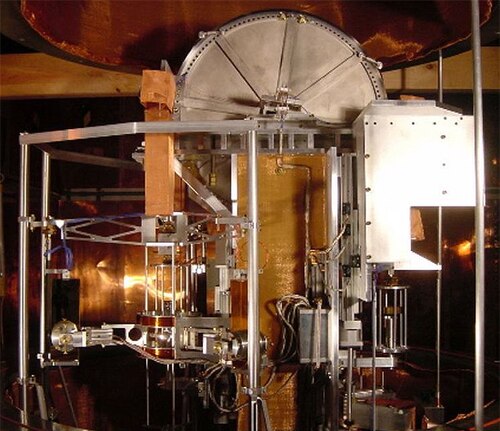
One of the primary technologies used to realize this new definition is the Kibble balance. Originally designed to measure the Planck constant in relation to the IPK, it can now be used to calibrate secondary standard weights, ensuring practical mass measurements remain accurate and stable in laboratories worldwide.
Unit Conversions and Scale
The kilogram is a versatile unit used across various scales. In the imperial system, it is approximately equivalent to 2.2046 pounds. Below is a summary of how the kilogram relates to other common measurements and its place in the SI system.
| System/Context | Conversion/Value |
|---|---|
| Avoirdupois (Pounds) | ≈ 2.2046 lb |
| Avoirdupois (Ounces) | ≈ 35.274 oz |
| Unified atomic mass units | 6.022 140 76 × 1023 Da |
| Water Density (at 4 °C) | ≈ 1 kg/L |
Frequently Asked Questions
What is the difference between mass and weight?
Mass is a measure of the amount of matter in an object (measured in kilograms), whereas weight is the force exerted on that mass by gravity (measured in Newtons).
Why was the kilogram redefined in 2019?
The redefinition moved the unit from a physical object (the IPK) to fundamental constants. This ensures the unit is permanent, unchanging, and can be reproduced anywhere in the universe using physics, rather than relying on a single piece of metal.
Is the "kilo" the same as a kilogram?
In informal speech, "kilo" is often used as a shorthand for kilogram. However, in formal scientific and technical writing, the SI system requires the use of the full name or the symbol "kg".
How does the Planck constant relate to mass?
The Planck constant (h) relates the energy of a photon to its frequency. Because energy, mass, and time are interconnected in physics, fixing the value of the Planck constant allows scientists to define the kilogram in terms of the second and the metre.
What are the common multiples of the kilogram?
Common SI multiples include the milligram (mg), which is 1/1000 of a kilogram, and the megagram (Mg), which is 1,000,000 grams (also known as a tonne).