Killarney: The Heart of County Kerry
Nestled on the northeastern shore of Lough Leane, Killarney (Irish: Cill Airne, meaning "church of sloes") is one of Ireland's most picturesque and storied towns. Located in County Kerry within the province of Munster, it serves as a gateway to the breathtaking landscapes of Killarney National Park. From the rugged peaks of MacGillycuddy's Reeks to the serene waters of the Lakes of Killarney, the town is a masterclass in natural beauty and historical depth.
Beyond its scenery, Killarney is celebrated for its cleanliness and civic pride, having been named Ireland's tidiest town in 2011 and winning the Best Kept Town award in 2007. With a population of 14,412 as of the 2022 census, it stands as the second-largest town in the county.
| Category | Details |
|---|---|
| Province/County | Munster / County Kerry |
| Population (2022) | 14,412 |
| Elevation | 50 m (160 ft) |
| Primary Industries | Tourism, Manufacturing (Cranes, Plastics) |
| Annual Visitors | Approximately 1.1 million |
| Tourism Revenue | Approximately €410 million per year |
A Journey Through History
Early Religious Settlements
Killarney's recorded history is deeply intertwined with early Irish Christianity. In 640 AD, St. Finian the Leper founded a monastery on Innisfallen Island in Lough Leane, a site that remained occupied for roughly 850 years until the monks were dispossessed by Queen Elizabeth I in 1594. Tradition even suggests that the Irish High King Brian Boru was educated here.
Nearby Aghadoe also holds significant historical weight. Once potentially a pagan site, it later became associated with the 5th-century missionary St. Abban. The area features ogham stones—ancient Irish inscriptions using a primitive alphabet—dating back to the 7th century, marking it as an important early settlement.
Castles and Abbeys
The landscape is dotted with architectural remnants of the medieval and early modern periods. Following the Anglo-Norman invasion of 1169, Parkavonear Castle was built at Aghadoe to serve as a strategic lookout over the valley. In the late 15th century, the O'Donoghues Mor clan constructed Ross Castle on the lake shore, though ownership later shifted to the Mac Carty Mor during the Desmond Rebellions of the 1580s.
Spirituality continued to shape the region with the founding of Muckross Abbey in 1448 by Donal McCarthy Mor as a Franciscan friary. Though it was burned by Cromwellian forces in 1654, the ruins remain a poignant landmark today.
Revolution and Governance
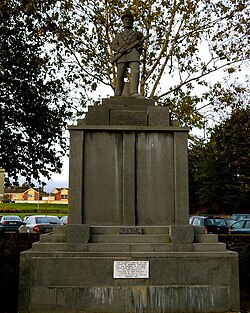
Killarney played a significant role in the Irish War of Independence due to its strong republican ties. The town saw frequent skirmishes with British forces, including the notable Headford Ambush, where the IRA attacked a railway train. The subsequent Irish Civil War also left its mark, including the killing of five Republican prisoners by Free State forces shortly after the Ballyseedy massacre.
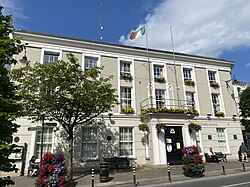
Administratively, the town evolved from having town commissioners in 1854 to an urban district in 1898, and eventually a town council in 2001. Today, it is managed as the Killarney Municipal District under the Kerry County Council. The Killarney Town Hall, built around 1930, remains a central civic landmark.
The Evolution of Tourism and Economy
The Rise of the Visitor Industry
Tourism began to flourish in the mid-18th century under the influence of Thomas, the fourth Viscount Kenmare. The town gained significant international attention following a visit from Queen Victoria in 1861. However, the most transformative event was the arrival of the railway in July 1853, which triggered a boom in local hospitality. Within a year, the number of hotels in town more than doubled.
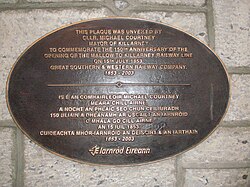
Killarney also established itself as the starting point for the 175-kilometre Ring of Kerry, a circuitous route that continues to attract millions of visitors. This legacy of hospitality is evident in the town's modern economy, where tourism generates roughly €410 million annually. In a move toward sustainability, Killarney became the first town in Ireland to ban single-use coffee cups in 2023.
Industrial Development
While tourism dominates, Killarney has a strong industrial backbone. Early efforts by Viscount Kenmare in the 1740s introduced linen mills, followed by hosiery and shoe manufacturing, such as the Hillards factory. In the modern era, the town is home to Tricel (founded in 1973) and Liebherr Cranes, which has manufactured container cranes in the town since 1958.
Transport and Accessibility
Killarney is well-connected by road via National Primary Route N22 and National Secondary Routes N72 and N71. For those traveling by rail, Iarnród Éireann (Irish Rail) provides direct services to Dublin, Cork, and Tralee.
Bus services are managed by Bus Éireann, and the town has embraced modern technology with the "TFI Anseo" app, a demand-responsive transport service launched in 2025 to improve local mobility. Air travelers can use Kerry Airport, located 17 km away in Farranfore, or the larger Cork Airport (89 km).
Sports, Culture, and Community
A Sporting Hub
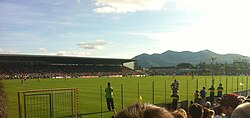
Killarney is a powerhouse of Irish sport. The GAA (Gaelic Athletic Association) is central to local life, with the Fitzgerald Stadium hosting county hurling and football teams. The town is home to several clubs, including the highly successful Dr. Crokes, who have won the All-Ireland Senior Club Football Championship.
Other sporting highlights include:
- Rowing: The Killarney Regatta is one of Ireland's oldest surviving regattas, featuring traditional fixed-seat rowing.
- Football: The town hosts three clubs in the Kerry District League, including Killarney Athletic and Killarney Celtic.
- Golf: The Killarney Golf & Fishing Club is a prestigious venue that attracts national competitions like the Irish Open.
- Rugby: Killarney RFC competes in the Munster Junior League.
Arts and Popular Culture
The town's beauty has long inspired artists and musicians. From the compositions of Cyril Rootham to the lyrics of Van Morrison, Killarney is a frequent muse. It is mentioned in numerous romanticized songs of Ireland, including "Christmas in Killarney" and "My Father Was Born In Killarney." In literature, the town serves as the setting for Colin O'Sullivan's award-winning novel, Killarney Blues.
Notable Residents
Killarney has been home to a diverse array of influential figures, from Academy Award-nominated actor Michael Fassbender and singer Jessie Buckley to sporting legends like Colm Cooper and political figures such as Seán Kelly.
International Connections
Killarney maintains global ties through twinning agreements with various towns across the United States (including Scottsdale, Arizona, and Springfield, Illinois), Italy, Germany, England, and Sweden.