Kiautschou Bay Leased Territory: Germany's Model Colony in China
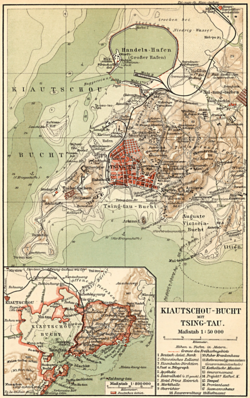
From 1898 to 1914, the Kiautschou Bay Leased Territory (also known as the Jiaozhou Bay Concession) served as a strategic German outpost on the southeastern coast of the Shandong Peninsula. Centered around the bay and the administrative capital of Tsingtau (modern-day Qingdao), this territory was more than just a naval base; it was envisioned as a "model colony" designed to showcase German efficiency, infrastructure, and colonial policy to the world.
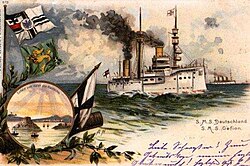
Operated by the East Asia Squadron of the Imperial German Navy, the territory played a pivotal role in Germany's late entry into the imperialistic scramble for global colonies, serving as both a coaling station for naval power and a gateway to the vast Chinese market.
Key Facts
- Duration: Leased from 1898 to 1914.
- Area: Approximately 552 km² (213 sq mi).
- Capital: Tsingtau (Qingdao).
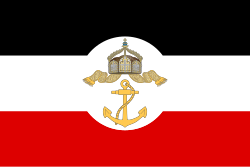
- Administration: Managed by the Imperial Naval Office (Reichsmarineamt), not the Colonial Office.
- Population (1912): 165,000 Chinese and 3,896 Europeans.
- Key Legacy: Modern urban planning, electrification, and the Tsingtao Brewery.
The Path to Acquisition
Germany's interest in Jiaozhou Bay began decades before the actual occupation. In 1860, a Prussian expeditionary fleet explored the region, and by the 1870s, geographer Baron Ferdinand von Richthofen had recommended the bay as an ideal naval base. By 1896, Rear Admiral Alfred von Tirpitz had personally examined the site to determine its suitability for German naval ambitions.
The catalyst for action came in November 1897 with the "Juye Incident," where the Big Sword Society murdered two German Roman Catholic priests. While some in Berlin preferred diplomacy, Kaiser Wilhelm II ordered Rear Admiral Otto von Diederichs to seize the territory with "greatest energy."
The Seizure of Qingdao
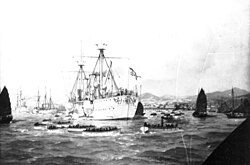
On November 14, 1897, Diederichs led an amphibious force of 717 personnel. In a swift operation, German forces disabled telegraph lines and occupied outer forts and powder magazines by 8:15 AM. Despite a brief moment of uncertainty when orders were nearly revoked, the occupation was upheld, and Diederichs was promoted to vice admiral.
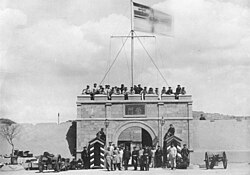
By March 6, 1898, Germany signed a lease treaty with the Chinese government. Rather than outright annexation, Germany accepted a leasehold for 99 years. Under international law, the territory remained legally part of China, but Germany exercised all sovereign powers within the leased area and a surrounding 50 km wide neutral zone.
Development of a Model Colony
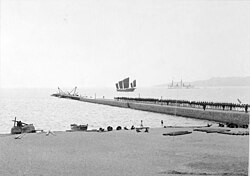
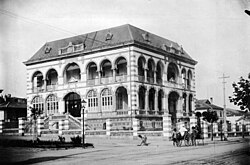
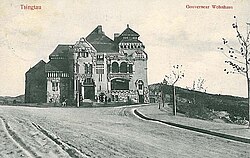
Unlike many other colonial ventures, Kiautschou was managed by the Imperial Naval Office. The governors, all high-ranking naval officers, oversaw a rigorous modernization program funded by over $100 million in investment. The small fishing village of Tsingtau was transformed into a modern city featuring wide streets, a comprehensive sewer system, and safe drinking water—luxuries that were rare in Asia at the time.
Economic and Social Innovation
Germany implemented a Georgist policy in the territory, meaning the sole source of government revenue was a 6% land value tax. This was specifically designed to prevent the land speculation that had plagued German colonies in Africa.
The territory also became an educational hub, boasting the highest density of schools and per capita student enrollment in China. Economic growth was further bolstered by the Deutsch-Asiatische Bank and the completion of the Tsingtau-Jinan railway in 1910, which eventually linked Tsingtau to Berlin via the Trans-Siberian Railway.
Administration and Governance
The territory was led by a Governor who managed both military and civil administrations. The governance structure included a government council (Gouvernementsrat) and a Chinese Committee to advise the governor on local affairs.
| Category | Detail |
|---|---|
| Administrative Center | Tsingtau (Qingdao) |
| Governing Body | Imperial Naval Office (RMA) |
| Primary Revenue Source | 6% Land Value Tax |
| 1912 Population | ~168,896 (Chinese and European) |
| Currency | Banknotes pegged to Spanish/Mexican silver dollar |
The End of German Rule
The German era ended abruptly with the outbreak of World War I. On August 15, 1914, Japan issued an ultimatum demanding Germany relinquish the territory. Following the rejection of this demand, Japan declared war and bombarded the territory, officially occupying the bay on November 7, 1914.
After the resolution of the "Shandong Problem," the territory was returned to the Republic of China on December 10, 1922, though it would later be occupied by Japan again during the Second Sino-Japanese War (1937–1945).
Frequently Asked Questions
Why was Kiautschou Bay called a "model colony"?
It was designed to demonstrate the effectiveness of German colonial policy through superior infrastructure, including electrification, advanced sewage systems, and a high density of educational institutions.
How was the territory funded?
The government utilized a land value tax of six percent, a Georgist economic policy intended to eliminate land speculation and provide a stable source of revenue.
Who managed the territory's administration?
Because of its strategic naval importance, the territory was managed by the Imperial Naval Office (Reichsmarineamt) rather than the Imperial Colonial Office, with all governors being senior navy officers.
What happened to the territory after World War I?
Japan occupied the territory in 1914. Following international negotiations, it was ceded back to the Republic of China on December 10, 1922.
What was the official status of the land under the 1898 treaty?
It was a leasehold for 99 years. Legally, the land remained part of China, but Germany exercised all sovereign powers for the duration of the lease.