Khmer Republic: The Rise and Fall of Lon Nol's Regime
The transition of Cambodia from a monarchy to the Khmer Republic was marked by political instability, foreign intervention, and a brutal civil war. What began as a coup to shift the nation toward a more pro-Western stance eventually spiraled into a conflict that reshaped the region and paved the way for the ascent of the Khmer Rouge.
The 1970 Coup and the Ousting of Sihanouk
In March 1970, while Prince Norodom Sihanouk was visiting France, a political earthquake struck Phnom Penh. Anti-Vietnamese riots broke out, leading to the sacking of the North Vietnamese and Viet Cong embassies. These events were likely organized or tolerated by Prime Minister Lon Nol and his deputy, Prince Sisowath Sirik Matak.
Lon Nol took a hardline stance against North Vietnamese forces, closing the port of Sihanoukville and issuing a 72-hour ultimatum for all PAVN (People's Army of Vietnam) and Viet Cong forces to leave Cambodian soil. Despite these aggressive moves, Lon Nol was initially hesitant to depose Sihanouk. It was only after Sirik Matak played a recording of Sihanouk threatening to execute them both that Lon Nol was compelled—reportedly at gunpoint—to sign the documents necessary for the coup.
On March 18, 1970, the National Assembly stripped Sihanouk of his power, and Lon Nol assumed the role of Head of State. While some provincial cities held pro-Sihanouk demonstrations, the new regime suppressed them with extreme brutality, resulting in several hundred deaths.
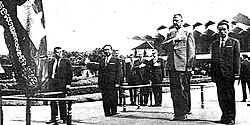
The Declaration of the Khmer Republic
The coup fundamentally altered Cambodia's international relations. North Vietnam withdrew its recognition of Cambodia, while the new regime re-established ties with South Vietnam. This shift led to the Cambodian campaign of April–July 1970, where the South Vietnamese Army (ARVN) and US troops entered eastern Cambodia to attack communist sanctuaries.
On October 9, 1970, a military court condemned Sihanouk to death in absentia. Simultaneously, the regime declared the establishment of the Khmer Republic. In response, Sihanouk formed GRUNK, a Beijing-based government-in-exile that allied with communist forces to overthrow Lon Nol.
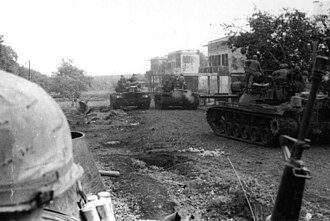
The Expansion of the FANK
To defend the new Republic, the Royal Khmer Armed Forces (FARK) were reorganized into the Khmer National Armed Forces (FANK). The military grew rapidly from 35,000 to approximately 150,000 men by the end of 1970, fueled by anti-Vietnamese sentiment and US military aid.
However, the FANK was plagued by systemic issues. Despite US efforts to "Americanize" the army's structure, the force suffered from severe corruption—including officers claiming salaries for "ghost soldiers"—and a lack of experienced leadership. While some commanders saw local success, large-scale offensives like Operations Chenla I and II ended in heavy defeat.
Internal Strife and Political Decay
The Khmer Republic was internally fractured from the start. A damaging power struggle emerged between Lon Nol and Sirik Matak. Lon Nol's health frequently failed him, leading to periods where Sirik Matak acted as premier, which created resentment among other officials and the urban youth.
By 1972, Lon Nol and his brother, Lon Non, successfully marginalized Sirik Matak, placing him under house arrest. Lon Nol then assumed the role of Head of State himself. Although he held presidential elections in 1972, they were widely viewed as rigged, further alienating the population and opposition figures like In Tam.
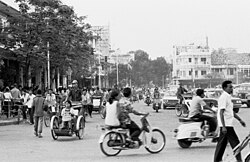
The Road to Collapse (1973–1975)
The Paris Peace Accords of January 1973 provided a brief, illusory respite. While Lon Nol declared a unilateral ceasefire, the CPNLAF (Communist Party of Kampuchea Armed Forces) continued to advance. By April 1973, the Republic was in disarray, with FANK troops looting their own capital.
The US attempted to stabilize the regime by forcing Lon Nol to broaden his power base, leading to the creation of a Political Council. However, this was a temporary fix. By 1974, communist forces captured the former royal capital of Oudong, signaling the Republic's impending doom.
The Final Offensive
During the 1975 dry season offensive, the Khmer Rouge surrounded Phnom Penh. Despite the tenacity of some FANK soldiers, fresh Chinese arms supplies gave the communists the upper hand. On April 1, 1975, Lon Nol resigned and fled into exile.
Phnom Penh fell on April 17, 1975. The remaining leadership, including Sirik Matak and Long Boret, were executed shortly after. The final vestige of the Republic, the temple of Preah Vihear, was captured by the Khmer Rouge on May 22, 1975.
Key Facts
- Coup Date: March 18, 1970.
- Military Growth: FANK expanded from 35,000 to over 200,000 troops.
- US Aid: The Republic received approximately one million dollars of US military and economic aid per day.
- Key Figures: Lon Nol (President), Prince Sirik Matak (Architect of the coup), Prince Sihanouk (Deposed monarch).
- Final Fall: Phnom Penh fell on April 17, 1975; Preah Vihear fell on May 22, 1975.
| Feature | Details |
|---|---|
| Government Type | Republic (replacing Monarchy) |
| Primary Military Force | Khmer National Armed Forces (FANK) |
| Main Opponents | CPNLAF (Khmer Rouge) and North Vietnamese forces |
| Major US Influence | Military training, funding, and strategic bombing |
| Outcome | Total collapse and takeover by the Khmer Rouge |
Frequently Asked Questions
Was the CIA involved in the 1970 coup?
While Prince Sihanouk claimed the CIA was involved, there is little evidence to support this. However, some sections of the US military, specifically the Army Special Forces, may have provided support and training to the plotters after being approached by Lon Nol.
Why did the FANK struggle despite massive US aid?
The FANK was severely handicapped by widespread corruption, such as officers claiming pay for non-existent troops, and a general lack of military competence among the high command.
What was the role of Prince Sihanouk after the coup?
Sihanouk formed GRUNK, a government-in-exile based in Beijing. He allied himself with the communists to seek the overthrow of the Lon Nol regime.
How did the Khmer Republic finally end?
The regime collapsed during the 1975 dry season offensive. Lon Nol fled the country on April 1, and Phnom Penh fell to the Khmer Rouge on April 17, 1975, followed by the final fall of Preah Vihear in May.