Keilor History: From Ancient Landscapes to Colonial Settlement
Nestled within a basin of the Maribyrnong River, Keilor is a township with a rich tapestry of history that spans millions of years. From its geological formation and the presence of prehistoric giants to its role as a vital hub during the Victorian gold rush, Keilor offers a unique glimpse into the evolution of the Australian landscape and society.
Geological Foundations and Ancient Life
The physical landscape of Keilor was shaped approximately 1 million years ago when lava flows covered the region, creating expansive basalt plains (flat lands formed from volcanic rock). Over millennia, the Maribyrnong River carved its way through these plains, creating the basin seen today.
Long before human arrival, the area was home to Australian megafauna—giant prehistoric animals. These included Diprotodons and kangaroos standing 3 metres high, which inhabited the region until their extinction roughly 13,000 years ago at the conclusion of the ice age.
Indigenous Heritage and Early Settlement
Keilor is recognized as one of the oldest inhabited sites in Australia. The Wurundjeri Indigenous Australians lived in the area for approximately 40,000 years, maintaining a deep connection to the land long before European arrival.
European settlement began around 1838-39, led by pastoralists James Watson and brothers Alexander and John Hunter. James Watson, the first land-holder in the district, is credited with naming the suburb. He likely named it after Keillor, a farm in Forfarshire, Scotland, which was one of four properties tenanted by his father, Hugh Watson.
The Gold Rush and Urban Growth
During the 1850s, Keilor became a strategic stopover for travelers journeying from Melbourne to the Bendigo goldfields. It served as a noted camping ground for bullock teams heading to and from the diggings at Ballarat and Castlemaine.
This influx of traffic spurred rapid commercial development. By March 2, 1854, the Keilor Post Office had opened, and the township soon expanded to include a general store, blacksmith, hotel, police station, and courthouse. A wooden bridge originally spanned the river, which was later replaced by an iron bridge in 1868.
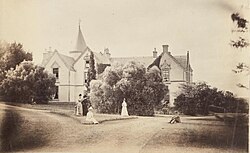
One of the most prominent early settlers was William Taylor (1818–1903). In 1849, Taylor purchased 13,000 acres in the district and constructed a residence called Overnewton. In 1859, he transformed this building into a Scottish Baronial mansion, now known as Overnewton Castle.
While Keilor remained a primarily agricultural district for many decades, it underwent a significant transformation after World War II. The availability of cheap land and the rise of large industries in neighboring suburbs led to a rapid increase in the local population.
Key Facts
- Ancient Inhabitants: The Wurundjeri people inhabited the area for about 40,000 years.
- Prehistoric Life: Home to 3-metre high kangaroos and Diprotodons until 13,000 years ago.
- Naming: Named by James Watson after a farm in Forfarshire, Scotland.
- Landmark: Overnewton Castle was converted into a Scottish Baronial mansion in 1859.
- Infrastructure: An iron bridge replaced the original wooden river crossing in 1868.
| Period/Year | Event/Feature |
|---|---|
| ~1 Million Years Ago | Lava flows create basalt plains |
| ~40,000 Years Ago | Wurundjeri Indigenous Australians inhabit the area |
| ~13,000 Years Ago | Extinction of megafauna (e.g., Diprotodons) |
| 1838-39 | First European settlements by James Watson and the Hunters |
| 1849-1859 | William Taylor establishes Overnewton and builds the castle |
| 1854 | Opening of the Keilor Post Office |
| Post-WWII | Rapid population growth and industrialization |
Frequently Asked Questions
Who named the suburb of Keilor?
The suburb was named by James Watson, the first European land-holder in the district, who named it after a farm called Keillor in Forfarshire, Scotland.
What is the significance of Overnewton Castle?
Originally a house built by William Taylor in 1849, it was transformed in 1859 into a Scottish Baronial mansion, serving as a prominent architectural landmark of the early settlement.
What prehistoric animals lived in the Keilor area?
The area was once home to Australian megafauna, including Diprotodons and kangaroos that reached heights of 3 metres.
How did the gold rush affect Keilor?
Keilor became a vital stopover for bullock teams and travelers moving between Melbourne and the goldfields of Bendigo, Ballarat, and Castlemaine, leading to the establishment of essential services like a post office, hotel, and courthouse.
Why did Keilor's population increase after World War II?
The population grew rapidly due to the availability of cheap land and the establishment of large-scale industries in the surrounding suburbs.