Juan María Bordaberry: The Presidency and Fall of a Uruguayan Leader
The political trajectory of Juan María Bordaberry represents one of the most turbulent eras in Uruguayan history. Elected during a period of intense social unrest, Bordaberry transitioned from a handpicked successor to a democratic president, and eventually to a dictator who was ultimately ousted by the very military forces that supported his rise.
The Path to the Presidency
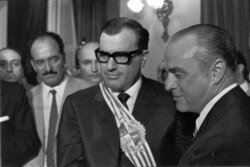
Bordaberry entered the presidency in 1972 as a candidate for the Colorado Party. His victory was a result of the Ley de Lemas, a unique electoral system where the candidate from the party receiving the most total votes is elected, regardless of whether that individual received the most individual votes. In the 1971 election, Bordaberry actually finished 60,000 votes behind Wilson Ferreira Aldunate of the National Party. However, because the combined Colorado vote exceeded the National vote by over 12,000, Bordaberry secured the office.
Governance and Institutional Crisis
Bordaberry assumed power during a severe institutional crisis characterized by the authoritarian legacy of his predecessor, Jorge Pacheco, and the rise of terrorist threats. Initially viewed as a minor political figure with little independent standing, Bordaberry continued Pacheco's hardline methods. His administration was marked by the suspension of civil liberties, the banning of labor unions, and the imprisonment and killing of political opposition figures.
To consolidate control, Bordaberry appointed military officers to the majority of leading government positions. While he maintained an interest in agricultural improvement—working with Agriculture Minister Benito Medero—his political alliances were often unstable. A notable misstep was the appointment of Jorge Sapelli as Vice President, who eventually resigned and publicly repudiated Bordaberry in 1973.
The Transition to Dictatorship
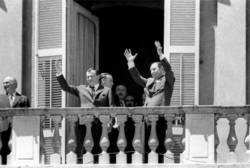
The definitive shift toward autocracy occurred on June 27, 1973. Bordaberry dissolved Congress and suspended the Constitution, granting the police and military unrestricted power to restore order. For the following three years, he governed by decree, supported by the National Security Council, known as COSENA.
His cabinet evolved alongside his political shift. During the initial democratic period, he worked with figures such as José Antonio Mora, Luis Barrios Tassano, and Julio María Sanguinetti. Once the dictatorial rule was established, his inner circle shifted to include Juan Carlos Blanco Estradé, Néstor Bolentini, and Alejandro Végh Villegas.
The Military Ouster
Bordaberry's downfall came when his authoritarian ambitions exceeded those of his military allies. In June 1976, he proposed a new corporatist constitution—a system that would have permanently abolished political parties and codified a permanent role for the military in government. This proposal proved too extreme even for the military leadership, leading to his forced resignation. Following his removal, Bordaberry retired to his ranch.
Key Facts
- Election Method: Won via the Ley de Lemas system despite receiving fewer individual votes than the National Party's lead candidate.
- Constitutional Break: Dissolved Congress and suspended the Constitution on June 27, 1973.
- Governance Tool: Ruled by decree through the National Security Council (COSENA).
- Reason for Fall: Forced to resign in 1976 after proposing a corporatist constitution that permanently banned political parties.
| Category | Details |
|---|---|
| Political Party | Colorado Party |
| Term Start | 1972 |
| Key Allies (Democratic) | Julio María Sanguinetti, José Antonio Mora |
| Key Allies (Dictatorial) | Juan Carlos Blanco Estradé, Alejandro Végh Villegas |
| End of Presidency | June 1976 (Forced Resignation) |
Frequently Asked Questions
How did Bordaberry become president if he didn't get the most votes?
He was elected under the Ley de Lemas system, which awarded the presidency to the top candidate of the party that received the highest aggregate vote count, rather than the individual with the most votes.
What was the role of COSENA?
The National Security Council (COSENA) assisted Bordaberry in ruling by decree after he dissolved Congress and suspended the Constitution in 1973.
Why did the military force Bordaberry to resign?
The military ousted him in 1976 because he proposed a corporatist constitution that would have permanently eliminated political parties, a step that went further than the military was willing to go.
Who was Jorge Sapelli?
Jorge Sapelli served as the Vice President of Uruguay under Bordaberry but later resigned and publicly repudiated the president in 1973.
What measures did Bordaberry take against political opposition?
Bordaberry suspended civil liberties, banned labor unions, and oversaw the imprisonment and killing of opposition figures.