JPMorgan Chase: A Global Financial Powerhouse
JPMorgan Chase is a leading global financial services firm, operating as a public company traded on the New York Stock Exchange under the ticker JPM. Headquartered at 270 Park Avenue in New York City, the firm is a cornerstone of the global economy, serving as a component of the Dow Jones Industrial Average (DJIA), the S&P 100, and the S&P 500.
The organization provides a comprehensive suite of services, ranging from traditional banking and credit cards to complex equities trading, private equity, and wealth management. With a worldwide reach, it manages trillions of dollars in assets, making it one of the most influential financial institutions in existence.
Key Facts

- Chairman & CEO: Jamie Dimon
- Total Assets: US$ 4.425 trillion (2026)
- Assets Under Management (AUM): US$ 4.791 trillion (2026)
- Annual Revenue: US$ 182.4 billion (2026)
- Net Income: US$ 57.05 billion (2026)
- Global Workforce: 318,512 employees (2026)
- Tier 1 Capital Ratio: 15.5% (2026)
Organizational Structure
![As of June 2008, the JPMorgan logo used for the company's Investment Banking, Asset Management, and Treasury & Securities Services units[11]](/images/62/d2/62d28be5685fd37feec28f256d6e9fd3fea736bd08cd6e78e21b97e250b4cbd2.webp)
To manage its vast array of services, JPMorgan Chase is divided into three primary business segments:
- Consumer and Community Banking (CCB): Operating primarily under the Chase brand, this segment focuses on retail banking and consumer services.
- Asset and Wealth Management (AWM): Operating under the J.P. Morgan brand, this unit manages investments for individuals and institutions.
- Commercial and Investment Banking (CIB): Utilizing both J.P. Morgan & Chase branding, this segment handles corporate finance, equities trading, and treasury services.
A Legacy of Mergers and Acquisitions
The modern entity is the result of over two centuries of banking evolution. Its roots trace back to several historic predecessors, including the Manhattan Company (founded 1799), Chemical Bank (1824), J.P. Morgan & Co. (1871), and Chase National Bank (1877). The current corporate structure was formally established on December 1, 2000.

Throughout its history, the firm has expanded through strategic acquisitions. Notable mergers include the integration of Chemical Bank and Chase Manhattan Bank in 1996, and the merger of J.P. Morgan & Co. with Chase Manhattan in 2000. In 2004, the firm merged with Bank One Corporation.

During the financial crisis of 2008, JPMorgan Chase further expanded its footprint by acquiring Bear Stearns and Washington Mutual.


More recently, the firm continued its growth trajectory by acquiring First Republic Bank in 2023.
Financial Performance and Ownership
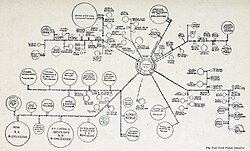
JPMorgan Chase has shown significant growth in revenue and assets over the last few decades. From a revenue of US$ 25.87 billion in 1998, the firm has scaled to projected revenues of US$ 182.4 billion by 2026. Its total equity has similarly grown from US$ 35.10 billion in 1998 to US$ 362.4 billion in 2026.
The company is largely owned by institutional investors. The largest shareholders include The Vanguard Group (9.46%), BlackRock (6.66%), and State Street Corporation (4.35%).
| Metric | Value |
|---|---|
| Revenue | US$ 182.4 Billion |
| Net Income | US$ 57.05 Billion |
| Total Assets | US$ 4.425 Trillion |
| AUM | US$ 4.791 Trillion |
| Employee Count | 318,512 |
Corporate Leadership and Influence

The firm is led by Chairman and CEO Jamie Dimon, who has held the CEO role since January 2006. The senior leadership team also includes President Daniel E. Pinto and COO Jennifer Piepszak. The Board of Directors consists of high-profile executives from various industries, including leaders from Microsoft, IBM, and General Dynamics.
Beyond finance, the firm maintains a significant cultural presence through its art collection and sports sponsorships. It is the official sponsor of the US Open and has naming rights to venues such as the Chase Center in San Francisco and Chase Field in Phoenix.
Frequently Asked Questions
What are the three main business segments of JPMorgan Chase?
The firm is divided into Consumer and Community Banking (Chase), Asset and Wealth Management (J.P. Morgan), and Commercial and Investment Banking (J.P. Morgan & Chase).
Who is the current CEO of JPMorgan Chase?
Jamie Dimon has served as the Chief Executive Officer since January 2006 and as Chairman since January 2007.
Which major banks merged to form the current company?
The company was formed through a series of mergers involving the Manhattan Company, Chemical Bank, J.P. Morgan & Co., and Chase National Bank, with a pivotal merger occurring in December 2000.
What is the difference between the Chase and J.P. Morgan brands?
Generally, the Chase brand is used for consumer-facing retail banking and community services, while the J.P. Morgan brand is used for investment banking, asset management, and wealth management for high-net-worth clients.
What is the firm's current financial standing?
As of 2026 projections, the firm holds total assets of US$ 4.425 trillion and assets under management (AUM) of US$ 4.791 trillion, with a Tier 1 capital ratio of 15.5%.