José Luis Rodríguez Zapatero: The Political Journey of a Spanish Prime Minister
José Luis Rodríguez Zapatero is a prominent Spanish politician and a long-standing member of the Spanish Socialist Workers' Party (PSOE). Serving two terms as the Prime Minister of Spain following victories in the 2004 and 2008 general elections, Zapatero led the nation through a period of significant social reform and international realignment. Though his full name includes the paternal surname Rodríguez, he is most commonly known by his maternal surname, Zapatero.
Key Facts
- Office: Prime Minister of Spain (April 17, 2004 – December 21, 2011).
- Party: Spanish Socialist Workers' Party (PSOE) since 1979.
- Leadership: Secretary-General of the PSOE (July 22, 2000 – February 4, 2012).
- Education: University of León.
- Major Policy: Withdrawal of Spanish troops from Iraq in 2004.
Early Life and Political Awakening
Born on August 4, 1960, in Valladolid, Castile and León, Zapatero was the son of Juan Rodríguez y García-Lozano, a lawyer, and María de la Purificación Zapatero Valero. He spent his formative years in León, the ancestral home of his family.
Zapatero's entry into politics was marked by a pivotal moment in 1976 when he attended a PSOE rally in Gijón. The speech delivered by Felipe González, the future Prime Minister, deeply influenced him. While Zapatero's family had traditionally leaned toward the Communist Party—the only organized political force before the death of Francisco Franco in 1975—the Gijón rally convinced him that the Socialist Party represented the most viable future for the Spanish left.
By 1982, Zapatero had risen to lead the socialist youth organization in the province of León. During this time, he attempted to encourage a "left turn" in the PSOE's political program, though he was advised by González to move away from his more traditional conservative-left viewpoints.
Rise Through the Cortes
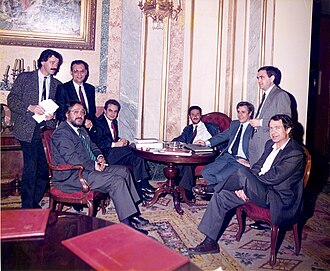
Zapatero entered the Cortes (the Spanish Parliament) in 1986 as the youngest member, representing the province of León. He maintained his seat through several subsequent elections, eventually shifting his constituency to Madrid for the 2004 elections.
During his early parliamentary years, Zapatero described himself as a "left-wing conservative." He explained this paradox by citing his family's history as part of the left that lost the Spanish Civil War (1936–1939) and the subsequent impact of the Franco regime (1939–1975). He argued that for the Spanish left to succeed, it needed to modernize and overcome its own ideological conservatism.
Leading the Opposition
Following a disappointing defeat for the PSOE in the March 2000 elections, where the People's Party (PP) under José María Aznar secured an absolute majority, Zapatero was appointed Secretary-General of the PSOE. His early years as leader of the opposition were challenging, with poor results in regional elections in the Basque Country (2001) and Galicia (2001) leading some to question his strategic approach.
However, Zapatero gained political traction by criticizing the Aznar government's handling of the 2003 Yak-42 plane crash in Turkey, which killed Spanish soldiers. He accused the government of neglecting safety and insurance and criticized the lack of a full inquiry.
The 2004 General Election and Premiership
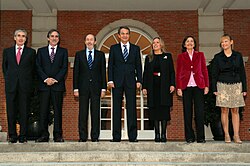
Despite polls predicting another victory for the People's Party, Zapatero led the PSOE to victory on March 14, 2004, securing 164 seats. His campaign focused on several key promises:
- The creation of 180,000 new houses annually for purchase or rent.
- A balanced budget with a flexible approach.
- Bilingual education (English and Spanish) alongside regional languages.
- Providing one computer for every two students.
- Capping legal processes at two years or providing financial compensation.
Zapatero took office on April 17, 2004. One of his first and most significant acts was the announcement on April 19, 2004, to withdraw 1,300 Spanish troops from Iraq.
Domestic and International Policy
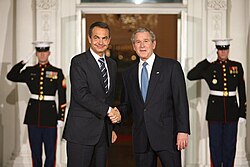
Zapatero's tenure was marked by a push for social modernization, including the expansion of LGBT rights and reforms to the education system. However, his administration faced severe economic headwinds; by January 2011, Spain's unemployment rate had climbed to 20.33%.
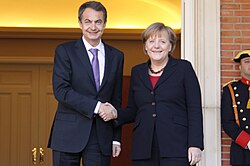
On the international stage, Zapatero was a proponent of European integration. He supported the European Constitution and held a referendum in Spain in 2005, where 77% of voters approved the treaty. However, the treaty ultimately failed after it was rejected by French voters.
Later Years and Legacy
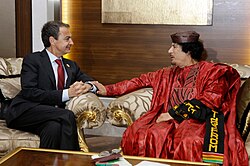
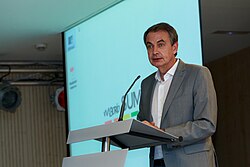
Zapatero announced in April 2011 that he would not seek re-election, leaving office on December 21, 2011. Following his premiership, he served on the State Council starting in February 2012. He has remained a public figure, appearing at events such as the WorldPride 2017 Madrid Summit.
| Role | Period | Key Detail |
|---|---|---|
| Member of Congress (León) | 1986 – 2004 | Youngest member upon first election |
| Secretary-General of PSOE | 2000 – 2012 | Led the party as opposition and in government |
| Prime Minister of Spain | 2004 – 2011 | Elected for two terms |
| State Council Member | 2012 – onwards | Post-premiership judicial/advisory role |
Frequently Asked Questions
Why is he called Zapatero instead of Rodríguez?
In Spanish naming customs, the first surname is paternal (Rodríguez) and the second is maternal (Zapatero). While both are part of his legal name, he is most commonly known by his maternal surname, Zapatero.
What was Zapatero's most significant foreign policy decision?
His most prominent foreign policy move was the decision to withdraw all 1,300 Spanish troops from Iraq shortly after taking office in April 2004.
How did the 2004 election result surprise observers?
Most opinion polls prior to the election predicted a victory for the People's Party, but Zapatero's PSOE won with 164 seats in the Cortes.
What economic challenge did Zapatero face toward the end of his term?
Zapatero struggled with a rising unemployment rate, which reached 20.33% by January 2011, exceeding his government's target of 19.4%.
What was Zapatero's stance on the European Constitution?
He strongly supported the European Constitution and organized a referendum in Spain in 2005, which passed with nearly 77% support, although the treaty was later blocked by a "no" vote in France.