JordanHashemite Kingdom of JordanAmmanPetraDead Sea

Jordan: A Journey Through the Hashemite Kingdom

Jordan: A Journey Through the Hashemite Kingdom The Hashemite Kingdom of Jordan is a land of profound historical depth and diverse landscapes, situated at the crossroads of the Middle Eas...

Jordan: A Journey Through the Hashemite Kingdom

The Hashemite Kingdom of Jordan is a land of profound historical depth and diverse landscapes, situated at the crossroads of the Middle East. From the lowest point on Earth to the red sands of the desert, Jordan blends ancient civilizations with a modern, parliamentary semi-constitutional monarchy. Guided by the motto "God, Country, King," the nation serves as a stable hub in a dynamic region.

Key Facts
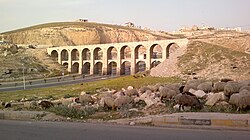
Ottoman Ten Arches Bridge built south of Amman in 1904, as part of the Hejaz railway, which stretched across the length of Transjordan and linked Damascus with Medina
  • Capital: Amman (the largest city).
  • Government: Unitary parliamentary semi-constitutional monarchy led by King Abdullah II.
  • Population: Approximately 11.48 million (2023 estimate).
  • Official Language: Arabic.
  • Currency: Jordanian dinar (JOD).
  • Geography: Home to the Dead Sea, the lowest point on Earth.
  • Economy: A high Human Development Index (HDI) of 0.754 as of 2023.

A Legacy of Civilizations
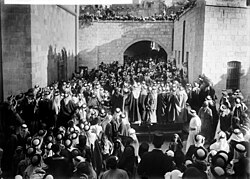
As-Salt residents gather on 20 August 1920 during the British High Commissioner's visit to Transjordan.

Jordan's history spans millennia, beginning with some of the earliest evidence of human artistry. The 'Ain Ghazal Statues, dating back to approximately 7250 BC, represent some of the oldest human sculptures ever discovered.
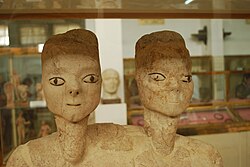
The 'Ain Ghazal Statues, c. 7250 BC, uncovered in Amman, are some of the oldest human statues ever found.

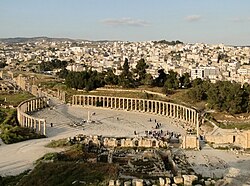
As centuries passed, the region became a center for various empires. The Mesha Stele (c. 840 BC) provides a written record of the glory of King Mesha of Moab, while the Greco-Roman influence is still visible today in cities like Jerash. Jerash was once part of the Decapolis, a league of ten cities, seven of which are located within modern Jordan.
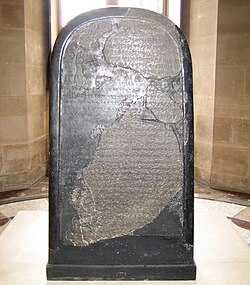
The Mesha Stele (c. 840 BC) records the glory of Mesha, King of Moab, displayed at the Louvre Museum.

The Oval Forum of Jerash (c. 1st century AD), then member of the ten-city Greco-Roman league, the Decapolis, seven of which are present in modern-day Jordan

The Nabataean civilization left an indelible mark on the landscape, most notably in Petra. This ancient city features Al-Khazneh, believed to be the mausoleum of King Aretas IV from the 1st century AD.
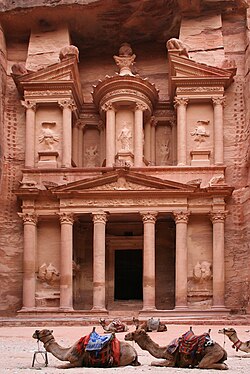
Petra, one of the New 7 Wonders of the World, contains Al-Khazneh, believed to be the mausoleum of the Nabataean King Aretas IV, 1st century AD.

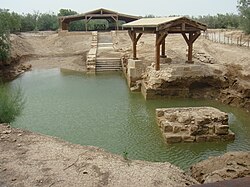
During the Byzantine era, Jordan became a significant center for early Christianity. The Madaba Map from the 6th century AD is the oldest surviving depiction of the Holy Land, and the ruins of Al-Maghtas are believed to be the site where John the Baptist baptized Jesus.
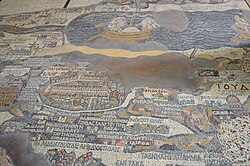
Byzantine Madaba Map showing the Jordan River and the Dead Sea. Dating to the 6th century AD, it is the oldest surviving depiction of the Holy Land.

Al-Maghtas ruins on the Jordanian side of the Jordan River, believed to have been the location of the Baptism of Jesus and the ministry of John the Baptist

The Path to Modern Statehood

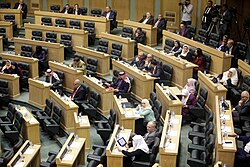
The House of Representatives during a parliamentary session

The modern era of Jordan began with the Great Arab Revolt of 1916 against the Ottoman Empire. The transition to a sovereign state progressed through the establishment of the Emirate on April 11, 1921, leading to full independence from the United Kingdom on May 25, 1946.
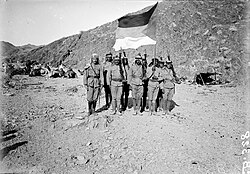
Soldiers of the Hashemite-led Arab Army holding the flag of the Great Arab Revolt against the Ottoman Empire in the Hejaz, 1916

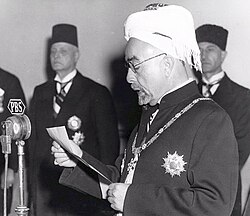
King Abdullah I on 25 May 1946 declaring independence, with Prime Minister Ibrahim Hashem in the background

The kingdom has been shaped by its leaders, including King Abdullah I, King Hussein, and the current monarch, King Abdullah II. Key national figures such as Prime Minister Wasfi Tal and Army Chief Habis Majali have also played pivotal roles in the nation's development.
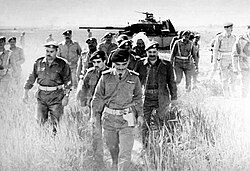
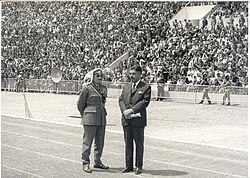
King Hussein on 21 March 1968 checking an abandoned Israeli tank in the aftermath of the Battle of Karameh

Army Chief Habis Majali and Prime Minister Wasfi Tal during a military parade in 1970, two widely acclaimed national figures

Geography and Natural Wonders

U.S. President Donald Trump and First Lady Melania Trump with King Abdullah II and Queen Rania of Jordan at the White House, 2017

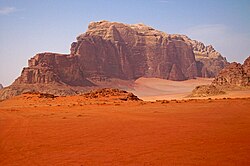
Jordan's geography is characterized by extreme contrasts. The western border is defined by the Dead Sea, a natural resort and the lowest point on Earth. In the south, the valley of Wadi Rum is famous for its Mars-like terrain, making it a frequent location for international film productions.
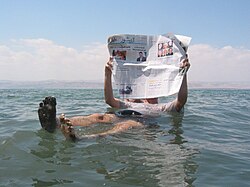
The Dead Sea, which is located along Jordan's western border, is the lowest point on Earth and a natural resort that has attracted visitors from across the region for millennia.

Wadi Rum is a valley in southern Jordan whose resemblance to the surface of Mars has made it a popular tourist and filming location, including scenes of The Martian.

Environmental challenges are a reality for the kingdom; Jordan was ranked as the seventeenth most water-stressed country in the world in 2022. Additionally, forests cover less than 2% of the land, though protected areas like the Dana Biosphere Reserve preserve the nation's biodiversity.
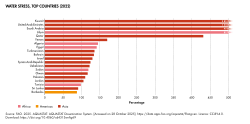
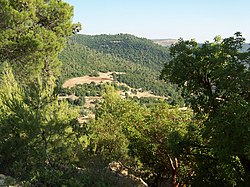
Jordan was the seventeenth most water-stressed country in the world in 2022.

A forest in Ajloun, northern Jordan. Forests make less than 2% of Jordan, making it among the world's least forested countries.

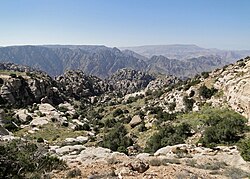
The Dana Biosphere Reserve in southern Jordan lies along the Jordan Trail, a hiking path that is gaining popularity.

Economy, Society, and Infrastructure
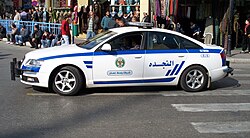
An Amman City Centre Police patrol vehicle. Jordan's law enforcement was ranked 37th globally by the 2016 World Internal Security and Police Index.

Jordan's economy is diverse, utilizing natural resources such as phosphates and investing in renewable energy. The Tafila Wind Farm is the first and largest commercial wind farm in the Middle East, generating 117 MW of power.
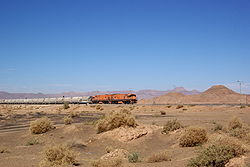
A phosphate train at Ram station

The 117 MW Tafila Wind Farm in southern Jordan is the first and largest commercial wind farm in the Middle East.[233]

The nation is also known for its humanitarian efforts, hosting a significant number of refugees. The Zaatari camp is the largest Syrian refugee camp in the world, housing approximately 80,000 people.
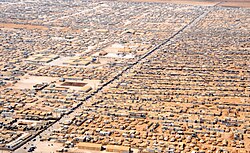
An aerial view of a portion of the Zaatari refugee camp which contains a population of 80,000 Syrian refugees, the largest Syrian refugee camp in the world

Socially, Jordan has made great strides in education. As of 2015, the youth female literacy rate (ages 15–24) reached an impressive 99.37%.

Jordanian school girls pictured reading in a public school. Jordan's youth female literacy rate (15 – 24 years) was 99.37% in 2015.[269]

National Identity and Culture

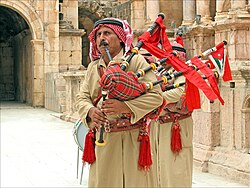
Jordanian culture is a blend of Bedouin traditions and urban modernity. Mansaf, a traditional dish originating from Bedouin life, serves as a primary symbol of Jordanian hospitality. The nation also celebrates its heritage through events like the Jerash Festival, where folklore bands perform traditional music.
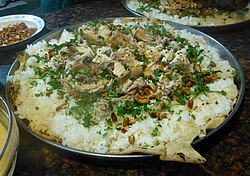
Mansaf, the traditional dish of Jordan, originates from Bedouin life and is a symbol of Jordanian hospitality.

Jordanian folklore band playing bagpipes in Jerash

Country Overview Summary

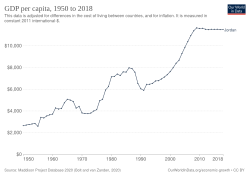
Change in per capita GDP of Jordan, 1950–2018. Figures are inflation-adjusted to 2011 International Geary-Khamis dollars.
Category Detail
Official Name Hashemite Kingdom of Jordan
Total Area 89,342 km²
Population (2023 est.) 11,484,805
GDP (Nominal 2023) $50.022 billion
HDI (2023) 0.754 (High)
Main Ethnic Group Arab (95%)
Primary Religion Islam (95%)

Frequently Asked Questions

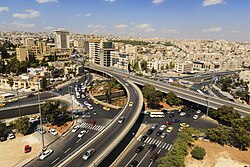
View of a part of the capital Amman
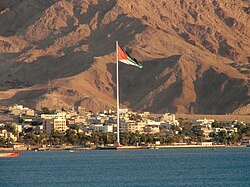
The Aqaba Flagpole in the southernmost city of Aqaba, Jordan's only coastal outlet

What is the significance of the Dead Sea in Jordan?

The Dead Sea is the lowest point on Earth and serves as both a natural resort and a significant geographical landmark along Jordan's western border.

When did Jordan gain its independence?

Jordan declared its independence from the United Kingdom on May 25, 1946.

What is Mansaf?

Mansaf is the traditional national dish of Jordan, originating from Bedouin culture and symbolizing the country's hospitality.

How does Jordan address its energy needs?

Jordan is investing in renewable energy, exemplified by the Tafila Wind Farm, which is the first and largest commercial wind farm in the Middle East.

What is the Decapolis?

The Decapolis was a league of ten Greco-Roman cities; seven of these cities are located within the borders of modern-day Jordan, including Jerash.