John Lydgate: The Prolific Monk and Poet of the Chaucerian Era
John Lydgate (c. 1370 – c. 1451) stands as one of the most industrious literary figures of the Middle Ages. A Benedictine monk based at the Bury St Edmunds Abbey, Lydgate was a central figure in the Chaucerian movement—a literary tradition that followed the style and influence of Geoffrey Chaucer. With a staggering output of approximately 145,000 lines of verse, Lydgate expanded the boundaries of English poetry, blending religious devotion with courtly romance and historical epic.
Key Facts
- Identity: An English monk, poet, and former Prior of Hatfield Broad Oak.
- Literary Output: Produced roughly 145,000 lines of poetry across various genres.
- Major Works: Best known for The Troy Book and The Fall of Princes.
- Patronage: Supported by Kings Henry IV, Henry V, and Henry VI, as well as the Duke of Gloucester.
- Education: Likely studied at Gloucester College, University of Oxford.
Early Life and Spiritual Journey
Born in Lidgate, near Haverhill, Suffolk, Lydgate's early years were marked by the typical mischief of childhood. In his later poem, The Testament, he candidly recalled stealing apples, lying to avoid trouble, and gambling with cherry stones. His path toward a religious life began in 1382 when he entered the Benedictine monastery of Bury St Edmunds Abbey.
Lydgate's progression through the Catholic Church orders was steady: he was ordained as a subdeacon in 1389, a deacon in 1393, and finally a priest in 1397. His intellectual development continued at the University of Oxford, likely at Gloucester College (now Worcester College), between 1406 and 1408. During this academic period, he authored Isopes Fabules, a work reflecting his deep scholastic training.
A Career of Royal Patronage
Lydgate was not merely a cloistered monk; he was an ambitious writer who sought the favor of the English elite. He maintained friendships with Thomas Chaucer, the son of Geoffrey Chaucer, and secured patronage from three successive kings: Henry IV, Henry V, and Henry VI. Other notable supporters included the mayor and aldermen of London and the chapter of St Paul's Cathedral.
In 1423, Lydgate was appointed Prior of Hatfield Broad Oak in Essex. However, he soon resigned this position to dedicate himself fully to his travels and his prolific writing career. From 1422 onward, his primary supporter was Humphrey, Duke of Gloucester.
Literary Contributions and Genres
Lydgate mastered nearly every major genre of his time, excluding the fabliau (a short, often bawdy, comic tale), which was deemed unsuitable for a monk. His work evolved from shorter, Chaucer-inspired lyrics to massive, moralistic epics.
Epic and Historical Narratives
Lydgate's most ambitious projects were his historical epics. The Troy Book (30,117 lines), commissioned by Prince Henry (later Henry V), was an expanded translation of Guido delle Colonne's Latin history. He further explored chivalric themes in The Siege of Thebes (4,716 lines). His final and longest work, The Fall of Princes (36,365 lines), focused on the vicissitudes of Fortune, drawing inspiration from Boccaccio's De Casibus Virorum Illustrium.
Religious and Allegorical Works
Drawing on the rhetorical style of Chaucer's The Man of Law's Tale, Lydgate wrote legends for local monastic patrons, including St Edmund and St Alban. His more devout work, The Life of Our Lady, is noted for its genuine spiritual depth. His early career also featured accessible allegories such as The Complaint of the Black Knight and The Temple of Glas.
Legacy and Critical Reception
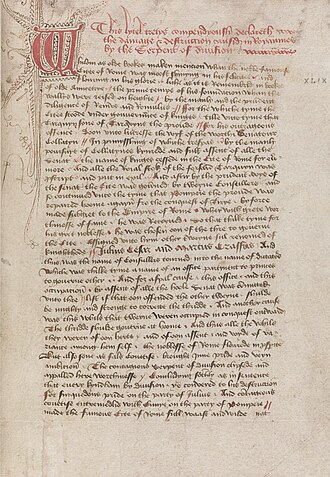
While Lydgate was revered in his own time, later critics were less kind. Joseph Ritson famously described him as a "voluminous, prosaick and drivelling monk," and some modern historians have labeled his verse as "banal." Despite this, Lydgate's influence persists in the English language; he is credited with the first full usage of the adage "Needs must" (He must nedys go that the deuell dryves), a phrase later used by William Shakespeare.
Lydgate spent his final years at Bury St Edmunds Abbey, where he likely died around 1451. In a fascinating modern discovery in 2014, a graffito containing his signature and a coded message was found on a wall at St Mary's Church in his birth village of Lidgate.
| Work | Approximate Length | Genre/Subject | Source/Influence |
|---|---|---|---|
| The Troy Book | 30,117 lines | Historical Epic | Guido delle Colonne |
| The Fall of Princes | 36,365 lines | Moral Narrative | Boccaccio |
| The Life of Our Lady | 5,932 lines | Religious Poem | Devotional |
| The Siege of Thebes | 4,716 lines | Chivalric Epic | Roman de Thebes |
| Legends of St Alban | 4,734 lines | Hagiography | Chaucerian model |
Frequently Asked Questions
What was John Lydgate's relationship with Geoffrey Chaucer?
Lydgate was a great admirer of Chaucer and a friend to his son, Thomas. He adopted the Chaucerian style and explored most of the genres Chaucer established, though he expanded them into much longer, more moralistic forms.
Which works are falsely attributed to Lydgate?
The long allegorical poem The Assembly of Gods and the satirical work London Lickpenny were once attributed to him, but modern scholarship has discredited these claims.
What is the significance of the "Needs must" phrase?
Lydgate is credited with the first known usage of the adage in its fullest form: "He must nedys go that the deuell dryves." This expression was later adopted by William Shakespeare in All's Well That Ends Well.
Where did John Lydgate spend most of his life?
Lydgate spent the majority of his life as a monk at the Bury St Edmunds Abbey in Suffolk, England, though he briefly served as the Prior of Hatfield Broad Oak in Essex.
How did Lydgate's writing style change over time?
His early works were shorter and more closely aligned with Chaucer's lyrics and allegories. As he aged, his poetry became progressively longer and more voluminous, leading some later critics to view his later work as overly wordy or banal.