John Hall: From Musician to U.S. Representative
John Hall is a multifaceted figure known for his transition from the music industry to the halls of American political power. A progressive Democrat, Hall's entry into public service was driven by a deep commitment to environmental protection and community advocacy, eventually leading him to represent New York's 19th congressional district in the U.S. House of Representatives.
Early Community Activism and Local Governance
Before entering national politics, Hall established a strong record of local activism in New York. He was actively involved with the Mid-Hudson Nuclear Opponents, a group that successfully prevented the construction of a nuclear power plant in Greene County on the Hudson River. While residing in Saugerties, he co-founded Saugerties Concerned Citizens and played a pivotal role in drafting the town's first zoning law.
Hall's leadership became more prominent when he led the opposition against a proposed 200-acre solid waste dump on the historic Winston farm in Ulster County. This grassroots effort served as a springboard for his political career, leading to his election to the Ulster County Legislature in 1989.
Later, in the late 1990s, Hall turned his attention to education. After voters rejected three consecutive school budgets, he ran for the Saugerties Board of Education. He was elected twice and subsequently chosen as president by his fellow trustees, overseeing the successful passage of budgets throughout his tenure.
Tenure in the U.S. House of Representatives
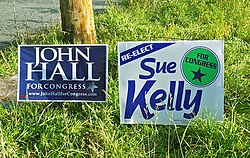
In 2005, motivated by concerns regarding the Iraq War, environmental issues, and dissatisfaction with the incumbent Representative Sue Kelly, Hall decided to run for Congress. After winning the Democratic primary, he defeated Kelly in the general election to represent New York's 19th district.
During his time in the House, Hall held several key committee assignments, including the Committee on Transportation and Infrastructure and the Select Committee on Energy Independence and Global Warming. He was notably one of only three freshmen representatives to be appointed as a subcommittee chairman, leading the Subcommittee on Disability Assistance and Memorial Affairs within the House Veterans Affairs Committee.
In this leadership role, Hall helped author the Veterans Claims Modernization Act of 2008. This legislation passed both the House and Senate unanimously and was signed into law by President George W. Bush, who described the act as "good government."
Election Cycles and Departure
Hall was re-elected in 2008, defeating Republican Kieran Lalor with 59% of the vote. However, the 2010 election saw him lose his seat to Republican Nan Hayworth. In July 2011, Hall announced he would not seek a rematch, citing the prohibitive costs of fundraising following the Supreme Court's decision in Citizens United v. FEC. He expressed a desire to return to his family and tour with his band.
Policy Positions and Political Philosophy
Despite representing a historically Republican-leaning area, Hall identified as a progressive and was a member of the Congressional Progressive Caucus. His legislative record includes voting to increase the minimum wage and supporting federal funding for embryonic stem cell research.
Hall's stance on drug policy was nuanced. He previously argued that drug prohibition had failed and supported reforms regarding medical marijuana and the Higher Education Act's restrictions on financial aid for students with drug offenses. However, in July 2007, he voted against an amendment that would have ended raids on medical marijuana patients.
Other notable positions included:
- Healthcare: Voted in favor of the Healthcare Reform Bill in both the House (2009) and Senate (2010).
- Reproductive Rights: Opposed the Stupak Amendment, which sought to restrict federal funds for abortion.
- Environment: Acted as a critic of BP's management of the Deepwater Horizon oil spill.
Key Facts
- District: Represented New York's 19th congressional district.
- Key Legislation: Co-authored the Veterans Claims Modernization Act of 2008.
- Political Affiliation: Progressive Democrat and member of the Congressional Progressive Caucus.
- Local Legacy: Co-founded Saugerties Concerned Citizens and served as Saugerties Board of Education president.
- Congressional Committees: Served on Veterans Affairs, Transportation and Infrastructure, and Energy Independence and Global Warming.
| Election Year | Opponent | Result | Notes |
|---|---|---|---|
| 2006 | Sue Kelly | Won (51%) | Defeated incumbent in a historically Republican district. |
| 2008 | Kieran Lalor | Won (59%) | Re-elected to the 111th Congress. |
| 2010 | Nan Hayworth | Lost | Ended his tenure in the House of Representatives. |
Frequently Asked Questions
Why did John Hall leave politics in 2011?
Hall decided not to run for re-election against Nan Hayworth because of the extreme fundraising requirements created by the Supreme Court's Citizens United v. FEC decision. He also wished to spend more time with his family and tour with his band.
What was John Hall's most significant legislative achievement?
His most prominent achievement was helping to write the Veterans Claims Modernization Act of 2008, which passed unanimously through Congress and was signed into law by President George W. Bush.
How did Hall's music career intersect with his political life?
Beyond his public image, Hall's music caused friction with political campaigns. He successfully issued cease and desist letters to the George W. Bush (2004) and John McCain (2008) campaigns for using his song "Still the One" without permission.
What were Hall's views on drug policy reform?
Hall believed that drug prohibition had failed and supported reforms for medical marijuana and student financial aid. However, his voting record was mixed, as he voted against a 2007 amendment to end raids on medical marijuana patients.
Which committees did John Hall serve on in Congress?
He served on the Committee on Transportation and Infrastructure, the House Veterans Affairs Committee (where he chaired the Subcommittee on Disability Assistance and Memorial Affairs), and the Select Committee on Energy Independence and Global Warming.