Jogye Order: The Largest Buddhist Sect of South Korea
The Jogye Order (officially the Jogye Order of Korean Buddhism) stands as the most prominent Buddhist sect in South Korea. With a vast network of approximately 3,100 temples and 13,000 monks as of 2018, it serves as a cornerstone of Korean spiritual life. While its modern administrative form was established in 1962, the order's spiritual lineage stretches back to the Unified Silla period, blending ancient traditions with contemporary practice.
Key Facts
- Status: The largest Buddhist sect in South Korea.
- Principal Scripture: The Diamond Sutra.
- Core Practice: Ganhwaseon (a form of Zen meditation focusing on koans).
- Leadership: Led by a Supreme Patriarch (Ven. Seongpa) and a President (Ven. Jinu).
- Scale: Operates 25 parishes with thousands of subordinate temples.
Religious Philosophy and Practice
The Jogye Order is rooted in Seon (Zen) Buddhism. Its core principles emphasize direct pointing to the mind, seeing one's true nature to attain Buddhahood, and transmitting the Dharma to save all sentient beings. The primary method of practice is ganhwaseon, where a master provides a hwadu (a paradoxical riddle or koan) to a disciple to trigger deep meditative inquiry.
Despite its Seon focus, the order embraces syncretic Buddhism, incorporating elements from Huayan, Pure Land, and Vajrayana traditions. This openness allows followers to engage in various practices, including nianfo (chanting the name of Amitabha Buddha) and other scriptural studies.
Historical Evolution
Foundations and the Goryeo Era
The order takes its name from Mount Caoxi, the residence of Huineng, the sixth patriarch of Chan Buddhism. It originated from the Nine Mountain Schools of the Unified Silla period, with Doui credited as the founder who first brought Seon to Korea. During the Goryeo dynasty, the leader Jinul reorganized these schools, promoting the principle of donojeomsu—the concept of sudden enlightenment followed by gradual cultivation.
Persecution and Resilience
The Joseon dynasty shifted state preference toward Confucianism, leading to centuries of Buddhist suppression, including bans on monks entering the capital. However, Buddhism survived in sansa (mountain temples) through the efforts of monks like Hyujeong and Yujeong. Even during the Japanese colonial period, monks such as Jinjong and Manhae resisted colonial rule and worked to establish an independent Buddhist order, leading to the 1941 formation of the Jogye Order of Joseon Buddhism.
Modern Era and Purification
Following Korea's liberation, a "purification movement" (1954–1962) sought to remove daecheoseung (married monks), a practice introduced during the Japanese occupation. This led to the official establishment of the Jogye Order of Korean Buddhism in 1962, centered on bhikkus (unmarried monks). Those who wished to remain married eventually formed the separate Taego Order in 1970.
The order has also faced political turmoil, most notably the October 27th Buddhist Persecution in 1980, when the Chun Doo-hwan government arrested nearly 2,000 monks and personnel, an event widely viewed as an abuse of state power and a violation of religious freedom.
Organizational Structure and Governance
The Jogye Order operates through a tripartite system: the headquarters (executive), the central council (legislative), and the precepts adjudication council (judicial). The Supreme Patriarch holds the highest authority with a five-year term, while the President manages administrative affairs and is elected via an indirect system by a 321-member electoral body.
The order is divided into 25 parishes. Each parish is led by a bonsa (head temple), which oversees numerous malsa (subordinate temples). For example, Jogyesa in Seoul serves as the first parish.
| Category | Detail |
|---|---|
| Supreme Patriarch | Ven. Seongpa (2022-2027) |
| President | Ven. Jinu (2022-2026) |
| Number of Temples | ~3,185 |
| Number of Monks | ~13,327 |
| Followers | 12 million (reported) / 260,000 (registered) |
Global Outreach and Philanthropy
In the 21st century, the order has focused on globalization through the Cultural Corps of Korean Buddhism. This initiative introduced Templestay, a program allowing the public to experience monastic life, and the promotion of traditional Korean temple cuisine.
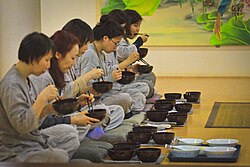
The order is also active in social welfare via the Jogye Order Social Welfare Foundation, providing aid to the disabled, elderly, and homeless. Their philanthropic reach extends internationally, providing disaster relief for events such as the 2005 Sri Lanka earthquake and the 2011 Tōhoku earthquake.
![In 2020, the order donated for the overcoming of COVID-19 pandemic.[19]](/images/3d/19/3d19e4c4c7f036f8106102893cae4044b5e684a775d9b3b41271856e4f7d8391.jpg)
Affiliated Institutions
- Bulgyo Sinmun: A major Buddhist newspaper founded in 1960 to aid missionary work.
- Central Buddhist Museum: Established in 2007 to preserve national treasures, including reliquaries from the Bulguksa Temple pagoda.
- Educational Institutions: The order operates 24 schools, including Dongguk University and Joongang Sangha University.
Frequently Asked Questions
What is the difference between the Jogye Order and the Taego Order?
The primary difference stems from the "purification movement" of the 1950s. The Jogye Order consists of bhikkus (unmarried monks), while the Taego Order was formed by daecheoseung (married monks).
What is ganhwaseon meditation?
Ganhwaseon is a meditation practice where a student focuses on a hwadu (koan)—a paradoxical question—to break through logical thinking and achieve a direct realization of their true nature.
What is the role of the Supreme Patriarch?
The Supreme Patriarch is the highest authority within the Jogye Order, serving a five-year term as the spiritual leader of the sect.
How does the parish system work?
The order is divided into 25 parishes. Each is led by a head temple (bonsa) that manages the administrative and spiritual affairs of numerous smaller subordinate temples (malsa) within its region.
What is Templestay?
Templestay is a globalization program launched by the order that allows visitors to stay at a temple, participate in Buddhist rituals, and experience monastic life and temple cuisine.