Jikji: The World's Oldest Book Printed with Movable Metal Type
In the history of human communication, few innovations have been as transformative as the invention of movable type. While many associate the dawn of the printing age with Johannes Gutenberg’s 15th-century Bible, a much older treasure exists. The Jikji, a Korean Buddhist document, stands as the world's oldest extant book printed using movable metal type, predating Gutenberg by nearly 80 years.
Compiled during the Goryeo Dynasty, the Jikji is not only a masterpiece of early printing technology but also a profound spiritual guide. Its significance was formally recognized by UNESCO in September 2001, when it was inscribed on the Memory of the World Register.
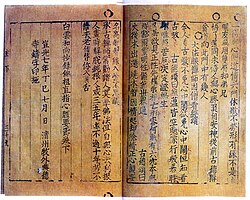
Understanding the Jikji
The full title of the document is Baegun hwasang chorok buljo jikji simche yojeol. In English, it is commonly translated as the "Anthology of Great Buddhist Priests' Zen Teachings." The abbreviated title, Jikji, is derived from a core Buddhist concept: "Jikji Insim Gyeonseong Seongbul." This translates to: "When you see a person’s heart correctly through meditation, you realize that the nature of the heart is the mind of Buddha."
Origins and Authorship
The text was written by the Buddhist monk Baegun (1298–1374), also known by his Buddhist name, Gyeonghan. Baegun’s spiritual journey included studying under the Chinese Master Seok-ok and the Indian high priest Jigonghwasang. He eventually served as the chief priest of several temples, including Anguksa and Shingwangsa, before writing and editing the Jikji at Chwiamsa Temple in Yeoju.
Spiritual Content
The Jikji serves as a collection of excerpts from the teachings of revered Buddhist monks across generations. It was designed as a guide for students of Buddhism, which was the national religion of Korea during the Goryeo Dynasty (918–1392). Specifically, the text outlines the essentials of Seon, the Korean predecessor to what is known in Japan as Zen Buddhism.
The History of Its Printing
The Jikji was originally published in two volumes at Heungdeok Temple in 1377. While the original metal-printed edition consisted of 307 chapters, only the second volume survives today. This surviving volume is currently held at the National Library of France (BnF) in the Manuscrits Orientaux division.
Interestingly, a woodblock version—a method where text is carved into wooden blocks rather than using individual metal characters—was also produced in 1378. Several woodblock printings of the Jikji still exist today in varying states of completeness, held by institutions such as the National Library of Korea and the Academy of Korean Studies.
Technical Characteristics
The surviving metal-printed pages offer a fascinating look at 14th-century technology. The paper is thin and white, and the dimensions of the metal type are approximately 24.6 × 17.0 cm. Unlike modern printing, the lines in the Jikji are not perfectly straight, and the ink thickness varies significantly. Some characters even appear reversed or incomplete, reflecting the manual nature of the process.

Key Facts
- Date of Publication: 1377 (Goryeo Dynasty).
- Historical Milestone: Predates Gutenberg's Bible by approximately 78 years.
- UNESCO Status: Inscribed on the Memory of the World Register in 2001.
- Current Location: The surviving metal-printed volume is held at the National Library of France.
- Author: The Buddhist monk Baegun.
- Printing Method: Movable metal type.
Modern Restoration and Rediscovery
The Jikji gained global attention in 1972 when it was displayed in Paris during the "International Book Year." It was "rediscovered" by Dr. Park Byeongseon, a librarian at the National Library of France.
To honor this heritage, significant efforts have been made to restore the work. Between 2011 and 2016, Cheongju city invested approximately 1.81 billion won (roughly US$1.5 million) into a Goryeo-era metal type restoration project. Experts used the traditional wax casting method—a process where letters are attached to beeswax, covered in soil, and filled with molten iron—to replicate the original 31,200 characters. This allowed for a full reconstruction of the printing plates used in the 14th century.
| Version Type | Status | Current Location(s) |
|---|---|---|
| Metal Movable Type (Vol. 1) | Lost | N/A |
| Metal Movable Type (Vol. 2) | Extant | National Library of France (BnF) |
| Woodblock Prints | Extant | National Library of Korea, Bulgap Temple, Academy of Korean Studies |
The Ownership Controversy
The Jikji is currently at the center of a long-standing dispute regarding cultural heritage. The second volume was brought to France by the diplomat Victor Collin de Plancy in the early 1900s. It was later purchased by collector Henri Véver and donated to the National Library of France in 1911.
The Arguments:
- The National Library of France maintains that the Jikji is a piece of "common, worldwide heritage" that is better preserved and displayed within their prestigious institution.
- Korean Activists and Organizations, such as the Committee to Bring Jikji Back to Korea, argue that the book is a vital piece of Korean national history and should be repatriated to its country of origin.
Frequently Asked Questions
How does the Jikji compare to the Gutenberg Bible?
The Jikji is significantly older. It was printed in 1377, while Johannes Gutenberg's famous 42-line Bible was printed between 1452 and 1455, making the Jikji roughly 78 years older.
What is the "wax casting method" used in its restoration?
The wax casting method is an ancient technique where letters are attached to beeswax derived from honeycombs. A mold is created by wrapping the wax in soil, and molten iron is then poured into the spaces where the wax has melted to create the metal type.
Why is only one volume of the metal-printed Jikji available?
While the original work was published in two volumes, the first volume of the metal-printed edition is no longer extant. Only the second volume survives, which is why researchers often use the surviving woodblock versions to help fill in missing information during restoration.
Where can I see the Jikji today?
The surviving metal-printed volume is kept at the National Library of France in Paris. However, the National Library of France also provides a digital copy online for public access.
What is the significance of the Jikji to Buddhism?
The Jikji is a compilation of teachings from the most revered Buddhist monks. It serves as a practical guide for students to understand the essentials of Seon (Zen) Buddhism and the nature of the mind.