Jewish-Muslim Historical Interactions and Interfaith Relations
For over fourteen centuries, Jews have lived within predominantly Islamic nations. Because national borders have shifted frequently throughout this history, many communities—such as the Jewish population in Cairo—have existed across multiple different nations over time. The relationship between these two groups has been characterized by periods of profound cultural synergy, legal frameworks of protected status, and times of intense conflict.
The Middle Ages and the Golden Age
In the Iberian Peninsula, under Muslim rule, a period often called the Golden Age of Jewish culture emerged. During this era, Jews made significant advancements in philosophy, mathematics, astronomy, chemistry, and philology.
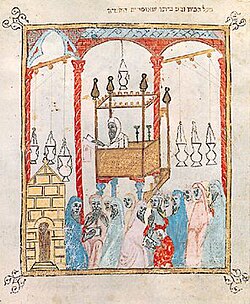
Traditionally, Jews and Christians living in Muslim lands were classified as dhimmis. This status allowed them to practice their religion and manage their own internal affairs, provided they adhered to specific conditions. These included paying the jizya (a per capita tax for free, adult non-Muslim males) while being exempt from the zakat (the tax required of Muslim males). While dhimmis were generally prohibited from bearing arms or testifying in most Muslim courts—as they followed Halakha (Jewish law) rather than Sharia—they were largely free to choose their professions and residences.
The Pact of Umar provided the guidelines for these restrictions. While some historians note that requirements for distinctive clothing were likely later inventions of the Abbasid Caliphate rather than Quranic mandates, the Pact of Umar remained a restrictive framework. Despite this, Jews under Islamic rule generally experienced more compassion and political advancement than those in Western Christendom at the time, with some ascending to high-ranking government positions.
Periods of Persecution and Restriction
Tolerance was not universal. The 12th century saw the Almohad dynasty in Al-Andalus and North Africa engage in the killing or forced conversion of Jews. Similarly, in Morocco, Jews were eventually confined to walled quarters known as mellahs, a practice that intensified between the 15th and 19th centuries. Other notable events include the conversion of the Khazaria state to Judaism, while its subject, Volga Bulgaria, converted to Islam.
Religious Conversions
Conversion from Judaism to Islam
Islam accepts converts and encourages Dawah (the act of inviting others to Islam). Historically, Jews were viewed as People of the Book, granting them freedom of religion. However, forced conversions occurred under specific regimes for political or religious reasons. Examples include the Anusim (or Daggataun) of Timbuktu in 1492 and the Chala of the Bukharan Jewish community.
In Persia, the Safavid dynasty (16th–17th centuries) forced Jews to publicly convert and take the name Jadid-al-Islam (New Muslims), though an edict in 1661 eventually overturned these forced conversions. In Yemen, the 17th-century Mawza Exile forced Jews to choose between conversion or banishment to the desert. In 1839, the Jews of Mashhad converted en masse to end a pogrom, practicing Judaism secretly for over a century.
In Turkey, the claimed messiah Sabbatai Zevi and several thousand followers converted to Islam in 1668, becoming known as the Dönmeh.
Conversion from Islam to Judaism
Judaism generally does not proselytize and encourages non-Jews to follow the Seven Laws of Noah. Consequently, conversions from Islam to Judaism are rare. Notable examples include Ovadyah (a contemporary of Maimonides), Reza Jabari (an Iranian flight attendant), and Avraham Sinai (a former Hezbollah fighter).
The Contemporary Era
Today, Iran hosts the largest Jewish community among predominantly Muslim countries, followed by Turkey and Uzbekistan. In Iran, Jews are recognized as a religious minority and are allocated a seat in parliament, though strict emigration laws limit their movement.
The Arab-Israeli conflict remains the defining element of modern relations. Following the proclamation of the State of Israel on May 14, 1948, and the subsequent 1948 Arab-Israeli War, temporary borders known as the Green Line were established. This era saw massive population shifts: approximately 711,000 Arabs fled or were expelled, and between 800,000 and 1,000,000 Jews were forcibly expelled from or fled Arab and Muslim nations due to persecution.

Interfaith Activities and Dialogue
The concept of Abrahamic religions encompasses the three main monotheistic faiths: Judaism, Christianity, and Islam. Formal interfaith exchanges became more common in American cities after the 1993 Oslo Accords, with Jordan and Qatar also actively fostering dialogue through institutes and conferences.
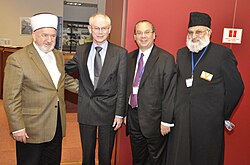
However, these relations have faced setbacks. Following the 9/11 attacks, some interfaith dialogues collapsed due to anti-Jewish rhetoric from certain community leaders. For example, Imam Mohammad Al-Gamei'a of the New York Islamic Cultural Center made controversial claims regarding Jewish responsibility for the attacks, and Imam Fawaz Damra in Cleveland was revealed to have used inflammatory language against Jews in a 1991 recording.
Despite these challenges, positive initiatives continue. The Foundation for Ethnic Understanding, led by Rabbi Marc Schneier and Russell Simmons, hosts the National Summit of Imams and Rabbis and the "Weekend of Twinning." In Los Angeles, the Center for Muslim-Jewish Engagement—a partnership between the University of Southern California, The Hebrew Union College, and the Omar Foundation—provides scholarly resources and text-study groups to build community bonds.
Key Facts
- Golden Age: A period of high cultural and scientific achievement for Jews in Muslim-ruled Iberia.
- Dhimmi Status: A legal framework allowing non-Muslims to practice their faith in exchange for the jizya tax.
- Population Shifts: Post-1948, roughly 800,000 to 1 million Jews left Arab nations, while 711,000 Arabs fled or were expelled from Israel.
- Abrahamic Faiths: The collective term for Judaism, Christianity, and Islam.
- Modern Presence: Iran currently has the largest Jewish population among predominantly Muslim countries.
| Term/Concept | Definition/Impact | Context |
|---|---|---|
| Dhimmi | Protected non-Muslim subjects | General Islamic Law |
| Jizya | Per capita tax on non-Muslim males | Financial obligation for protection |
| Pact of Umar | Restrictive guidelines for Jews/Christians | Early Islamic territories |
| Mellahs | Walled Jewish quarters | Morocco (15th century onwards) |
| Dönmeh | Converts who maintained Jewish identity | Turkey (Sabbatai Zevi followers) |
Frequently Asked Questions
What was the Golden Age of Jewish culture?
It was a period in the Iberian Peninsula under Muslim rule where Jews achieved significant progress in science, philosophy, and the arts, enjoying a level of tolerance and social mobility higher than that found in contemporary Western Christendom.
What is the difference between jizya and zakat?
The jizya was a tax paid by free, adult non-Muslim males (dhimmis) to the government, whereas the zakat was a religious tax imposed specifically on free, adult Muslim males.
Who are the Dönmeh?
The Dönmeh are descendants of the followers of Sabbatai Zevi, a claimed messiah who was forced to convert to Islam in 1668. While they converted, many continued to view themselves as Jews.
How did the 1948 conflict affect Jewish populations in Arab countries?
Following the creation of the State of Israel and the 1948 Arab-Israeli War, between 800,000 and 1,000,000 Jews were either forcibly expelled from or fled Arab and Muslim nations due to increasing persecution.
What is the current status of Jews in Iran?
Iran has the largest Jewish community in the Muslim world. They are officially recognized as a religious minority and have a designated seat in the Iranian parliament, although they face strict government restrictions on emigration.