Javelin Throw: History, Rules, and World Records
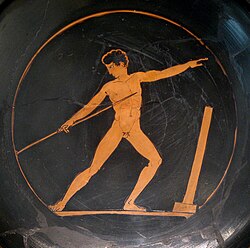
The javelin throw is one of the most storied events in athletics, evolving from an ancient weapon of war into a precision Olympic sport. It requires a unique blend of explosive power, speed, and technical accuracy to propel a spear-like implement across a field for maximum distance.
From its early depictions in ancient art to the modern era of aerodynamic redesigns, the sport has continuously pushed the boundaries of human performance. Today, it is governed by strict specifications to ensure fair competition and safety.
Key Facts
- Men's World Record: 98.48 m set by Jan Železný in 1996.
- Women's World Record: 72.28 m set by Barbora Špotáková in 2008.
- Olympic Men's Record: 92.97 m set by Arshad Nadeem in 2024.
- Olympic Women's Record: 71.53 m set by Osleidys Menéndez in 2004.
- Equipment: Men use an 800g javelin; women use a 600g javelin.
History of the Sport
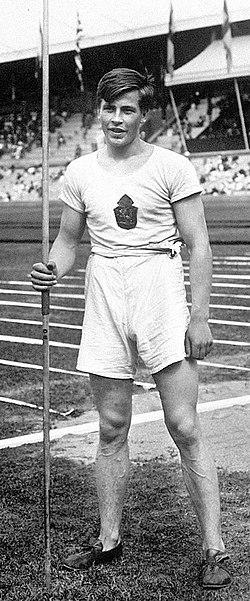
The javelin has deep roots in human history, but its formalization as a competitive sport saw significant milestones in the early 20th century. The first recorded marks for women's javelin were documented in Finland in 1909. Initially, women used the same equipment as men, but a shorter and lighter javelin specifically for women was introduced in the 1920s.
The women's event officially joined the Olympic program in 1932, where Mildred "Babe" Didrikson of the United States claimed the first gold medal.
Rules and Technical Specifications
World Athletics defines the size, shape, minimum weight, and center of gravity for the javelin to maintain consistency across competitions. The center of gravity is the point where the implement is perfectly balanced, which determines how the javelin flies through the air.
Equipment Dimensions
- Men: Length between 2.6 and 2.7 m; weight of 800 g. The grip is located 0.9 to 1.06 m from the tip.
- Women: Length between 2.2 and 2.3 m; weight of 600 g. The grip is located 0.8 to 0.92 m from the tip.

The Competition Area
Unlike other throwing events that use a circle, javelin throwers utilize a runway 4 m wide and at least 30 m long. This runway ends in a throwing arc with an 8 m radius. Athletes use the runway for a "run-up" to build momentum. A throw is only valid if the athlete does not leave the runway until after the javelin has landed.
Javelin Redesigns and Safety
The evolution of the javelin has been marked by technical disputes. In the 1980s, some javelins flew so far they risked hitting spectators or landing flat, making it difficult to determine the exact landing spot. This led to the implementation of a new javelin type in 1986.
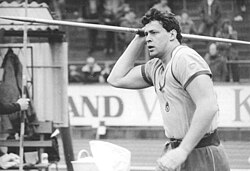
In the early 1990s, some manufacturers attempted to recover lost distance by adding holes, dimples, or rough paint to increase tail drag (the resistance created at the back of the implement). These modifications were banned at the end of 1991, and records set with such equipment—including a 96.96 m throw by Seppo Räty—were nullified.
Weight Requirements by Age Group
To ensure safety and proper development, the weight of the javelin varies by the athlete's age and category.
| Age Group | Men's Weight | Women's Weight |
|---|---|---|
| U14 | 400 g | - |
| U16 | 600 g | 500 g |
| U18 | 700 g | - |
| Junior (U20) | 800 g | 600 g |
| Senior | 800 g | 600 g |
| Masters (75+) | 400 g | 400 g |
Notable Athletes and Cultural Impact
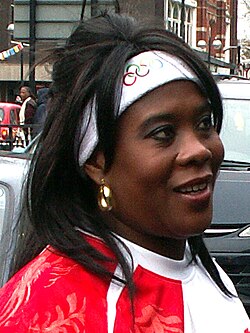
The sport has produced legendary figures such as Jan Železný, who holds the current men's world record, and Barbora Špotáková, who holds the women's record. In the UK, Tessa Sanderson became a pioneer as the first Black British woman to win an Olympic gold medal (1984), competing in six consecutive Summer Olympics from 1976 to 1996.
The javelin's influence extends beyond the stadium. In 1994, composer Michael Torke wrote a piece titled Javelin, commissioned by the Atlanta Committee for the Olympic Games to celebrate the 1996 Summer Olympics.
Frequently Asked Questions
What is the longest javelin throw ever recorded?
The longest throw on record is 104.80 m, achieved by Uwe Hohn in 1984. However, this is considered an "eternal world record" because the javelin design was changed in 1986 for safety and landing accuracy.
Why was the javelin design changed in 1986?
The redesign was implemented because javelins were flying too far, posing a danger to spectators and frequently landing flat, which made it difficult for officials to mark the exact point of impact.
What is the difference between the men's and women's javelin?
The men's javelin is heavier (800 g) and longer (2.6–2.7 m), while the women's javelin is lighter (600 g) and shorter (2.2–2.3 m).
Can the javelin be thrown indoors?
While almost always thrown outdoors, it is occasionally thrown indoors. The men's indoor world record is 85.78 m, set by Matti Närhi in 1996.
What happens if an athlete steps over the arc?
The competitor must not leave the runway until after the implement has landed. If they cross the throwing arc before the javelin lands, the throw is invalid.