Japan Coast Guard Equipment and Armaments
The Japan Coast Guard (JCG), formerly known as the Maritime Safety Agency (MSA), maintains a sophisticated fleet of vessels, aircraft, and weaponry designed to ensure maritime safety and security. From its early days of utilizing second-hand naval ships to the development of high-speed, technologically advanced patrol craft, the JCG has evolved to meet the shifting challenges of Japan's territorial waters.
Key Facts
- Fleet Size: Operates 476 watercraft and 98 aircraft.
- Strategic Hub: Ishigaki is the JCG's largest base, surpassing Yokohama, to address grey-zone challenges near the Senkaku Islands.
- Vessel Classification: Ships are categorized by size as PL (Large), PM (Medium), PS (Small), and PC (Craft).
- Specialized Units: The Special Security Team (SST) utilizes advanced weaponry, including MP5 submachine guns and anti-materiel rifles.
- Modernization: Transitioned from USCG-modeled ships to indigenous designs better suited for Japanese sea conditions.
Evolution of the JCG Vessel Fleet
Immediately following its inception, the MSA relied on smaller, slower second-hand ships from the former Japanese Navy. In 1949, new construction began under the guidance of the General Headquarters (GHQ), which mandated that ships be modeled after the United States Coast Guard (USCG). This era saw the introduction of the 700-ton PL Daiou-class (based on Cactus-class buoy tenders), the 450-ton PM Awaji-class (based on Thetis-class), the 270-ton PS Kuma-class (based on Active-class), and the 23-meter PC Hatsunami-class.
These American-style copies proved inadequate for Japan's specific operational needs and sea conditions. Consequently, after the Treaty of San Francisco took effect, the MSA began designing its own vessels. This led to the larger 900-ton Nojima-class (PL) and a differentiation of PS vessels into the 350-ton Tokachi-class and 130-ton Hidaka-class.
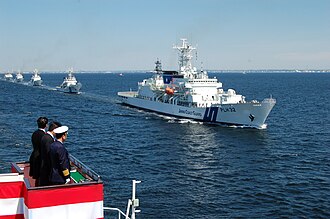
Adapting to Economic Zones and High-Speed Threats
The late 1970s brought new international rules regarding national exclusive economic zones, necessitating a larger fleet. The JCG responded by producing the 1,000-ton PL Shiretoko-class, 500-ton PM Teshio-class, and 30-meter PC Murakumo-class in large quantities. During this time, the agency also introduced PLH vessels equipped with air-sea rescue helicopters.
By the 1980s, the emergence of high-speed criminal vessels and North Korean armed trawlers (fushin-sen) prompted the development of the 180-ton PS Mihashi-class, which balanced ocean-going capability with high speed. Modern upgrades have since included remote-control turrets with automatic tracking for precise machine cannon fire.
Strategic Deployment in the Senkaku Region
To counter grey-zone challenges—situations that fall between peace and open conflict—around the Senkaku Islands, the JCG has significantly expanded its Ishigaki Island facilities. Ishigaki now serves as the largest JCG base, housing 12 large patrol vessels (ten Kunigami-class and two Hateruma-class) and accommodating up to 600 crew members. Additionally, the 11th Regional Coast Guard Headquarters in Naha stations six ships, including three Tsugaru-class vessels.
Fleet and Asset Statistics
The JCG maintains a diverse array of assets to cover everything from hydrographic surveys to high-stakes law enforcement.
| Asset Category | Quantity |
|---|---|
| Patrol Vessels | 147 |
| Patrol Craft | 239 |
| Special Guard and Rescue Craft | 67 |
| Hydrographic Survey Vessels | 15 |
| Aids to Navigation (Tenders/Evaluation) | 19 |
| Buoy Tenders | 5 |
| Training Vessels | 3 |
| Fixed-Wing Aircraft | 35 |
| Rotary-Wing Aircraft | 60 |
| Remotely Piloted Aircraft Systems (RPAS) | 3 |
Armaments and Weaponry
Vessel-Mounted Weapons
Early MSA weaponry was restricted to small arms due to post-war disarmament. However, the Korean War highlighted the need for better security, leading to the installation of larger guns in 1954. Initial armaments included Mark 22 3"/50 caliber guns for PL vessels, Bofors 40 mm L/60 guns for PM and PS types, and Oerlikon 20 mm L/70 guns for smaller craft.
Modernization began in the 1970s, replacing 3-inch guns and introducing Oerlikon 35 mm L/90 guns and JM61-M 20 mm rotary cannons. The 1989 introduction of the PLH Shikishima brought full-scale remote operation and automatic tracking. Today, to counter armed trawlers, PLs are often equipped with remotely controlled 40 mm L/70 guns or 30 mm chain guns with optical directors.
Personal Weapons
The JCG has transitioned from WWII-era Nambu Type 14 pistols and M1 rifles to modern equipment. Standard issue evolved from M60 revolvers to Howa Type 64 rifles, and eventually to the Howa Type 89. Some security units use Smith & Wesson Model 5906 TSW or 360J revolvers.
The Special Security Team (SST) utilizes specialized gear, including Heckler & Koch MP5 A5/SD6 submachine guns, P228 pistols, Howa M1500 sniper rifles, and McMillan Firearms anti-materiel rifles.
Frequently Asked Questions
What do the vessel designations PL, PM, PS, and PC mean?
These designations classify the size of the patrol vessels: PL stands for Large, PM for Medium, PS for Small, and PC for "Craft," which refers to very small vessels.
Why did the JCG move away from USCG-based ship designs?
The early copies of American ship types were found to be unsuitable for the specific operational requirements and the unique sea conditions found around the Japanese archipelago.
Which JCG base is currently the largest?
The base on Ishigaki Island is now the largest, having surpassed the Yokohama facilities to better manage challenges near the Senkaku Islands.
What specialized weapons does the Special Security Team (SST) use?
The SST is equipped with high-end tactical gear, including Heckler & Koch MP5 A5/SD6 submachine guns, P228 pistols, Howa M1500 sniper rifles, and McMillan anti-materiel rifles.
Does the Japan Coast Guard operate its own emergency land vehicles?
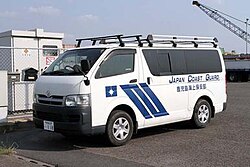
The JCG does not have dedicated emergency vehicles; instead, it uses civilian vans for logistics and minibuses, such as the Toyota Coaster and Nissan Civilian, for transporting prisoners or illegal immigrants.