Isthmus of Panama: The Geological Bridge That Changed the World
The Isthmus of Panama, historically referred to as the Isthmus of Darien, is a narrow strip of land that serves as the critical link between North and South America. Positioned between the Caribbean Sea and the Pacific Ocean, this land bridge is more than just a geographic curiosity; it is a site of immense geopolitical and strategic importance, housing both the nation of Panama and the world-renowned Panama Canal.
The formation of this isthmus was a planetary event, altering ocean currents, shifting global climates, and redefining the distribution of life on Earth. From its volcanic origins to its role in the California Gold Rush, the isthmus has remained a focal point of human and natural history.
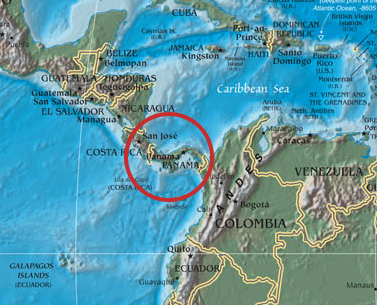
Key Facts
- Formation: Generally thought to have closed around 3 million years ago (Ma), though some evidence suggests as early as 10 to 15 Ma.
- Climate Impact: Its creation led to the formation of the Gulf Stream and contributed to the development of the northern polar ice cap.
- Biological Impact: Facilitated the Great American Biotic Interchange, allowing terrestrial species to migrate between continents.
- Human History: First reached by European explorer Vasco Núñez de Balboa in 1513.
- Strategic Value: Its narrow geography made it the ideal location for the Panama Canal, completed in 1914.
Geological Origins and the Central American Seaway
Millions of years ago, North and South America were separated by the Central American Seaway, a deep body of water that allowed the Atlantic and Pacific Oceans to mix freely. The transition from an open sea to a land bridge was driven by plate tectonics: the Cocos plate slowly slid beneath the Caribbean plate.
This collision created immense heat and pressure, triggering the eruption of underwater volcanoes. Over time, these volcanoes grew into islands, and the gaps between them were filled by massive amounts of sediment from both continents. While traditional theories suggest the isthmus closed roughly 3 Ma, recent studies using zircon crystals and genomic data from army ants suggest the process may have begun as early as 10 to 15 Ma.
![Notable past (purple) and current (orange) land bridges on a bathymetric equirectangular projection centred on 45° E[24]](/images/05/1e/051e4641ba356acdd89ef2dbb2eca349e9ec2282a6874e2befa71feb44a12b55.webp)
The Complexity of Closure
The closure was not a single event but a nuanced process. Evidence indicates that deep-water connections (below 1,800 meters) were broken between 12 and 9.2 Ma. However, surface water continued to exchange until approximately 4.6 Ma. Some researchers believe a temporary breach may have occurred as recently as 2.45 Ma, meaning the final seal of the isthmus remained a dynamic process for millions of years.
Global Environmental and Biological Consequences
The closure of the isthmus triggered a chain reaction of ecological and climatic shifts. By blocking the flow of water between the oceans, it forced the creation of the Gulf Stream. This current carried warm water northward, which, counterintuitively, increased moisture in the air over northern Europe, leading to heavier snowfall and the formation of the Arctic ice cap.
Biologically, the isthmus acted as both a barrier and a bridge. In the oceans, it caused allopatric speciation—the process where biological populations become isolated by geographic barriers, leading to the evolution of new species. On land, it enabled the Great American Biotic Interchange.
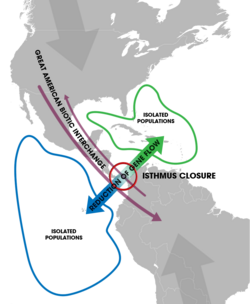
This interchange allowed animals to migrate between the two continents. North American species such as bears, cats, dogs, horses, and raccoons moved south, while South American ancestors of the opossum, armadillo, and porcupine moved north.
Human History and Strategic Significance
The isthmus has been inhabited for millennia. Paleo-Indians likely arrived between 18,000 and 15,000 years ago. The Monagrillo archaeological site provides evidence of some of Central America's earliest ceramics (2500 to 1200 BCE) and early maize agriculture, which eventually evolved into the Gran Coclé culture.
European contact began in the early 16th century. On September 25, 1513, Spanish conquistador Vasco Núñez de Balboa became the first European to reach the Pacific Ocean, which he called the "South Sea."
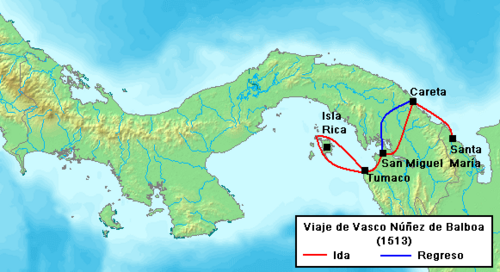
The colonial era was marked by both trade and tragedy. Spanish colonizers inflicted genocide upon the indigenous Cueva people, and by 1550, very few indigenous inhabitants remained in the major colonial cities. The isthmus became a vital hub for the Spanish Silver Train, transporting gold and silver from Peru to Porto Bello for shipment to Spain.
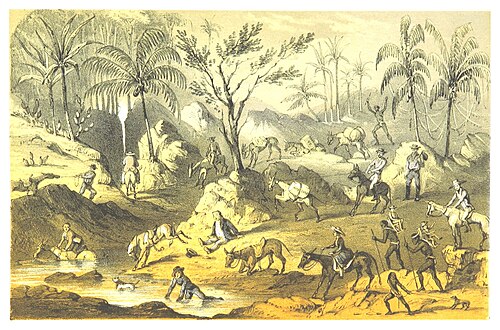
Later attempts at colonization, such as the Scottish Darien scheme in the 1690s, ended in disaster, with over 80% of participants dying within a year. By the mid-19th century, the California Gold Rush surged demand for transit across the isthmus. This eventually led to the efforts of Ferdinand de Lesseps and later the United States to construct the Panama Canal, which opened in 1914.
The Modern Biosphere
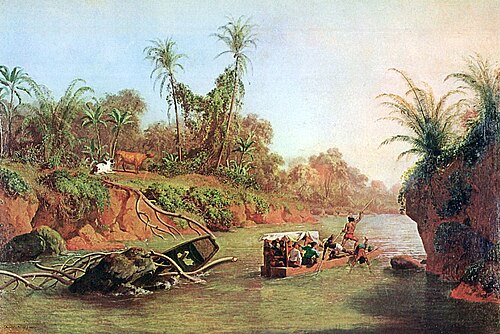
Today, the isthmus is a biodiversity hotspot, blending flora and fauna from both continents. It is home to over 978 species of birds and a vast array of insects, amphibians, and reptiles. The geography is split by a central mountain range, creating two distinct climates: a consistently wet Atlantic side and a Pacific side with defined wet and dry seasons.
| Category | Effect/Event | Significance |
|---|---|---|
| Geology | Closure of Central American Seaway | Separated Atlantic and Pacific Oceans |
| Climate | Formation of the Gulf Stream | Contributed to Arctic ice cap formation |
| Biology | Great American Biotic Interchange | Migration of land species between continents |
| Human History | Construction of Panama Canal | Revolutionized global maritime trade |
Frequently Asked Questions
When did the Isthmus of Panama form?
While it was long believed to have formed around 3 million years ago (Ma), recent geological and genomic evidence suggests the process was more complex, with some closures potentially occurring as early as 10 to 15 Ma.
What is the Great American Biotic Interchange?
It is the migration of terrestrial animals between North and South America made possible by the formation of the land bridge. This allowed species like bears and horses to move south and armadillos and opossums to move north.
How did the isthmus affect the global climate?
The closure of the seaway created the Gulf Stream. This warm current increased moisture in the atmosphere, which led to higher precipitation and snowpack in the north, contributing to the formation of the Arctic ice cap.
Who was the first European to see the Pacific Ocean from the isthmus?
Vasco Núñez de Balboa, a Spanish conquistador, reached the Pacific Ocean (then called the South Sea) on September 25, 1513.
What was the Darien scheme?
The Darien scheme was an unsuccessful attempt by the Kingdom of Scotland in the late 1690s to establish a colony called New Caledonia in the Darién Gap to control an overland trade route between the two oceans.