Ischigualasto Provincial Park: The Moon Valley of Argentina
Located in the northeast of San Juan Province in northwestern Argentina, Ischigualasto Provincial Park is a geological marvel known widely as Valle de la Luna (Valley of the Moon). This name stems from the park's otherworldly, moon-like landscapes, characterized by wind-eroded rock formations and a stark, arid environment. Established on November 3, 1971, the park covers 60,370 hectares and shares a geological connection with the neighboring Talampaya National Park in La Rioja Province.
Together, these two areas form the Ischigualasto-Talampaya Formation, a site of such immense scientific value that UNESCO designated them as World Heritage Sites in 2000.
Key Facts
- Location: San Juan Province, Argentina, near San José de Jáchal.
- UNESCO Status: World Heritage Site since 2000.
- Geological Era: Late Triassic (Carnian), approximately 231.4 to 225.9 million years ago.
- Key Discoveries: Some of the oldest known dinosaur remains in the world.
- Climate: Extremely dry with temperatures ranging from −10 °C to 45 °C.
History and Etymology
The name "Ischigualasto" has several proposed origins. One theory suggests it comes from the extinct Cacán language spoken by the Diaguita people, meaning "place where the moon alights." Other scholars suggest a Diaguita origin meaning "dead land," while some propose roots in the Huarpe language.
Scientific interest in the region began with the first paleontological description in 1930. By 1941, detailed studies revealed 70 species of fossil plants. In 1943, Dr. Ángel Cabrera of the University of La Plata described Exaeretodon, the first cynodont (a group of mammal-like reptiles) found in the area. The park's scientific profile grew significantly in 1958 when Harvard University expert Dr. Alfred Sherwood Romer discovered "extraordinary" fossil beds.
Geography and Environment
The park is situated at an altitude of approximately 1,300 meters above sea level, primarily within the Valle Fértil Department. The landscape is a high-altitude desert where vegetation—consisting of cacti, bushes, and scattered trees—covers only 10% to 20% of the terrain.
The environment is defined by extreme weather. Rainfall occurs mostly during the summer, and the region is subject to constant southern winds (20–40 km/h) and the occasionally violent Zonda wind. The result is a landscape of striking wind-eroded formations, including landmarks like the Sphynx and the Mushroom.
Paleontology of the Ischigualasto Formation
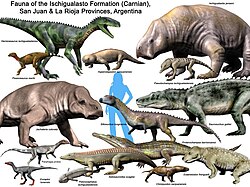
The Ischigualasto Formation is globally renowned for its Late Triassic deposits from the Carnian age. During this period, the region was a volcanically active floodplain with seasonal rainfall and lush vegetation, evidenced by petrified Protojuniperoxylon ischigualastianus tree trunks reaching over 40 meters in height.
The Dawn of the Dinosaurs
While dinosaurs are the most famous residents, they represent a small portion of the total tetrapod (four-limbed vertebrate) fossils. Early studies suggested they made up 6% of findings, a number that has since risen to approximately 11%.
- Predominant Species: Rhynchosaurs (such as Hyperodapedon) and cynodonts (such as Exaeretodon) are the most common fossils.
- Early Dinosaurs: The park contains early samples of both major dinosaur lineages: ornithischians (bird-hipped) and saurischians (lizard-hipped).
- Key Carnivores: Herrerasaurids make up 72% of the terrestrial carnivores found here, with Herrerasaurus being the most numerous.
- Primitive Species: Eoraptor lunensis, discovered in the early 1990s, is a critical specimen showing primitive dinosaur characteristics.
Summary of Park Specifications
| Feature | Details |
|---|---|
| Area | 60,370 ha (233.1 sq mi) |
| Coordinates | 30°4′S 68°0′W |
| UNESCO Criteria | Criterion viii (Natural) |
| Geological Period | Late Triassic (Carnian) |
| Key Fossil Taxa | Herrerasaurus, Eoraptor, Exaeretodon |
Frequently Asked Questions
Why is it called the Valley of the Moon?
It is called Valle de la Luna because of its unique, wind-eroded rock formations and arid landscape that resemble the surface of the moon.
What makes the fossils here so important?
The Ischigualasto Formation contains some of the oldest and best-preserved dinosaur remains in the world, providing crucial evidence about the early evolution of dinosaurs.
What was the environment like 230 million years ago?
During the Carnian age, the area was a volcanically active floodplain with seasonal rains and rich vegetation, including ferns, horsetails, and massive trees over 40 meters tall.
Which dinosaurs are most common in the park?
The most numerous dinosaur fossils are the carnivorous archosaurs of the genus Herrerasaurus.
Is the park part of a larger protected area?
Yes, it is part of the Ischigualasto / Talampaya Natural Parks UNESCO World Heritage site, sharing the same geological formation as Talampaya National Park.