Iran National Football Team: A Legacy of Asian Dominance
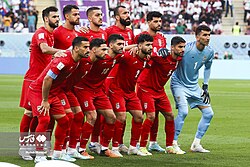
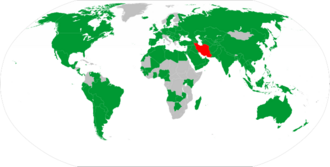
Known affectionately as Team Melli (the National Team) or the Yuzhaye Irani (Persian Cheetahs), the Iran national football team stands as one of the most successful and storied programs in Asian football. Governed by the Football Federation Islamic Republic of Iran (FFIRI), the team has a long history of competing at the highest levels of the sport, blending technical skill with a fierce competitive spirit.
From its early international steps to becoming a perennial powerhouse in the Asian Football Confederation (AFC), Iran's journey is marked by historic triumphs and a consistent presence on the global stage.
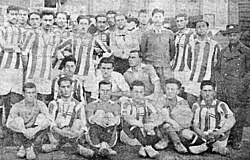
Key Facts
- Major Honors: Three-time AFC Asian Cup Champions (1968, 1972, 1976).
- World Cup Presence: Seven appearances in the FIFA World Cup finals, starting in 1978.
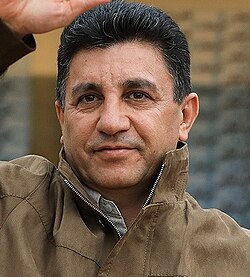
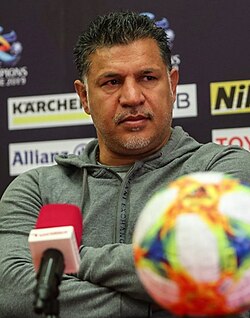
- Legendary Scorer: Ali Daei holds the record as the world's third all-time leading international goalscorer with 108 goals.
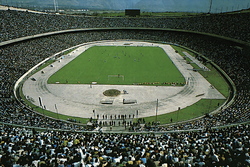
- Home Ground: The iconic Azadi Stadium serves as the team's primary home venue.
- Regional Success: Multiple titles in the Asian Games and the CAFA Nations Cup.
Historical Evolution and Major Tournaments
The Golden Era of the Asian Cup
Iran established itself as a dominant force in Asia during the late 1960s and 1970s. The team achieved a remarkable hat-trick of AFC Asian Cup titles, winning the championship in 1968, 1972, and 1976. This era cemented their reputation as the team to beat in the region.
FIFA World Cup Journey
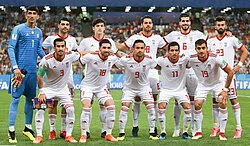
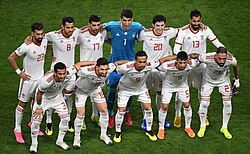
Iran's journey in the FIFA World Cup began in 1978 in Argentina. Since then, they have qualified for the tournament seven times (1978, 1998, 2006, 2014, 2018, 2022, and 2026). While they have primarily reached the group stages, their matches against global giants have provided moments of immense national pride.
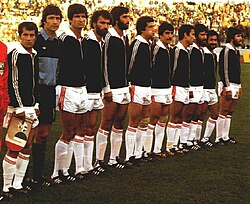
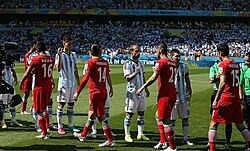
Recent campaigns have seen the team continue to challenge the world's best, including notable clashes against Argentina in 2014, Portugal in 2018, and England in 2022.
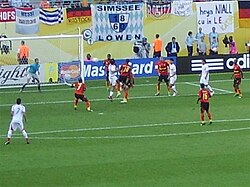
Regional and Continental Success
Beyond the Asian Cup, Iran has excelled in various regional competitions. They have secured three Asian Games titles (1974, 1990, 1998) and recently claimed the CAFA Nations Cup title in 2023. They also won the AFC–OFC Challenge Cup in 2003.
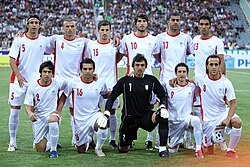
Performance Summary
The following table summarizes Iran's performance across the most prestigious competitions they have entered.
| Competition | Appearances | Best Result | Titles/Years |
|---|---|---|---|
| FIFA World Cup | 7 | Group Stage | N/A |
| AFC Asian Cup | 16 | Champions | 3 (1968, 1972, 1976) |
| Asian Games | 13 | Champions | 3 (1974, 1990, 1998) |
| CAFA Nations Cup | 2 | Champions | 1 (2023) |
| AFC–OFC Challenge Cup | 2 | Champions | 1 (2003) |
Iconic Figures and Modern Era
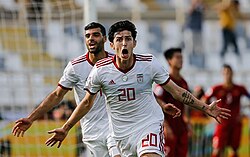
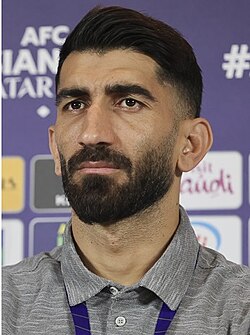
The team's success has been driven by legendary individuals. Ali Daei remains a global icon for his scoring prowess, while Javad Nekounam holds the record for the most caps with 149 appearances. In the modern era, players like Mehdi Taremi and Sardar Azmoun have led the attack, supported by the shot-stopping abilities of goalkeeper Alireza Beiranvand.
![FIFA World Rankings for Iran, August 1993 – June 2026[182]](/images/b1/79/b17923afb0a8b8715d541f47e605d5d243da59c28def28da4d21cf314927210d.png)
Frequently Asked Questions
What is the nickname of the Iran national football team?
The team is commonly known as Team Melli, which translates to "National Team," and they are also referred to as the Yuzhaye Irani, or the Persian Cheetahs.
How many times has Iran won the AFC Asian Cup?
Iran has won the AFC Asian Cup three times, securing the championship in 1968, 1972, and 1976.
Who is the all-time leading goalscorer for Iran?
Ali Daei is the all-time leading goalscorer for Iran and the world's third all-time leading international goalscorer, with 108 goals in 148 matches.
Which stadium is the home ground for Team Melli?
The team's primary home stadium is the Azadi Stadium.
How many FIFA World Cups has Iran participated in?
Iran has participated in seven FIFA World Cup tournaments, with their first appearance occurring in 1978.